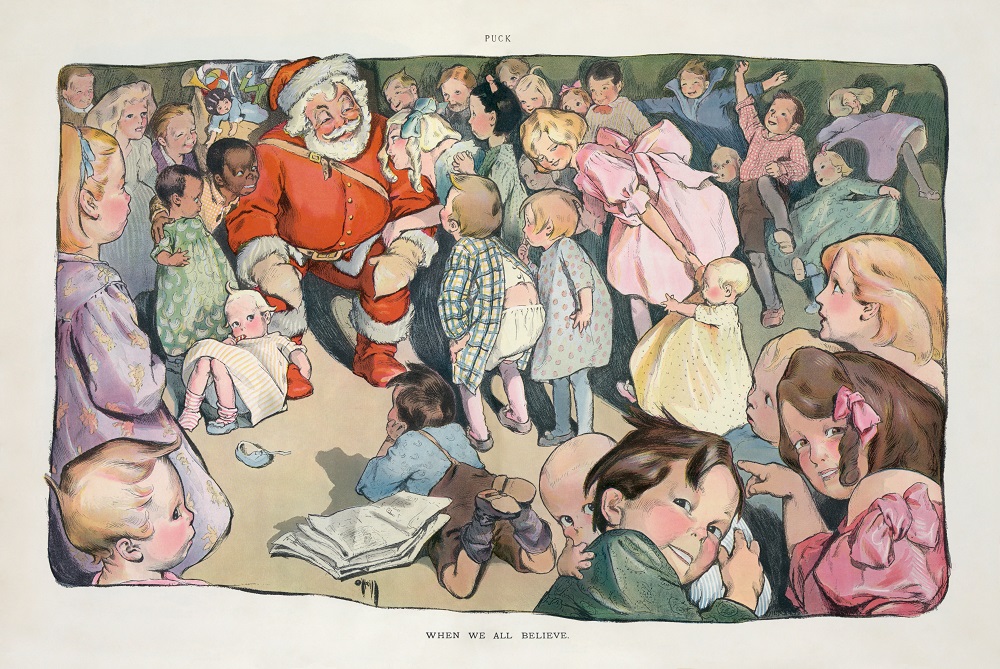
Santa Claus was created from various cultural traditions and people – real or fictional – from around the world. Below are some interesting facts about the origins of Santa.
The Santa Legend

As Christmas draws near every year, children – and adults who managed to hang on to their inner child – become giddy with anticipation of what Santa has in store for them. Like an omniscient deity who can observe all and see into our souls, Santa can tell who has been naughty or nice. He then rewards us accordingly, with either goodies in our stockings, or a lump of coal. The American version of Santa is the most popular today. It has him busy in his workshop in the North Pole, where elves toil to make toys for him year-round.
Santa then distributes the toys around the world on Christmas Eve, transported by flying reindeer that pull his sleigh through the air. That take is the one that became the globally dominant depiction of the legend. The American Santa came out of a melting pot of cultures – apt, for a melting pot country. As seen below, those melded traditions were combined with inputs from Western Christianity to eventually produce the fat, jolly, and bearded grandfatherly figure so widely known and loved today.
The Blended Origins of Santa Claus

Santa Claus drew from many cultures. From the English, we get the folkloric figure of Father Christmas, the gift giver. From the Dutch, we get the figure of Sinterklaas, whose feast occurs in early December. For good measure, there is even a touch of the ancient Germanic god Odin, who is associated with the pagan midwinter festival of Yule. However, the chief figure behind Santa is Saint Nicholas, a fourth century AD Greek bishop of Myra, a city on the southern coast of modern Turkey known today as Demre. The real life Saint Nick was probably bearded, but he was not the jolly fat old man who graces Christmas cards.
Saint Nicholas of Myra, also known as Nicholas of Bari (270 – 342 AD), was born in the Roman Empire at a time when Christianity was persecuted. There were real life stakes, significantly greater than depictions on coffee cups or the wording of season’s greetings. Nicholas was born into a wealthy family. His rich parents died when he was a young man, and left him a huge inheritance. Nicholas did not do what many young men might have done in his shoes, and party it up and splurge on life’s sensual joys. Instead, he used his inheritance to care for those in need.
Saint Nicholas, the Key Figure Behind Santa Claus

One beneficiary of Saint Nicholas’s largesse was a poor man with three daughters, who could not afford dowries for them. Without dowries, the girls’ father would have sold them into slavery – the world was harsher in those days. However, on three occasions, a bag with enough gold for a dowry appeared in the girls’ home, secretly tossed in through a window by Nicholas to land in a shoe or stocking left by the fireplace. His reputation as a secret gift-giver grew over time.
Nicholas became known for depositing coins or treats in the shoes of children, who would leave them out for that purpose. Eventually, he became bishop of Myra at a young age, but his bishopric was interrupted when Emperor Diocletian launched a round of Christian persecutions. Nicholas was exiled and imprisoned, until freed by Constantine the Great, the Roman Empire’s first Christian ruler. Stories about Nicholas’ generosity grew, and he was canonized after his death. He became the patron saint of children, and the chief inspiration behind the fictional Santa Claus.

_________________
Some Sources & Further Reading
Bowler, Gerry – Santa Claus: A Biography (2005)
Encyclopedia Britannica – Saint Nicholas
History Halls – Folklore and Mythology: The Origin of Mermaids
St. Nicholas Center – Who is St. Nicholas?

