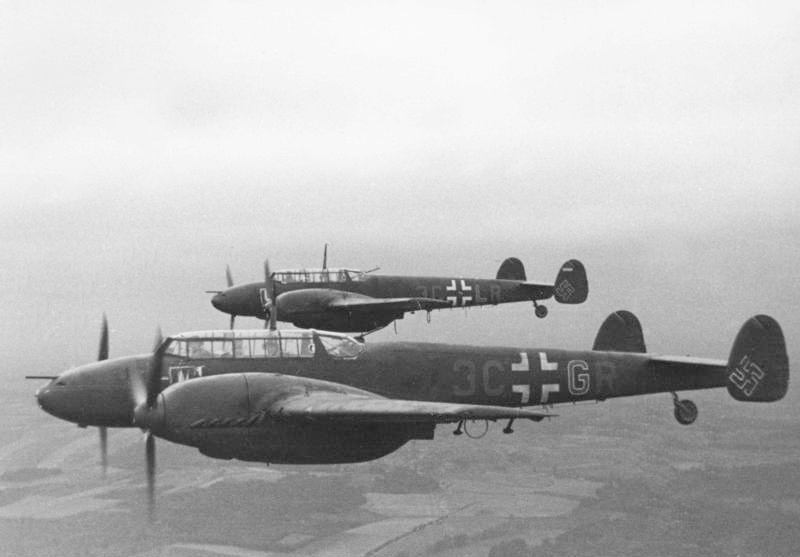
The twin-engine and twin-seat Messerschmitt Bf 110 Zestorer (“destroyer”) was one of Germany’s most ambitious pre-WWII aircraft designs. Conceived by Willy Messerschmitt in the mid-1930s, it was intended to combine heavy firepower, long range, and high speed. It embodied the belief that fast, long-range heavy fighters could outrun enemy interceptors, or overwhelm them with guns. The concept was good on paper. Real world performance, though, proved to be a mixture of strength and vulnerability, shaping a complex combat legacy.
Success in the War’s Opening Campaigns

The first Messerschmitt Bf 110 prototype flew in 1936. Despite early engine shortages and development delays, it soon became one of the fastest twin-engine fighters in Europe. Its airframe was sleek and narrow for its size, built around two Daimler-Benz engines. It armament was formidable: typically two 20 mm cannons, four 7.92 mm machine guns in the nose, and a flexible rear gun for the radio operator. Early models also offered substantial internal space for radios, fuel, and later radar. That made it ideal for missions that required endurance.
The Bf 110 impressed in Luftwaffe exercises conducted before the outbreak of World War II. It was confidently projected as the spearhead of future aerial combat. The Bf 110 performed well in the war’s opening campaigns, and seemed to validate the Zerstorer doctrine. In Poland and France, it excelled at long-range escort missions, ground attacks, and pursuit against disorganized or slower enemy aircraft. Its speed and firepower gave it an edge against early Allied fighters like the Potez 630 or Morane-Saulnier M.S.406.
The Battle of Britain Exposed the Bf 110’s Limitations

The Messerschmitt Bf 110’s range allowed it to accompany bombers deep into enemy airspace. Crews appreciated its stability, endurance, and reliability, and many pilots believed it would remain a mainstay of long-range fighter operations. Then came the Battle of Britain, where the Bf 110 met its greatest challenge. The Zestorer was simply outmatched by more agile British single-engine fighters. The Supermarine Spitfire and Hawker Hurricane could easily out-turn the heavy twin-engine fighter. Although still deadly in a straight-line attack, its lack of maneuverability made it vulnerable in dogfights. That put Zestorer units on the back foot throughout the battle. Rather than protect the bombers they were escorting like they were designed to do, Bf 110s had their work cut out for them just trying to protect themselves and survive.
British pilots quickly learned to target the Bf 110s first: they that their destruction weakened German bomber protection. Casualties mounted, and the Luftwaffe progressively reduced the Zestorer’s escort role. That marked a major doctrinal defeat. Despite the setbacks, though, the Bf 110 did not fade into obscurity. Instead, it found new life in roles that better matched its strengths, such as night fighting. Equipped with radar, flame dampers, and an additional crewman, the Bf 110 became one of the Luftwaffe’s primary night interceptors. In that arena, maneuverability mattered less, while stability, endurance, and the ability to carry radar and heavy guns were crucial.
The Complex Legacy of the Messerschmitt Bf 110 Zestorer

The Messerschmitt Bf 110 excelled as a night fighter. Especially when flown by experienced aces such as Heinz-Wolfgang Schnaufer, who scored dozens of victories flying the type. Zestorer night fighters played a central part in the defense against RAF Bomber Command, and racked up significant successes. The Bf 110 also proved adaptable in ground-attack and anti-shipping roles. Variants equipped with bombs, rockets, or heavy cannons up to 37 mm weapons were used on the Eastern Front and in the Mediterranean. Zestorers equipped with upward-firing 20 mm cannon nicknamed Schrag Musik – a German colloquialism for music with unusual tunes – proved especially destructive against night bombers. Against Soviet airplanes early in the war, Bf 110s again showed their destructive power, especially when used in coordinated assaults.
The Allies introduced faster and more advanced fighters, however, and the Bf 110’s daytime survivability steadily declined. By 1944, the Bf 110 was largely obsolete as a day fighter. It remained important as a night interceptor until the last months of the war, however. Its operational history reflects both the ambition and the limitations of interwar air combat theories. The Germans did succeed in coming up with a powerful and versatile machine. However, their assumption that size and firepower could compensate for maneuverability turned out to be a mistake. Even so, the Bf 110 left a lasting imprint as one of the Luftwaffe’s most distinctive and multifaceted combat aircraft.

_________________
Some Sources & Further Reading
History Halls – World War II Fighters: Germany’s Messerschmitt Bf 109
Treadwell, Terry C. – Messerschmitt Bf 110 (2005)
Vajda, Ferenc A., and Dancey, Peter – German Aircraft Industry and Production, 1933-1945 (1998)

