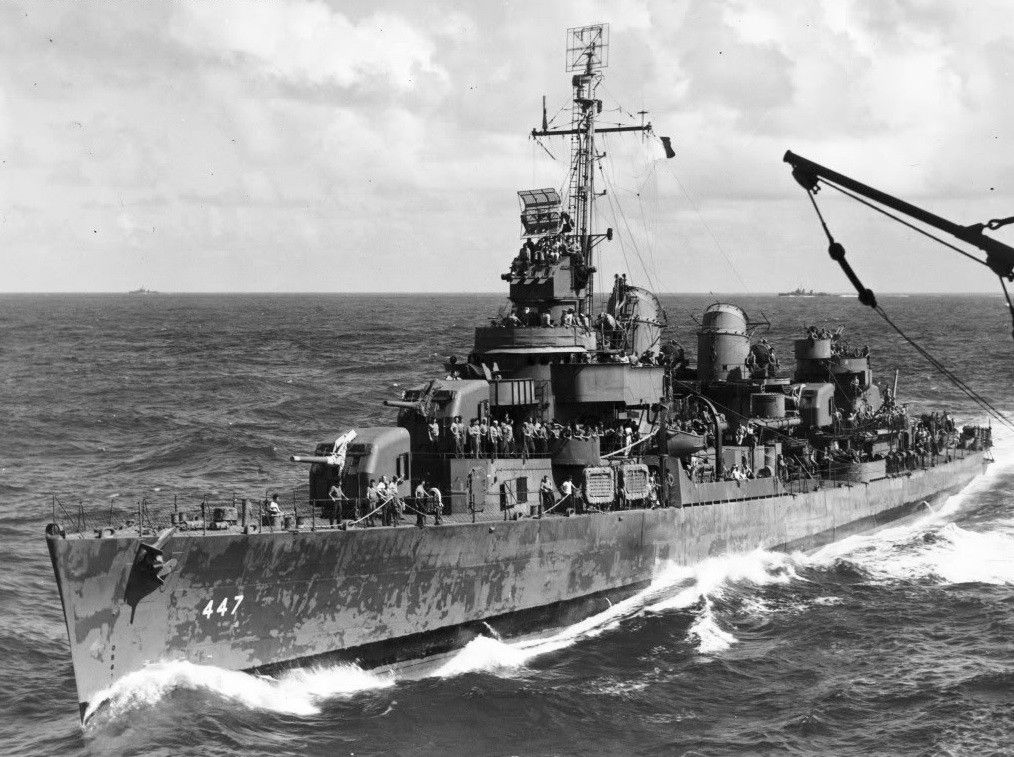
The Fletcher class destroyers represented the pinnacle of US destroyer design during World War II. Launched between 1941 and 1944, they embodied a lethally effective combination of speed, firepower, endurance, and adaptability. As a result, they became the backbone of the US Navy’s destroyer force. 175 were built – more than any other destroyer class in US history. Fletchers remained in service around the world for decades after the war.
A Destroyer Suited for the Vast Expanses of the Pacific

The Fletcher class emerged from lessons learned with earlier destroyer classes such as the Benson, Gleaves, and Sims types. Those prewar designs had excellent speed and armament, but were limited by their smaller hulls, which restricted range and stability. In the 1930s, the US Navy anticipated a Pacific war that would require long-range operations across vast distances. So it sought a destroyer with greater fuel capacity, stronger anti-aircraft defenses, and room for future upgrades. In 1939, the Bureau of Ships began to develop a new design.
Until then, destroyer sizes had been limited by naval treaties. When those treaties were scrapped, designers were finally freed to think big. The result was the Fletcher class. A larger destroyer, it displaced 2,500 tons at full load, had a length of 376.5 feet, and a beam of 39.75 feet. That made Fletchers significantly bigger than their predecessors, which allowed for greater endurance and improved seaworthiness. The increased size also provided space for additional weaponry and radar systems, as well as better living conditions for the crew, which typically numbered around 273 officers and sailors.
The Formidable Fletcher Class Destroyers

Fletcher design philosophy, combat record, and long-term legacy made them among the most significant classes of warships ever constructed. They were intended to fulfill a variety of roles and perform anti-ship, anti-aircraft, anti-submarine, and escort duties. Their main battery consisted of five 5 inch/ 127 mm Mark 12 guns in single mounts. They were placed two forward, one amidships, and two aft. Those dual purpose guns could engage both surface and aerial targets, and had a range of over nine miles.
The guns were controlled by advanced Mark 37 fire control systems. It used radar to greatly enhance accuracy in poor visibility or at night – a crucial advantage in the Pacific War. For anti-ship combat, the Fletchers carried ten 21 inch torpedo tubes that were arranged in two quintuple mounts amidships. The tubes could launch the powerful Mark 15 torpedo, which gave the destroyers formidable striking power against enemy surface vessels. As the war progressed, however, the focus shifted toward anti-aircraft defense.
Fast and Durable Warships

Fletcher class destroyers were originally fitted with 1.1-inch “Chicago Piano” guns and .50-caliber machine guns. Combat revealed that armament to be inadequate against enemy airplanes however. So it was replaced with a combination of 40 mm Bofors and 20 mm Oerlikon cannons. That eventually gave the Fletchers one of the heaviest AA batteries of any destroyer class during the war. For anti-submarine warfare, the Fletchers carried depth charge racks and projectors known as “K-guns”. Later, some received the innovative Hedgehog mortar system, which allowed for more accurate and safer attacks against submerged submarines.
The Fletcher class destroyers were powered by two General Electric or Westinghouse geared steam turbines that drove two propellers. They produced 60,000 shaft horsepower, and gave the destroyers a maximum speed of 38 knots – roughly 44 mph or 70 km/h. Their endurance was impressive: Fletchers could travel about 6,500 nautical miles at 15 knots. That made them ideal for operations across the vast Pacific theater. The design had emphasized ruggedness and reliability. That allowed them to sustain heavy damage yet not only stay afloat, but remain operational. The crews deeply appreciated that.
Fletchers Served Throughout the Pacific Theater

Fletcher-class destroyers saw action in virtually every major naval campaign from 1942 onward. The lead ship, USS Fletcher (DD-445), was laid down in October, 1941, launched in May, 1942, and commissioned two months later. She participated in the Guadalcanal campaign, in which she provided gunfire support, screened carriers, and engaged Japanese surface forces. Many of her sisters followed soon after, and served in every major battle and campaign of the Pacific War from the Solomons and the Philippines, to Iwo Jima and Okinawa.
Fletchers performed a wide variety of missions. They escorted aircraft carriers and convoys, protected amphibious landings, bombarded shore positions, rescued downed aviators, and fought in night surface actions against Japanese destroyers and cruisers. Their speed and agility made them excellent at torpedo attacks and evasive maneuvers. Their powerful guns made them valuable in surface engagements. One of the most famous Fletchers was USS Johnston (DD-557), commanded by Commander Ernest E. Evans. As seen below, he received a posthumous Medal of Honor for his heroism at the Battle off Samar in October, 1944.
From Surface Engagements to a Focus on Antiaircraft Duties

On October 25th, 1944, a massive Japanese naval force spearheaded by the Yamato, history’s biggest ever battleship, suddenly appeared a few miles of Leyte Gulf where an American amphibious invasion was underway, its ships and ground forces on shore largely unprotected. All that stood between the Japanese and a massacre of Americans at Leyte was a collection of small American warships. Although vastly outgunned, Fletcher class destroyer USS Johnston and a handful of other small US ships charged the superior Japanese fleet. The tenacity of their attacks, in which the Johnston was sunk, misled the Japanese commander into believing that strong US naval forces were nearby. So he turned his fleet around and withdrew, snatching defeat from what could have been a stunning Japanese victory.
Throughout WWII, many other Fletchers earned battle stars and commendations for similar feats of courage and endurance. The success of the Fletcher design lay not only in its initial capabilities but also in its adaptability. The ships were built with ample space and electrical capacity for upgrades. That allowed them to incorporate new radar, sonar, and anti-aircraft systems as the war progressed. Later in the war, many were fitted with improved radar-directed gunnery and more powerful AA weapons. They became formidable anti-aircraft escorts for carrier groups, which needed all the help they could get from late-war kamikaze attack.
Fletchers Served Into the Twenty First Century

When peace arrived, the US Navy decommissioned many Fletcher class destroyers. Of those that were kept, many underwent the FRAM (Fleet Rehabilitation and Modernization) program. Their aging weapons and electronics were replaced with new equipment for Cold War service. Some received modern sonar, ASROC (anti-submarine rocket) launchers, and helicopter platforms, which extended their utility into the 1960s and beyond. Only a few years after the guns silent at the end of WWII, they opened up again in Korea. Fletchers served in the Korean War, and once again proved invaluable in shore bombardment, screening, and escort duties.
By the late 1950s and 1960s, many were transferred to allied navies under the Military Assistance Program. Countries including Japan, Germany, Italy, Greece, Turkey, Argentina, Brazil, Chile, and others operated Fletchers well into the 1970s and 1980s. Remarkably, a Fletcher class destroyer remained in service into the twenty first century. The Mexican Navy’s ARM Cuitláhuac, formerly the USS John Rodgers, was the last Fletcher to retire. She was decommissioned in 2001, nearly 60 years after her construction. That longevity underscores the durability and timeless utility of the Fletcher design.
The Legacy of the Fletcher Class Destroyers

The Fletcher class set the standard for all subsequent US destroyer designs. Their balance of firepower, range, and flexibility influenced the postwar Allen M. Sumner and Gearing classes, which were essentially enlarged and refined Fletchers. Naval historians often regard the class as one of history’s most successful destroyer designs. Fletchers were equally capable of fighting aircraft, submarines, and surface ships in long deployments in harsh conditions. Their crews fondly remembered them as “workhorses of the fleet”. They were fast, rugged, and versatile, with room for many upgrades, yet compact enough to operate effectively in confined waters. They were admired by allies and respected by enemies. Japanese officers considered Fletchers among the most dangerous of US warships.
Fletcher class destroyers embodied America’s industrial might and naval ingenuity in WWII. They combined durability, firepower, and adaptability in a way no previous destroyer had achieved. From the steaming expanses of the Pacific to the icy waters off Korea, they served with distinction and courage. As illustrated by their performance at the Battle off Samar, Fletchers and their crews could punch far above their weight. The class’ long service life and widespread export testify to the design’s brilliance. More than just ships, the Fletchers represented a generation of sailors and shipbuilders who defined modern naval warfare. They left a legacy that endures in destroyer design and naval history to this day.

_________________
Some Sources & Further Reading
Destroyer History – Fletcher Class
Friedman, Norman – US Destroyers: An Illustrated Design History (1982)
History Halls – Flower Class Corvettes: The Unglamorous Ships That Averted Allied Defeat in WWII
Silverstone, Paul H. – US Warships of World War II (1965)

