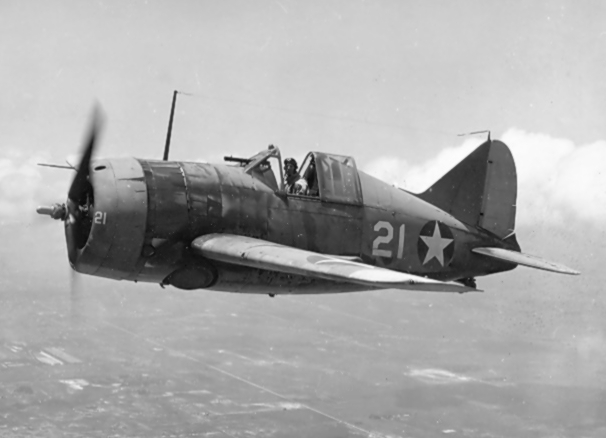
The Brewster F2A Buffalo was one of the US Navy’s first monoplane fighters. It represented a transitional stage between 1930s biplane fighters, World War II’s high-performance monoplanes. Though initially hailed as an advanced and promising design, the Buffalo’s reputation deteriorated rapidly as combat revealed its limitations. Its story reflects both the rapid pace of aviation development, and the unforgiving nature of aerial combat.
Early Promise Undone by an Inexperienced Manufacturer

The F2A was designed and built by the Brewster Aeronautical Corporation, a small company that had previously produced aircraft components. In 1935, the US Navy issued a requirement for a modern monoplane fighter to replace its aging biplane fleet. Brewster responded with the XF2A-1 prototype, which first flew in December, 1937. The aircraft impressed Navy evaluators with its retractable landing gear, enclosed cockpit, and all-metal construction. Those features represented a significant leap over the open-cockpit, fixed-gear biplanes then in service. Tested against the Grumman XF4F-1, an early version of what became the F4F Wildcat, the Brewster design was judged superior. So it was ordered into production as the F2A-1.
Early Brewster F2A Buffalo versions were compact and agile, with good visibility and decent handling characteristics. Powered by a Wright R-1820 Cyclone radial engine, the F2A-1 could reach speeds of around 300 mph or 480 km/h. That was quite respectable at the time. However, even before they entered widespread service, F2As began to suffer from the consequences of Brewster’s inexperience as a manufacturer. Production delays, inconsistent build quality, and weight increases plagued the design. The later F2A-2 and F2A-3 variants were heavier due to additional fuel, armor, and equipment. That dramatically reduced their speed, climb rate, and maneuverability.
A “Flying Coffin” to US Marines, but a “Pearl” to Finnish Pilots

By the time America joined WWII, the Brewster F2A Buffalo was already considered obsolete. The US Navy operated some aboard aircraft carriers, but their performance in early war exercises and in combat proved disappointing. In June, 1942, at the Battle of Midway, Marine Corps pilots flying F2A-3s faced Japanese A6M Zero fighters. The results were catastrophic. Of twenty Buffalos that took off, only a handful returned. Most of the rest were shot down with minimal Japanese losses. Pilots described the Buffalo as underpowered, sluggish, and unable to climb or maneuver effectively against more modern opponents. One Marine aviator famously called it a “flying coffin”.
While Buffalos performed poorly for US forces, they did far better in foreign service, especially with Finland. Before the war, several export versions, designated Model 239, were sold to Finland, Belgium, and the Netherlands East Indies. The Finnish Air Force used the Buffalo extensively in the Winter War, 1939 – 1940, and the Continuation War, 1941 – 1944, against the Soviet Union. In Finnish hands, the lighter, stripped-down Buffalos proved remarkably effective. Finnish pilots achieved impressive kill-to-loss ratios as high as 26:1 against less experienced Soviet aviators flying outdated planes. The Finns liked the Buffalo so much they nicknamed it “Taivaan Helmi”, or “Sky Pearl”. Some of their aces, including Ilmari Juutilainen, scored many of their victories in Buffalos.
Legacy of the Brewster F2A Buffalo

The Brewster Buffalo fared far worse in the Pacific against the Japanese than in the Eastern Front against the Soviets. The Royal Air Force and the Netherlands Air Force operated Buffalos in the defense of Malaya, Singapore, and the Dutch East Indies in 1941–1942. There, they faced elite Japanese pilots who flew agile and deadly Zeros and Ki-43 Oscars. Between their inherent shortcomings, plus tropical conditions, lack of spare parts, and poor tactics, F2As suffered heavy losses. Allied pilots frequently criticized the aircraft as overweight and unreliable, with many mechanical breakdowns before and during combat. By mid-1942, the F2A Buffalo had been withdrawn from front-line service by most users. The US Navy replaced it with the superior Grumman F4F Wildcat, and relegated surviving Buffalos to training or second-line duties.
The Brewster Aeronautical Corporation collapsed shortly thereafter, its reputation ruined by production scandals and technical failures. Though derided as one of WWII’s least effective Allied fighters, the Brewster F2A Buffalo remains a historically significant aircraft. It marked the US Navy’s transition into the monoplane era, and served as a valuable stepping stone in naval aviation development. It should also be noted that in the right circumstances, such as in the hands of skilled Finnish pilots against inexperienced Soviet ones, F2As proved quite capable. The Buffalo’s mixed legacy stands as a reminder that technology, tactics, and context all determine an aircraft’s fate in war.

_________________
Some Sources & Further Reading
History Halls – 20 Greatest Fighters of World War II
United States Naval History and Heritage Command – Brewster F2A Buffalo Fighters

