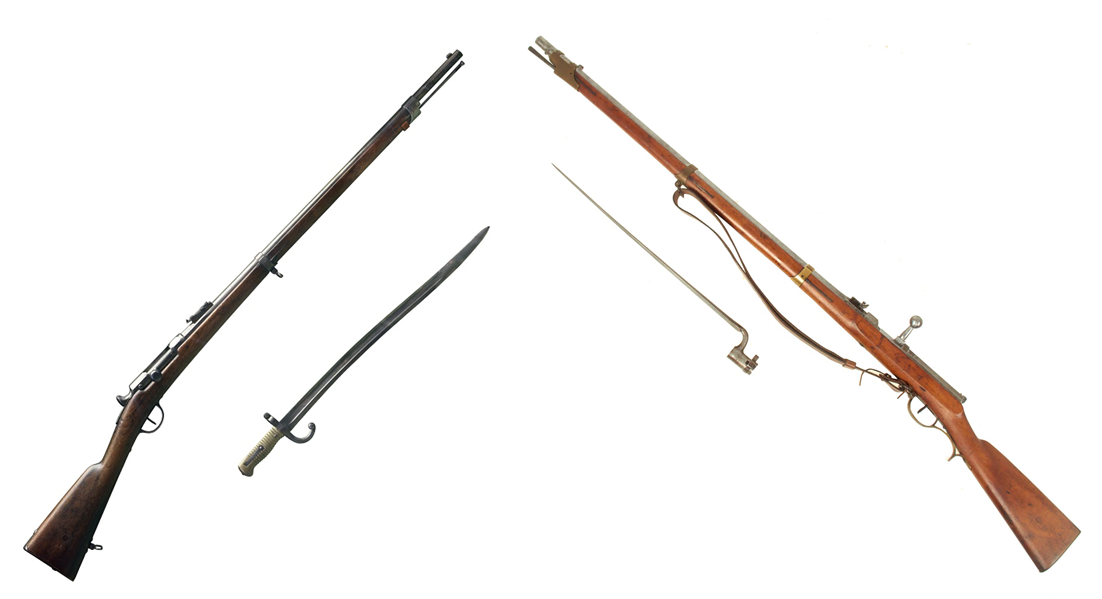
The Dreyse needle gun and the French Chassepot rifle were two of the nineteenth century’s most influential military firearms. Though both were bolt-action, breech-loading rifles that used needle-fire mechanisms, their design philosophies, performance, and battlefield impact differed in crucial ways. Their competition influenced and drove military rifle developments for generations.
The Prussian and French Rifles

The Dreyse needle gun, official designation Zundnadelgewehr M1841, was developed in the 1830s by Prussian gunsmith Johann Nikolaus von Dreyse. When Prussia officially adopted it in 1841, it became the world’s first standard-issue bolt-action breechloader. It was revolutionary at a time when most armies still used muzzle-loading muskets. The Dreyse system gave Prussia a technological edge for over two decades, and played a key role in the Austro-Prussian War of 1866. Its rival, the Chassepot Rifle, official designation Fusil modele 1866, was named after its inventor Antoine Alphonse Chassepot.
The French Army adopted the Chassepot rifle in 1866, specifically in response to the Prussian needle gun. Chassepot sought to correct the Dreyse’s weaknesses – poor gas sealing, limited range, and fragile firing needles – while keeping its advantages of speed and ease of loading. The Chassepot was introduced just in time to face the Dreyse during the Franco-Prussian War of 1870-1871. The French rifle proved itself superior to the Dreyse by all measures. However, that superiority did not avert French defeat.
The Dreyse used a paper cartridge that contained the bullet, powder charge, and primer all in one unit. In an unusual configuration, its primer was located at the base of the bullet, in front of the powder. When fired, the Dreyse’s needle pierced through the paper cartridge and powder to strike the primer. That arrangement meant that the firing needle was exposed to intense heat and corrosive gases, causing rapid wear and breakage. The Chassepot also used a paper cartridge, but with the primer at the rear, behind the powder charge. The firing needle therefore did not have to pass through the entire cartridge, which reduced damage.
The Chassepot Outperformed the Dreyse by all Measures

The Chassepot cartridge was more sophisticated, with a rubber obturator, or seal, at the bolt head that prevented gas leakage. That was a major improvement over the Dreyse. The Chassepot’s cartridge was more efficient and durable. The Dreyse’s design was ingenious, but primitive by comparison, with gas blowback and mechanical erosion. The Dreyse needle gun fired a .61 caliber or 15.4 mm bullet, with a 4.85 gram gunpowder charge. The Chassepot fired a smaller .43 caliber or 11 mm round, propelled by 5.68 grams of gunpowder. With a smaller bullet and more gunpowder the Chassepot had higher muzzle velocity and greater range. The French rifle fired bullets at 1,350 feet per second, vs the Dreyse’s 1,000 fps.
The Chassepot’s effective range was also twice that of the Dreyse’s – 1,200 meters vs 600. In elevated area firing mode, the Chassepot range could be extended to a mile, or 1,600 meters. Moreover, the Chassepot had a flatter trajectory and superior accuracy. Chassepot bullets also inflicted more damage when they hit, despite being smaller, than did the Dreyse’s. The German bullets tended to leave a relatively “clean” wound, with exit holes not significantly greater than entrance wounds. The Chassepot by contrast, which struck with significantly greater kinetic energy, often left exit wounds ten to thirteen times as big as the entrance holes. In short, the Chassepot outperformed the Dreyse in virtually every ballistic measure.
The Importance of a Sealed Breech

The two rifles also differed in how their breeches sealed gas. The Dreyse’s bolt closed directly against the rear of the barrel, but lacked a true gas seal. The Prussian army issued leather or cloth wadding to wrap around the bolt to reduce leakage, though this was only a partial solution. To prevent hot gases from escaping reward upon firing and injuring the shooter or causing burns, the bolt’s front was shaped in a cup-like form that directed gasses forward.
The Chassepot reduced or eliminated gas leakage with an innovative rubber ring that expanded under pressure when the rifle was fired. That effectively sealed the breech and prevented gas from escaping. It not only improved safety and comfort, but also increased muzzle velocity and consistency. The rubber ring could degrade after repeated firing, but it was easily replaced by soldiers in the field. The Chassepot’s sealed breech was one of its greatest strengths, and a major step toward modern metallic cartridge weapons.
The Chassepot Was More Soldier-Friendly than the Dreyse

As to reliability and ease of maintenance, the Dreyse’s needles were prone to breakage and had to be replaced regularly. The gas leakage fouled the mechanism quickly, which made cleaning essential after even moderate use. Moreover, the paper cartridges were vulnerable to moisture and rough handling. By contrast, the Chassepot’s needles were thicker. They also only had to strike a primer at the rear or base of the cartridge, unlike Dreyse needles, which had to traverse the powder charge to reach the primer at the cartridge’s front.
Because of its unusual primer location, Dreyse needles were surrounded by exploding gunpowder whenever the rifle was fired. The Chassepot’s needles lasted longer due to their shorter travel and better protection. The French rifle’s rubber seal also reduced fouling, and its cartridges were somewhat more weather-resistant than the Dreyse’s. Although the Chassepot’s rubber seal required periodic replacement, the rifle was simpler to maintain than its German counterpart. The French rifle was also lighter, weighing nine pounds (4.1 kilos) vs the Dreyse’s ten pounds (4.57 kg). The Chassepot was also shorter, measuring 4 feet 51.57 inches (1310 mm), against the Dreyse’s 56 inches (1424 mm). Lighter, more compact, and far more robust, the Chassepot was the more soldier-friendly rifle.
The Chassepot Gave the French a Tactical Edge

Both rifles offered a higher rate of fire than contemporary muzzle-loaders. The Dreyse could fire five to six aimed shots per minute. The Chassepot, which had a smoother bolt and better cartridge handling, could fire eight to ten aimed rounds per minute. The French rifle’s tighter seal and easier loading allowed users to maintain rapid fire with fewer stoppages. At the Battle of Konggratz in the Austro-Prussian War, 1866, Prussian infantry equipped with the Dreyse dominated Austrian forces armed mostly with muzzle-loading Lorenz rifles.
Prussian troops could reload and fire from prone positions, and delivered higher sustained rates of fire that inflicted devastating casualties. The Dreyse became a symbol of Prussia’s technological and organizational superiority. The tables were turned when the French fielded the Chassepot against Prussia’s now-aging Dreyse in the Franco-Prussian War, 1870-1871. French troops could engage at twice the distance as could the Germans. At long range, French units inflicted severe losses before their got close enough to respond. During early engagements, such as at Wissembourg and Spicheren, Chassepot fire proved deadly effective.
A Superior Rifle Did Not Save the French From Defeat

Although the French possessed a superior rifle, they still lost the Franco-Prussian War. The fact that their foe fought with a rifle that was inferior to its French counterpart by all measures did not avert defeat. France suffered from significant tactical and logistical failures during that war. Poor coordination, outdated command structures, and slow mobilization all combined to nullify the advantage of the French infantry’s superior rifle. Even though the Chassepot was significantly better than the Dreyse, France lost the war to Prussia’s superior command system and organization.
As to their wider impact, both weapons profoundly influenced future firearms development. The Dreyse introduced the bolt action principle – the defining feature of modern rifles. It was also a pioneer of the concept of self-contained cartridges, even if paper-based. Its gas leakage problems demonstrated the need for better gas sealing and durable materials, which led to metallic cartridge designs. As to the Chassepot, it demonstrated that breech sealing and cartridge integrity were essential for reliable performance. It served as a bridge between paper cartridge systems and the metallic cartridge rifles that soon followed, such as the French Gras Model 1874.
Legacies of the Dreyse and Chassepot Rifles

The Dreyse needle gun and the Chassepot rifle represent successive stages in the rapid evolution of nineteenth century small arms. The older Dreyse was a revolutionary pioneer that transformed infantry combat through breech-loading and bolt-action mechanisms. Its refined and optimized Chassepot descendant was introduced a quarter of a century later. The French rifle’s designers thus had ample time to study and address the Dreyse’s weaknesses. The Chassepot’s design directly influenced the later Mauser and Lebel rifle systems that dominated the late nineteenth century.
In tactical terms, the Dreyse helped Prussia forge a modern mobile army that overwhelmed Austria in 1866. The Chassepot gave France a temporary technical edge, but could not overcome Prussia’s superior organization in 1870. In technological terms, both weapons paved the road to the modern era of metallic cartridge, bolt action rifles. They led to designs such as the Mauser, Lee-Enfield, and Lebel, which dominated battlefields for the next century. Together, the Dreyse and Chassepot mark the transition point when firearms crossed the threshold from the age of muzzle loading riflemen standing in ranks and exchanging volleys at close range, to the age of industrial precision, and the fire and maneuver tactics of modern warfare.

_________________
Some Sources & Further Reading
History Halls – The Revolutionary Dreyse Needle Gun: A Major Step Towards Modern Military Rifles
Walter, John – Rifles of the World (2006)
West, Alston Robert – The Dreyse Military Needle Ignition System (2019)
West, Alston Robert – The Needle Ignition System of the Modele 1866 Chassepot (2017)

