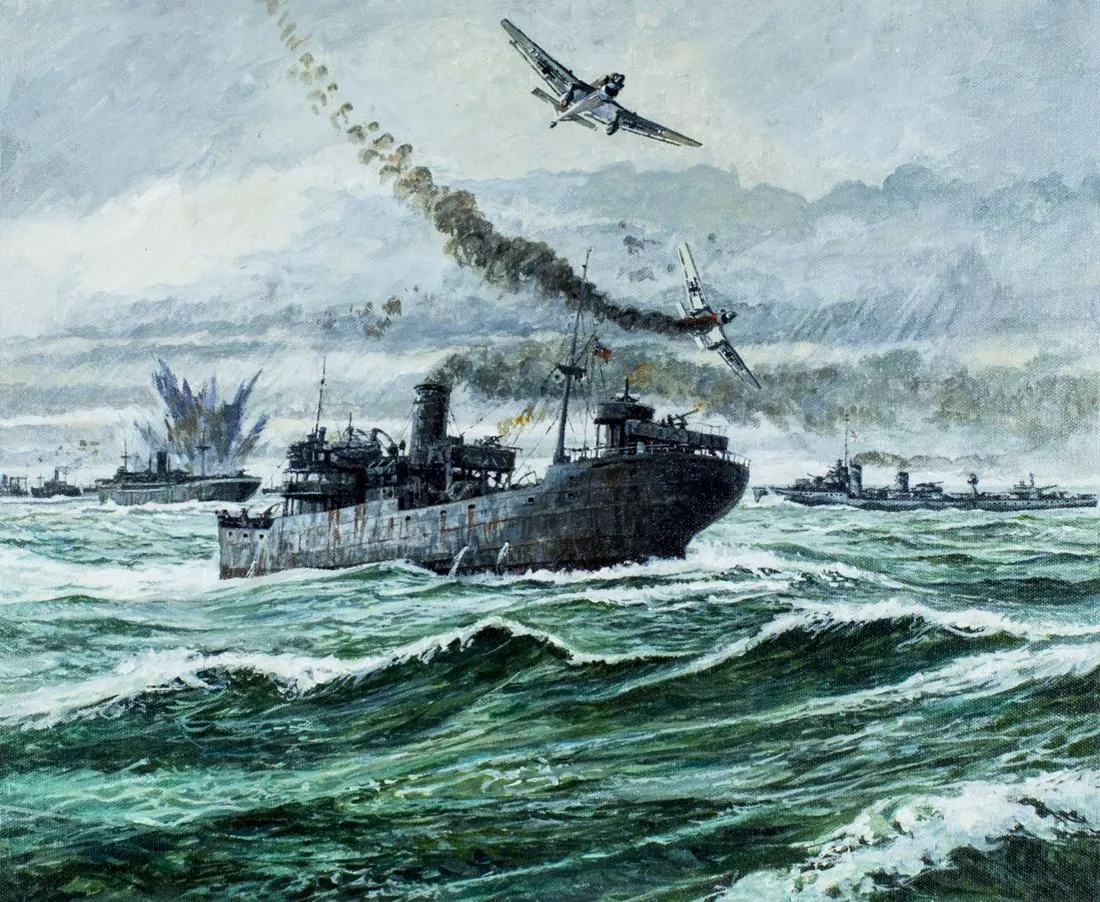
Few World War II naval operations matched the peril and tragedy of Arctic Convoy PQ 17. Tasked with delivering crucial supplies to the Soviet Union, it suffered one of the war’s worst maritime disasters. Its story combines courage, miscommunication, and tragedy in the frozen waters of the Arctic Ocean. The convoy’s ill fate illustrates both the dangers of the Arctic supply route, and the complexities of wartime decision-making.
The Arctic Supply Route

By 1942, the Soviet Union was locked in a desperate struggle against Nazi Germany. The Wehrmacht’s advance had devastated vast territories, and Soviet industry was strained to its limits. To sustain the Eastern Front, Joseph Stalin pressed Britain and the United States for material assistance. The Allies responded by organizing Arctic Ocean convoys to furnish the Soviets with tanks, aircraft, ammunition, and other supplies. They sailed along routes that brought them perilously close to the Norwegian coast. Then under German occupation, Norway hosted enemy bombers, submarines, and surface warships. Convoys thus had to brave incredibly dangerous waters before they docked at northern Soviet ports such as Murmansk and Arkhangelsk.
Allied merchant ships faced near-constant threats from German submarines, aircraft based in northern Norway, and the powerful surface fleet anchored at Trondheim and other ports, which included the battleship Tirpitz – a vessel whose very name struck fear into Allied sailors. Convoy PQ 17 was organized in the summer of 1942. It consisted of 35 merchant ships – 22 American, eight British, two Panamanian, one Dutch, one Norwegian, and one Russian. Together, they carried 297 aircraft, 594 tanks, 4,246 vehicles, and around 150,000 tons of other war materials.
The Departure of Convoy PQ 17

The convoy’s code name followed a standard system. “PQ” designated convoys bound for Russia, while “QP” marked those returning to Britain. To protect the valuable cargo, the convoy was assigned a substantial escort. The close escort included six destroyers, several corvettes, and anti-aircraft vessels, commanded by Commander Jack Broome. A cruiser covering force comprised of the heavy cruisers HMS London, HMS Norfolk, and the American USS Wichita, patrolled further west under Rear Admiral Hamilton. Beyond them, was heavy a distant covering force, commanded by Admiral Sir John Tovey. It included the battleships HMS Duke of York and the American USS Washington.
On June 27th, 1942, Convoy PQ 17 departed from Hvalfjorour, Iceland, and headed into the Arctic under the midnight sun. The weather was cold but clear. That favored both navigators and, unfortunately, German reconnaissance aircraft. The Germans were aware of PQ 17’s departure thanks to aerial reconnaissance and radio intercepts. Admiral Erich Raeder, head of the Kriegsmarine, saw in the convoy an opportunity to deal the Allies a devastating blow. The battleship Tirpitz, along with the heavy cruisers Admiral Hipper and Admiral Scheer, and several destroyers, were placed on alert for what was codenamed Operation Rosselsprung (“Knight’s Move”).
A Fateful Decision

The British Admiralty was equally aware of the danger. The mere existence of Tirpitz had a psychological effect that exceeded her actual operational impact. Her presence in Norwegian waters had already forced the Royal Navy to tie down enormous resources in the North Atlantic. If she were to sail and engage the convoy, the results could be catastrophic. On July 4th, 1942, the German fleet began to move from its base in Altenfjord. Although their intentions were uncertain, British intelligence interpreted this as confirmation that Tirpitz was en route to attack PQ 17.
At 9:11 PM that day, First Sea Lord Admiral Dudley Pound, directing operations from London, issued two fateful signals. The first ordered the cruiser covering force to withdraw westward to avoid a potential engagement with the German battleship. The second, sent shortly afterward, ordered the convoy to scatter. Until then, the merchant ships had been sailing in tight formation under escort. They were now instructed to disperse and make their way independently as best as they could to Russian ports.
Catastrophe Strikes Convoy PQ 17

Dudley Pound’s decision to order Convoy PQ 17 to scatter was based on incomplete and misleading intelligence. The German surface fleet had not yet located the convoy, and Tirpitz would soon turn back without firing a shot. However, once the convoy scattered, the merchant ships lost their mutual protection, and their protecting escorts, following orders, withdrew. The merchantmen were now alone in waters infested with U-boats and skies swarming with enemy bombers. In the following days, the convoy’s scattered ships became easy prey for German submariners and airmen. Reconnaissance aircraft from Luftflotte 5 quickly reported the dispersed vessels, and waves of torpedo bombers and U-boats began systematic attacks.
Between July 5th and July 10th, the destruction was relentless. Ships were torpedoed, bombed, or machine-gunned by the Luftwaffe. Survivors in lifeboats faced freezing seas, fog, and drifting ice. Out of the 35 ships that had set out in the convoy, 24 were sunk – a loss of nearly 70%. Only 11 ships managed to reach the Soviet ports of Arkhangelsk and Molotovsk. Among the losses were the American cargo ship SS Pan Kraft, which was sunk by U-601, and SS Honomu, bombed and destroyed by German aircraft. Crews often had little chance of survival. Some were rescued by Soviet patrol boats or by luck encountered other survivors, but hundreds perished from exposure or drowning.
A Self-Inflicted Defeat

The catastrophe that befell Convoy PQ 17 was a self-inflicted defeat. In addition to 153 merchant seamen killed, 24 ships were sunk, and took with them to the Arctic Ocean’s bottom 210 airplanes, 430 tanks, 3,350 vehicles, and 100,000 tons of desperately needed supplies. It shocked both the British Admiralty and public opinion. The Soviets, who depended on Allied material aid, were furious. A livid Stalin accused the British of cowardice, and even of having deliberately abandoned the convoy to appease Germany. Within the Royal Navy, the decision to scatter was soon recognized as a grave error. Admiral Tovey, who had commanded the covering forces, was appalled. He labeled it “the most ill-considered act ever carried out at sea”.
Commander Jack Broome, whose escort ships had been forced to turn back, shared Tovey’s view. He later wrote in his memoir Convoy is to Scatter that Dudley Pound’s order “broke every principle of convoy defense”. The First Sea Lord, defended his decision by citing the danger of Tirpitz, which he believed could annihilate the convoy. However, later evidence showed that the German surface fleet, hampered by navigation difficulties, had been recalled before reaching the convoy. The disaster was thus largely the result of miscommunication, and overreaction to a perceived rather than real threat.
A Disaster that Drew Attention to the Unsung Heroism of WWII Merchant Seamen

The destruction of PQ 17 temporarily disrupted Arctic convoys. The next planned convoy, PQ 18, was delayed until September, 1942. Regular Arctic convoys only resumed after major changes in tactics and escort organization. PQ 18 also suffered heavy losses, if not as catastrophic as what befell PQ 17 – 13 ships out of 40. However, it successfully reached the Soviet Union and restored some confidence in the route. In broader strategic terms, the disaster did not stop Allied aid to the USSR. Over the course of the war, more than four million tons of supplies reached Soviet ports through the Arctic route.
Nonetheless, the PQ 17 disaster left an indelible scar on Allied naval operations. The convoy’s code name became synonymous with tragedy and failure. In retrospect, Convoy PQ 17 remains a symbol of both courage and catastrophe. The merchant sailors and naval escorts who braved the Arctic seas demonstrated remarkable endurance and daring in the face of danger. Many were civilians – merchant seamen from Allied and neutral nations. They repeatedly braved the war’s most hostile environment without the protection of armor or heavy guns.
The Legacy of Convoy PQ 17

An official inquiry was conducted into the disaster and Admiral Pound’s orders. It found that he had acted under extreme stress, and based upon poor intelligence. The conclusion was that it was a tragic misjudgment, rather than ineptness or negligence on the First Sea Lord’s part. Still, the loss of 24 ships and hundreds of lives served as a harsh lesson in the importance of communication, intelligence accuracy, and unified command. Historians today see Convoy PQ 17 as one of the defining naval episodes of WWII. It was stark reminder that courage at sea could be undone by decisions made far from the front.
Despite the disaster, the convoy exemplified the Allied commitment to the USSR. It also demonstrated the immense human cost of keeping the Soviets supplied. Convoy PQ 17’s story encapsulates the dangers of the Arctic convoys, the perils of wartime misjudgment, and the extraordinary bravery of those who sailed under the harsh northern sun. Dudley Pound’s order to scatter remains one of the most controversial naval commands in history. Nonetheless, the Arctic supply route continued to function – albeit with greater caution. The ordeal of PQ 17’s sailors stands as a somber testament to the price of alliance and the unforgiving nature of war at sea.

_________________
Some Sources & Further Reading
Boyd, Andrew – Arms for Russia & the Naval War in the Arctic, 1941-1945 (2024)
Broome, Jack – Convoy is to Scatter (1972)
History Halls – Flower Class Corvettes: The Unglamorous Ships that Averted Allied Defeat in WWII
Winn, Godfrey – P.Q. 17 (1947)

