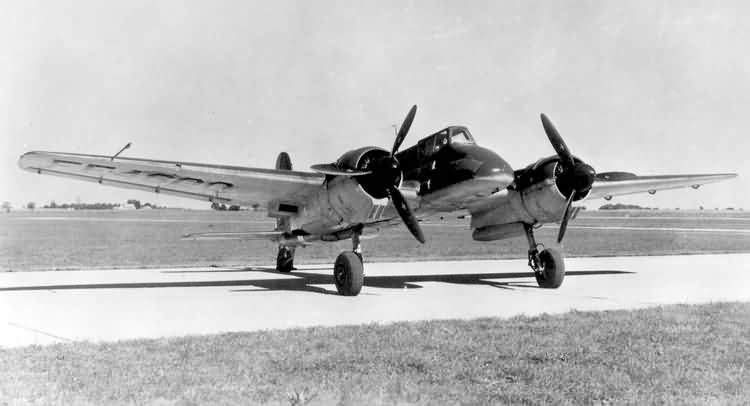
The Henschel Hs 129 was a German World War II ground attack airplane designed specifically for the Panzerjäger (tank-buster) role. Though often overshadowed by more versatile warplanes like the Junkers Ju 87 Stuka, the Hs 129 was one of the Luftwaffe’s few dedicated anti-armor planes. Rugged but underpowered, it became infamous among its pilots for being both difficult to fly and extremely vulnerable. In the hands of skilled crews, however, it inflicted serious damage on Soviet armor during the Eastern Front campaigns. That anti-armor lethality earned it the nickname the Luftwaffe’s “flying can opener”.
Origins of the Henschel Hs 129

The Luftwaffe recognized in the 1930s the importance of warplanes able to offer close air support and destroy armored vehicles. The Junkers Ju 87 Stuka could carry small bombs, but was increasingly vulnerable to anti-aircraft fire and enemy fighters. So the German Air Ministry (RLM) issued a requirement in 1937 for a heavily armored ground-attack airplane. It had to be able to survive intense ground fire while attacking tanks and troops at low altitude. Several companies submitted designs, but Henschel, already known for producing locomotives and armored vehicles, won the contract with its Hs 129.
The concept was an aircraft built around a heavily armored cockpit, with all vital components protected by a steel “bathtub”. It was meant to dive low over the battlefield, absorb punishment, and deliver precision fire on enemy armor. The first prototype, designated Hs 129A, flew in 1939. It quickly revealed severe design flaws. Germany’s most powerful engines were reserved for higher priority fighters and bombers. So Henschel had to use small, low-powered Argus As 410A-1 engines – air-cooled, inverted V-12s that produced just 465 horsepower each. They were inadequate for the Hs 129’s weight and armor.
The Need for a More Powerful Engine

The Henschel Hs 129’s weak engines led to sluggish performance, poor climb rate, and dangerous handling characteristics, especially during takeoff. Visibility from the cockpit was another major issue. The armored glass canopy and thick framing created narrow sightlines. Pilots often complained that they could barely see ahead, which made ground attacks even more hazardous. Poor ergonomics were another problem. The cramped cockpit, filled with armor plating, was so tight that the pilot could not fully turn his head. The controls were also heavy and unresponsive, and required considerable effort to maneuver.
Testing demonstrated that the airplane was too slow and underpowered for combat use. After only a handful of Hs 129A models were built, production was halted in 1940, and the company went back to the drawing board. Henschel and the Luftwaffe decided to seek a more powerful engine. They found it in the powerful French Gnome-Rhone 14M radial engines, captured when the Nazis conquered France in 1940. Each Gnome-Rhone produced around 700 horsepower, which provided a modest but much-needed boost in performance. The redesign produced the Hs 129B series, which became the definitive version.
A Well-Armored Warplane

The new Gnome-Rhone engines, though an improvement, were still not ideal. They tended to overheat, and since they were French-built, spare parts were hard to obtain. Nonetheless, the Hs 129B had improved stability, which made it a more viable warplane. Comprehensive armor made it more viable still. The Henschel Hs 129 had a 12 mm steel “bathtub” that surrounded the cockpit. It protected the pilot from small-arms fire and light flak. The windshield was made of 75 mm bulletproof glass. Fuel tanks were self-sealing, and key engine components were shielded. That protection came at the cost of speed and agility, but survivability was prioritized for low-altitude missions.
Armament was flexible, designed to adapt to different battlefield roles. The standard Hs 129B-1 carried two 7.92 mm MG 17 machine guns and two 20 mm MG 151/20 cannons in the nose. It also had racks for small bombs or anti-tank weapons under the fuselage. Later variants were fitted with increasingly powerful guns to penetrate Soviet armor. The Hs 129B-2/R2 carried a 30 mm MK 101 cannon in a belly pod. That was followed by the improved MK 103, which fired high-velocity rounds that could pierce 75 mm of armor. In 1943, a small number of Hs 129s were fitted with the massive BK 3.7 (37 mm) cannon, similar to that used on the Ju 87G Stuka.
Henschel Hs 129 Armament

The most formidable version, the Hs 129B-3/Wa, mounted a 75 mm Bordkanone BK 7.5 anti-tank gun. It was the largest gun ever fitted to a German operational aircraft. It carried twelve rounds, and was equipped with an autoloader. Though it could destroy any Allied tank of the time, the enormous recoil and weight dramatically reduced performance. Only about 25 of this variant were built. The Hs 129B first saw combat in 1942 on the Eastern Front, where it was assigned to Schlachtgeschwader 1 (SG 1) and SG 9. Its main task was to support German ground forces during major offensives, and to blunt Soviet armored counterattacks.
The Hs 129 proved highly effective against light and medium armor, such as the T-26 and BT series. Pilots used hit-and-run tactics, and dove at low altitude to target tank columns with cannon fire or small bombs. However, the airplane’s limitations quickly became apparent. Against heavily armored Soviet tanks like the T-34 and KV-1, early armaments were often inadequate. Only with the introduction of the 30 mm MK 103 and later the 75 mm gun could it reliably destroy such targets. Even then, accuracy was crucial: a miss meant wasted ammunition and needless exposure to intense anti-aircraft fire.
Limitations of the Hs 129

The Henschel Hs 129’s slow speed and poor climb rate also made it vulnerable to improved Soviet fighters such as the Yak-9 and La-5. To address that, missions were often flown under the protective cover of Luftwaffe fighters or in heavily coordinated ground-support operations. A limited number of Hs 129s were sent to North Africa in 1942 with Sch.G.2 to support Rommel’s Afrika Korps. There, they operated under extremely harsh desert conditions, where their engines often struggled with sand and heat.
The Hs 129s attacked Allied armor near El Alamein and during the retreat to Tunisia, but had little strategic impact. The type was simply too slow and lacked range to be decisive in that theater. In the west, small numbers were deployed in 1944 to counter Allied armored spearheads after D-Day. By then, however, Germany lacked air superiority, and the Hs 129 was virtually defenseless against Allied fighters. Losses mounted rapidly, and production was eventually curtailed as resources shifted to fighter defense.
A Flawed Airplane, but a Formidable Tank Killer

Despite its many flaws, the Henschel Hs 129 filled an important niche in the Luftwaffe’s arsenal. Pilots who mastered it found it rugged and surprisingly stable during low-level attack runs. Its armor allowed many to return from missions riddled with bullet holes. Soviet troops reportedly feared the aircraft’s distinctive shape and the destruction it could inflict on convoys. Still, its effectiveness was constrained by logistical and technical difficulties. Engine shortages limited production, and lack of spare parts and complex maintenance reduced sortie rates. Throughout its entire production run, fewer than 900 Hs 129s were built. By comparison, more than 6,500 Stukas were manufactured.
By 1944, the Luftwaffe’s Schlachtgeschwader were struggling to maintain effective ground-attack operations. Hs 129 units were gradually withdrawn or destroyed in combat as the Eastern Front collapsed. A few survived until the war’s final months, and were used in desperate anti-tank actions during the defense of Germany. The warplane’s last missions were flown in early 1945, often without fighter cover, against overwhelming Soviet and Allied air superiority. Almost all were lost. No Hs 129s survived the war intact, and only a few wrecks and partial airframes remain in museums today.
Legacy of the Henschel Hs 129

The Hs 129 was one of the world’s first purpose-built dedicated tank destroyer aircraft. It preceded later designs like the American A-10 Thunderbolt II in concept, if not execution. Its heavily armored cockpit, specialized armament, and focus on survivability influenced later ground-attack doctrines. Its potential was crippled, however, by inadequate engines and production constraints. Had it been fitted with more powerful German power plants like the BMW 801 or DB 603, it might have rivaled the Soviet Ilyushin Il-2 Sturmovik, its closest contemporary and adversary. Instead, the Hs 129 remained a promising but flawed weapon. It embodied both German engineering ingenuity, and the limitations of wartime logistics.
The Henschel Hs 129 was a paradox: an aircraft that was both advanced in concept and primitive in execution. It excelled in anti-armor role, but was plagued by mechanical troubles and poor flight performance. It nonetheless earned respect as a formidable tank killer in the Eastern Front’s desperate battles. Though only a few hundred were built, the Hs 129’s legacy lived on as a testament to the evolution of close air support. It demonstrated that even an imperfect machine could leave a lasting mark on the history of aerial warfare.

_________________
Some Sources & Further Reading
Bernad, Denes – Henschel Hs 129 in Action (2001)
Dressel, Joachim – Bombers of the Luftwaffe (1994)
History Halls – 23 Greatest Bombers of World War II
Pegg, Martin – Hs 129: Panzerjager! (1997)

