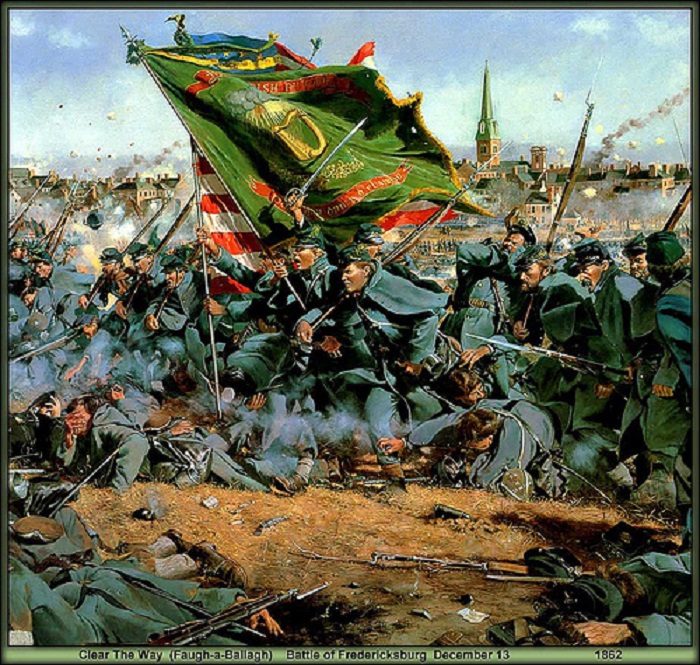
The US Civil War was not just fought by native-born Americans, but by soldiers from all over the world and of all kinds of backgrounds. At the war’s start, roughly 13% of the country’s population was foreign-born. However, their representation in America’s armed forces greatly exceeded their population percentage. Immigrants were not spread evenly across America, but were chiefly concentrated mostly in the northern states. Accordingly, the Union Army had a significantly higher percentage of foreign-born soldiers than did the Confederate one. Indeed, almost half the Union Army’s soldiers were foreign-born, or were the sons of immigrants. Of two million men who served the Union in uniform, a quarter to a third – 543,000 to 625,000 – were not born in America. Another 18% had at least one foreign born parent.
The Rivals’ Differing Views on Immigrant Soldiers

Ethnic Germans fought for the Union in large numbers – about 216,000 German-born men fought for the North, plus another 250,000 first generation German-Americans. Both sides had Irish regiments. About 20,000 Irishmen fought for the Confederacy – significantly fewer than the roughly 160,000 Irishmen who fought for the Union. Unsurprisingly, with slavery as the war’s central cause, it was easier for the Union to attract volunteers than it was for the slave-holding Confederacy.
Also unsurprisingly, the Confederates were salty about the Union’s greater success in attracting foreign volunteers. Confederate diplomats overseas railed to Europeans that the North was recruiting their sons to serve as cannon fodder. Simultaneously, pamphlets circulated by Confederate diplomats referred to those same sons of Europe fighting for the Union as “mercenaries” and “the refuse of the old world”.
The North Found it Easier to Attract Immigrant Soldiers

It was easier for the North to recruit idealists than it was for the slave-holding South. Especially when it came to German immigrants, who often likened the Confederates to the types of people they had left Europe to get away from. After the failed 1848 Revolution, thousands of young Germans fled to America. When the Civil War erupted, many rushed to fight against the forces of slavery and aristocracy that reminded them of those they had fled.
A German mother described why her seventeen-year-old son fought for the North: “I am from Germany where my brothers all fought against the Government and tried to make us free, but were unsuccessful … We foreigners know the preciousness of that great, noble gift a great deal better than you, because you never were in slavery, but we are born in it”. As a German enlistee wrote home, the war was about: “freedom or slavery, and you can well imagine, dear mother, I support the cause of freedom with all my might”.

Even the Chinese Were Represented in the Ranks of US Civil War Soldiers

The overwhelming majority of foreign volunteers were European, but there were unexpected enlistees from elsewhere in. For example, at least fifty Chinese fought in the war, mostly for the Union. There could have been many more, not found in the archives because of how race was classified at the time. The 1860 census had only three racial categories: white, black, or mulatto. Many Chinese were defined as white in enlistment rolls.
However, whatever was said on paper did not prevent their mistreatment because of racial prejudice. Nonetheless, they soldiered on. Chinese volunteers included William Ah Hang, one of the first Asian-American to join the US Navy, enlisted in 1863. Another was John Tomney, who joined a New York regiment and was killed in action at the Battle of Gettysburg. There was also Joseph Pierce, who became the highest-ranked Chinese-American in the Union Army when he was promoted to corporal.

_________________
Some Sources & Further Reading
American Battlefield Trust – Chinese-Americans in the Civil War
History Halls – Sherman Made Georgia Howl, but Not as Loudly as He Made South Carolina Scream
History Ireland – Irishmen in the Confederate Army
Time Magazine, June 29th, 2015 – The Civil War Was Won by Immigrant Soldiers

