Military history is full of daring strategists and brilliant tacticians. It is also littered with commanders whose incompetence, arrogance, or ignorance led to disaster. From ancient battlefields to modern wars, bad generalship has cost lives, empires, and led to the fall of nations. Below are ten of history’s worst examples of bad generalship.
10. Marcus Licinius Crassus

Marcus Licinius Crassus, the richest man in Rome, earned his fortune through real estate and political alliances, not military skill. In 53 BC, his ambition for glory drove him to invade Parthia without adequate preparation. He led seven legions into the desert, ignoring advice from local allies and underestimating the enemy’s horse archers. It caught up with at the Battle of Carrhae. There, his 43,000 men were destroyed by a Parthian force of 9,000 horse archers and 1,000 heavy cavalry. The Parthians annihilated Crassus’ army with mobile cavalry and archery tactics that the slow-moving Roman infantry could not counter. Crassus’s bad generalship, arrogance, indecision, and refusal to adapt sealed his fate. He was killed in a botched parley. The defeat humiliated Rome, weakened its eastern frontier, and destabilized its government. His failure was one of antiquity’s clearest examples of how greed and vanity can destroy armies.
9. Publius Quinctilius Varus

Emperor Augustus appointed Publius Quinctilius Varus to govern newly conquered Germania in 9 AD. Varus was an able administrator, but lacked understanding of frontier warfare. Believing the Germanic tribes were pacified, he marched three Roman legions deep into the Teutoburg Forest without reconnaissance. His supposed ally, the Germanic noble Arminius, betrayed him and ambushed the Romans in dense woods. For three days, Varus’s army was slaughtered. Trapped in terrain unsuitable for their tactics, the legions were annihilated, and around 20,000 men were lost. Varus fell on his sword. The defeat ended Rome’s expansion beyond the Rhine. It also haunted Augustus, who took to banging his head on walls while crying: “Quintilius Varus, give me back my legions!” Varus’s bad generalship, lack of caution, and poor tactical awareness was a textbook example of catastrophic command failure.
8. Major General Edward Braddock

Major General Edward Braddock was sent to North America in 1755 during the French and Indian War. His conduct exemplified the dangers of rigid European thinking in unconventional terrain. Ordered to capture Fort Duquesne (modern Pittsburgh), Braddock insisted on traditional linear formations, bright uniforms, and heavy artillery despite dense forests and ambush-prone terrain. He ignored warnings from colonial officers like George Washington. Braddock marched his force into an ambush by a smaller French and Native American contingent along the Monongahela River. The disciplined British troops broke under guerrilla fire, Braddock was mortally wounded, and his army was routed. His refusal to adapt turned a manageable campaign into humiliation, and delayed British dominance in North America for years.
7. Napoleon Bonaparte’s Russian Campaign

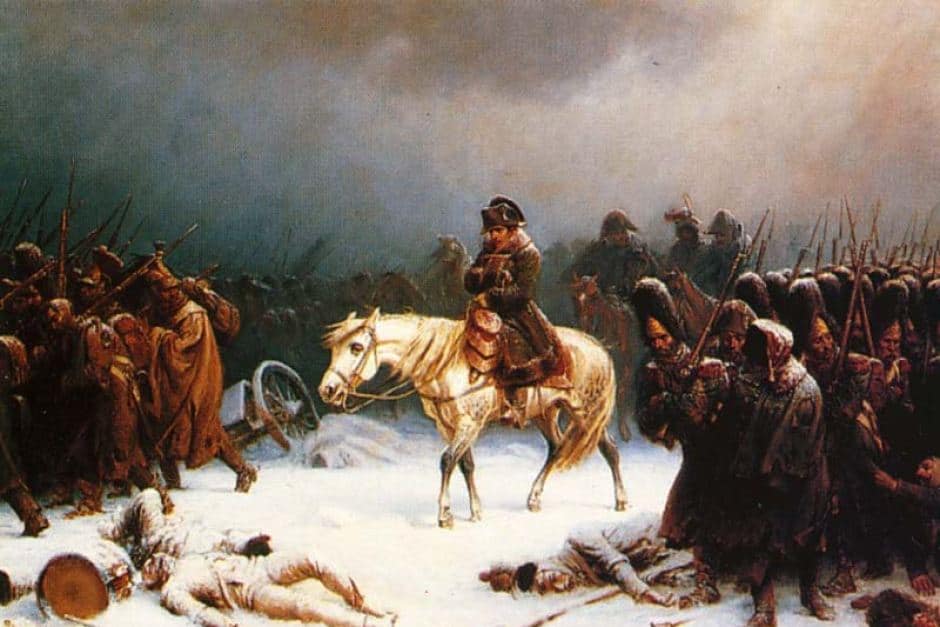
Napoleon is rightly celebrated as one of history’s greatest military geniuses, but even geniuses can commit catastrophic errors. His 1812 invasion of Russia remains one of the most infamous strategic blunders ever made. Convinced that a swift campaign would force Tsar Alexander I to submit, Napoleon led more than 600,000 men into Russia. The Russians avoided direct confrontation, and retreated while burning supplies in a scorched-earth strategy. By the time Napoleon reached Moscow, the city was in flames, and winter loomed. With no food or shelter, his Grand Army disintegrated during the retreat, and succumbed to starvation, disease, and cold. Fewer than 100,000 survived. Though a tactical genius, Napoleon’s hubris and disregard for logistics turned victory into catastrophe. His bad generalship in Russia marked the beginning of the end for his empire.
6. General John Burgoyne

In the American Revolutionary War, General John Burgoyne devised an ambitious plan to split the rebellious colonies by invading from Canada down the Hudson Valley in 1777. Confident in British superiority, Burgoyne advanced slowly, hauling heavy baggage, including his personal luxuries, through wilderness. His plan depended on coordination with other British forces that never arrived. His exhausted army was surrounded by American forces under General Horatio Gates at Saratoga, and forced to surrender. Burgoyne’s failure convinced France that the revolutionaries could win, and led to intervention that turned the tide of the war. His pompous self-confidence, inflexibility, and logistical incompetence make him one of Britain’s most notorious failures.
5. General Ambrose Burnside

Ambrose Burnside was brave and loyal, but profoundly out of his depth as an army commander. In 1862, he reluctantly accepted command of the Union’s Army of the Potomac. He then led it against Robert E. Lee’s Confederates at Fredericksburg, Virginia. Burnside planned to cross the Rappahannock River and storm fortified Confederate positions on high ground. Delays in pontoon bridges eliminated the element of surprise gave Lee time to prepare. Burnside launched frontal assaults anyway. Wave after wave of Union troops charged uphill into entrenched Confederate fire, and suffered over 12,000 casualties. Burnside wept at the carnage, but considered another attack before his subordinates stopped him. Burnside’s bad generalship at Fredericksburg, rigid tactics and poor planning made him one of the Civil War’s worst commanders. His name lives on though in “sideburns”, which he popularized.
4. General Antonio Lopez de Santa Anna

Santa Anna dominated Mexican politics and warfare in the early nineteenth century, and often placed personal ambition above national interest. His record includes both victories and epic defeats, most notably during the Texas Revolution and the Mexican-American War. In 1836, after his victory at the Alamo he grew overconfident in his superiority and ignored reconnaissance. He was surprised by Texan forces at San Jacinto, where his army was crushed and he was captured. The defeat led to Texas’ independence. In 1847, during the war with the United States, he squandered opportunities to defend Mexico effectively. He misallocated troops, and failed to effectively coordinate his forces. His bouts of bad generalship, erratic leadership, and vanity contributed to Mexico’s loss of nearly half its territory. Santa Anna’s repeated comebacks, corruption, and battlefield failures make him a symbol of destructive ego in leadership.
3. Douglas Haig

Field Marshal Douglas Haig remains one of the most controversial figures in British military history. In World War I, he commanded the British Expeditionary Force on the Western Front. There, he oversaw the battles of the Somme, 1916, and Passchendaele, 1917. Haig believed that relentless offensives and attrition would break German morale, despite mounting evidence that it only produced horrific casualties. At the Somme, nearly 60,000 British soldiers were killed or wounded on the first day – the bloodiest day in British history. Over four months, the Allies gained a few miles at the cost of more than a million casualties. Haig’s defenders argue that he adapted and ultimately helped win the war. However, his stubborn adherence to outdated tactics, disregard for new technologies like tanks, and willingness to accept appalling losses have forever tainted his legacy.
2. General Maurice Gamelin

As commander-in-chief of French forces in 1940, Maurice Gamelin bore responsibility for France’s rapid collapse before Nazi Germany. Gamelin had a distinguished career, and was seen as cautious and intellectual. By World War II, however, he was elderly and inflexible. He relied heavily on the defensive fortifications of the Maginot Line, convinced that any German attack would replicate WWI’s patterns. When the Wehrmacht invaded through the Ardennes – a route Gamelin considered impassable to tanks – he was unprepared. His slow communication and centralization meant French forces reacted too late. Within six weeks, France fell. Gamelin was unable to grasp modern mechanized warfare, and his leadership was lethargic. His bad generalship symbolized the tragic failure of France’s high command in 1940.
1. General Tommy Franks

In more recent times, General Tommy Franks, who commanded the 2003 invasion of Iraq, has faced criticism for strategic shortsightedness. The initial campaign was militarily brilliant and successful – the Iraqi Army was swatted aside, and Baghdad fell quickly. However, Franks failed to anticipate the challenges of occupation. He dissolved the Iraqi Army and allowed widespread looting, creating chaos that insurgents soon exploited. Franks retired shortly after the invasion, and left subordinates and civilian administrators to manage the unraveling situation. His failure to plan for postwar stabilization contributed to years of insurgency, sectarian violence, and geopolitical instability. While competent in conventional warfare, Franks’s narrow operational focus and lack of foresight have been widely condemned by historians and military analysts.
Patterns of Failure

Though separated by centuries, the ten examples of bad generalship, above, share recurring flaws that transcend time and technology. Their setbacks were rarely due to sheer bad luck. Rather, they stemmed from predictable patterns of poor leadership and decision-making. Arrogance and overconfidence were key factors. Many of these men – Crassus, Napoleon, Burgoyne, Santa Anna – believed that their superiority or previous success guaranteed victory. That arrogance blinded them to logistical constraints and enemy adaptability. Some disasters were due to failure to adapt to terrain and circumstances. Braddock and Gamelin both failed to recognize that warfare changes with geography and technology. Fighting a forest war as if it were a European parade ground, or expecting WWI trench warfare in 1940, proved fatal.
Inattention to logistics also led to disaster. Napoleon’s Russian campaign and Burgoyne’s march through the wilderness demonstrate how neglecting supply lines and environmental factors can destroy armies even without a decisive battle. Disregarding intelligence and good advice could also be fatal. Varus trusted Arminius blindly; Burnside downplayed his officers’ doubts; Santa Anna ignored scouts. Failure to listen to subordinates or heed intelligence consistently led to disaster. So did inflexibility. Haig’s attritional offensives and Burnside’s frontal assaults demonstrated a fatal devotion to doctrine over innovation. Even in the face of failure, they persisted in methods that slaughtered their men. Finally, lack of vision beyond the immediate, as happened with Tommy Franks, proved catastrophic. Franks exemplifies the modern dimension of failure: winning wars, but losing the peace. His lack of a coherent postwar plan demonstrates why generalship extends beyond mere tactical victory to strategic foresight.
Consequences of Poor Leadership

The human cost of the preceding examples of bad generalship was immense. Varus lost three legions; Napoleon’s Grand Army lost half a million men; Haig’s offensives consumed a generation of youth. Braddock’s defeat prolonged colonial insecurity, while Gamelin’s failure ushered in Nazi domination of Europe. Those disasters reshaped political maps, destroyed empires, and taught costly lessons that later generations often ignored. Military incompetence does more than lose battles: it undermines nations’ faith in leadership. France’s defeat in 1940 shattered the Third Republic; Mexico’s losses to the United States eroded national pride for generations; and Rome’s humiliation at Carrhae exposed vulnerabilities that enemies exploited for decades. The ripple effects of one general’s mistakes can go on for centuries.
The Thin Line Between Genius and Folly

A recurring question in military history is how such flawed leaders achieved command. The answer lies in the intersection of politics, personality, and timing. Crassus and Santa Anna rose through wealth and ambition; Burnside and Gamelin were appointed out of desperation or seniority; Haig and Franks benefited from bureaucratic confidence in systems rather than creativity. Institutions often reward obedience over innovation. Braddock and Gamelin followed textbook procedure, and ignored changing realities. By contrast, successful generals like Hannibal, Napoleon (in his early years), or Rommel, thrived on adaptability. Military bureaucracies fear disorder, and often elevate those least likely to take creative risks, which ensures mediocrity at the top.
It is important to note that the difference between a great general and a terrible one can be razor-thin. Napoleon’s genius at Austerlitz turned to folly in Russia. Haig’s persistence arguably contributed to victory in 1918, even though it wasted lives in 1916 and 1917. Context matters: a general might appear incompetent in one campaign and brilliant in another, depending on circumstances. Still, the ultimate measure of generalship lies in judgment – knowing when to fight, when to retreat, when to adapt, and when to listen. The men listed here failed those tests in the occasions described. Their bad generalship serves as a reminder that leadership is not just about courage or conviction. It is also about humility, flexibility, and the capacity to learn.
Lessons from Failure

Modern military academies still study the aformentioned disasters for the lessons they teach. A key one is that intelligence is priceless. Varus’s ambush and Burgoyne’s isolation prove that information, not just numbers, decides battles. Another lesson is that logistics win wars. Napoleon’s and Burgoyne’s failures underscore that supply chains are as vital as courage. Attention must also be paid to ensure that plans match evolving technology. Gamelin’s faith in the Maginot Line shows that static thinking cannot survive dynamic warfare. Commanders must also plan for peace as well as war. Franks’s failure in Iraq highlights that victory requires a political and social strategy, not just military success. Those principles, written in blood across centuries, remain timeless.
Incompetence at the top magnifies suffering below. Whether it was Varus losing Rome’s legions in a forest, Burnside sending men into hopeless assaults, or Gamelin sleepwalking into national ruin, their failures share a common thread: the inability to rethink outdated assumptions or adjust to changed circumstances. Leadership demands self-awareness, adaptability, and foresight. The failures described here transformed nations, and revealed the high cost of arrogance and ignorance in command. From the deserts of Parthia to the snows of Russia, from the trenches of the Somme to the streets of Baghdad, the echoes of bad generalship warn every generation that even the mightiest armies are only as strong as the wisdom of their commanders.
_________________
Some Sources & Further Reading
Chandler, David G. – The Campaigns of Napoleon (1966)
Encyclopedia Virginia – Battle of Fredericksburg
History Halls – Marcus Licinius Crassus
Jackson, Julian – The Fall of France: The Nazi Invasion of 1940 (2003)
Mintz, Marx M. – The Generals of Saratoga: John Burgoyne and Horatio Gates (1990)
Murdoch, Adrian – Rome’s Greatest Defeat: Massacre at the Teutoburg Forrest (2008)
Museum of the American Revolution – Braddock’s Defeat
New York Times, June 29th, 2008 – Occupation Plan for Iraq Faulted in Army History
Travers, Timothy – The Killing Ground (1987)

