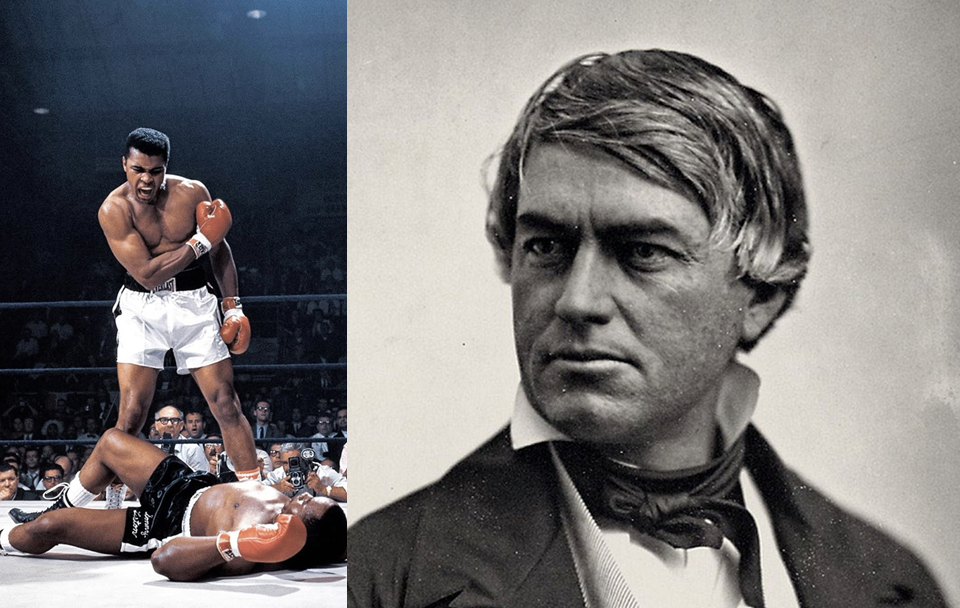
When legendary boxer Muhammad Ali announced his name change, he said: “Cassius Clay is a slave name. I didn’t choose it and I don’t want it”. His birth name’s origin was more interesting than that comment suggests, though. Cassius Marcellus Clay, Jr., who later changed his name to Muhammad Ali, was named for his father Cassius Marcellus Clay, Sr., who in turn was named for abolitionist Cassius Marcellus Clay, one of his era’s most notable and controversial men. As seen below, if he was to be named after a slave owner – or a former slave owner – Cassius Marcellus Clay was not a bad choice.
The Original Cassius Marcellus Clay

Cassius Marcellus Clay (1810 – 1903) was one of the American abolition movement’s most remarkable and controversial figures. A Kentucky planter, politician, soldier, and diplomat, Clay stood out as a Southern abolitionist at a time when such a stance was considered not only radical, but downright treasonous by many of his peers. His life was defined by courage, contradiction, and a lifelong battle for human freedom and social justice. He is no as well-known as figures like William Lloyd Garrison or Frederick Douglass. However, Clay’s influence, especially in his home state and in national politics, was significant and enduring.
Clay was born on October 19th, 1810, in Madison County, Kentucky, into the prominent Clay family. It was one of the wealthiest and most influential families of not only Kentucky, but the whole South. His father, Green Clay, was a Revolutionary War veteran, prosperous planter, and one of Kentucky’s largest land and slave owners. His relatives included an Alabama state governor, and a speaker of the US House of Representatives and US secretary of state. The young Cassius grew up surrounded by the institution of slavery. His views, however, eventually diverged dramatically from those of his family and peers.
An Abolitionist Southern Aristocrat

Cassius Marcellus Clay attended Transylvania University in Lexington, Kentucky, and later Yale College in Connecticut. It was during his time at Yale that he encountered the fervent abolitionist William Lloyd Garrison. Garrison’s fiery rhetoric and uncompromising moral stance against slavery made a deep impression on Clay. He later credited Garrison with awakening his conscience and setting him on the path to becoming an abolitionist. It was a path surrounded by great personal danger for somebody in Kentucky back then. Clay returned to the Blue Grass State after graduation, and began a political career with the Whig Party. He served several terms in the Kentucky legislature between 1835 and 1841. Despite his privileged background, he quickly became an outspoken critic of slavery.
Clay argued that slavery was not only morally wrong, but also economically detrimental to the South’s development. He believed that slavery stifled innovation, discouraged immigration, and hindered education and industry. His views made him deeply unpopular among his peers. As a slaveholding border state, Kentucky was not receptive to abolitionist rhetoric. Yet Clay persisted. In 1845, he founded an anti-slavery newspaper, The True American, in Lexington. It was a bold and dangerous move. The paper published editorials that condemned slavery and called for gradual emancipation. The reaction was swift and violent. Clay received numerous death threats, but he refused to be silenced. A pro-slavery mob broke into the newspaper’s office, seized the printing press, and shipped it out of the state.
You Did Not Want to Fight Cassius Marcellus Clay

Cassius Marcellus Clay was a progressive who challenged the stereotypes about progressives being soft. He was known as much for his ferocious physical bravery as for his strong political convictions. He was a fearsome and fearless brawler, and as pugnacious as it gets. Not only did he carry two pistols, he kept his own personal cannon at home. However, his preferred personal weapon was not a firearm or artillery, but his trusty Bowie knife. It came in handy in multiple violent confrontations over his abolitionist stance, and helped him survive several assassination attempts. In 1843, as he was giving a speech in support of abolition, a hired assassin got up, pulled out a pistol, jumped on the stage, and shot him in the chest.
Fortunately for Clay the bullet was deflected by his Bowie knife. It still entered his chest, but did not penetrate deeply. Despite having been shot, and with a bullet lodged in him, Clay leapt upon and tackled his attacker. He stabbed him repeatedly, and cut off his nose and one of his ears while at it. In another dramatic encounter, after he gave a pro-abolition speech, Clay was attacked by six brothers. They stabbed him, shot him, and beat him within an inch of his life. Clay was game, though. He pulled out his Bowie knife, and went to work on the homicidal siblings. Not only did he fight off half a dozen attackers, he killed one of them and put the rest to flight.
“The Lion of White Hall”

Cassius Marcellus Clay’s reputation for fearlessness earned him the nickname “The Lion of White Hall”, after his Kentucky family estate. His readiness to meet violence with violence and defend himself by force made him an unusual abolitionist. Unlike the pacifist William Lloyd Garrison, Clay believed in the right of armed self-defense. He argued that the fight against slavery would require courage and, at times, violence. His stance reflected a blend of Southern honor culture and moral conviction, which set him apart from many Northern reformers.
Clay’s political evolution mirrored the growing national tension over slavery. By the 1850s, he had joined the newly formed Republican Party, the first major political party to oppose slavery’s expansion. Clay became a strong supporter of Abraham Lincoln. He saw him as a leader who could hold the Union together, even as he opposed the spread of slavery. In the 1860 presidential campaign, Clay’s speeches and influence helped secure votes for Lincoln, particularly among border-state moderates. When Lincoln was elected, he rewarded Clay by appointing him as the US minister to Russia – a post he held for most of the Civil War period.
Ambassador to Russia and Abraham Lincoln’s Protector

Cassius Marcellus Clay’s diplomacy in St. Petersburg proved crucial. He worked closely with Russian officials to maintain friendly relations and to ensure that Russia supported – or at least did not oppose – the Union’s cause. At one point, when Lincoln temporarily removed him from the post, the Russian government requested his return. It was a testament to his effectiveness and charisma as a diplomat. Clay returned briefly from Russia to Washington, DC, early in the Civil War, and helped defend the then-defenseless capital. Before regular troops were mustered, Clay organized a group of volunteers into a battalion known as the “Cassius M. Clay Guards” to protect the White House and government buildings from possible Confederate attacks.
Lincoln greatly appreciated Clay’s show of loyalty and courage. Although Clay was not directly involved in military operations, he remained an outspoken advocate for emancipation. He pressured Lincoln and other officials to adopt a more aggressive stance against slavery. He argued that the war should not just be fought not just to preserve the Union. It should also be fought to destroy the institution that had caused the Union to fracture in the first place. When Lincoln finally issued the Emancipation Proclamation in 1863, Clay saw it as vindication of his lifelong crusade.
A Controversial Old Age

Cassius Marcellus Clay returned to Kentucky after the war, and continued to promote progressive causes. He championed public education, opposed corruption, and advocated for racial equality and women’s rights. However, his radical views once again isolated him politically. Kentucky remained largely conservative and resistant to Reconstruction-era reforms, and Clay found himself increasingly marginalized. In his later years, Clay’s personal life became turbulent. As a husband and father, he left much to be desired. His marriage to Mary Jane Warfield ended bitterly after decades of conflict, and his later years were marked by controversy.
Clay had been an absentee father most of his life, and his children had been raised by Mary Jane, practically alone. Two of his daughters, Laura Clay and Mary Barr Clay, became prominent suffragists and women’s rights activists, in no small part because they had seen how badly their father had treated their mother, and because of their revulsion at how unfair property laws were to women. In his eighties, Clay made headlines by marrying a teenage girl. It scandalized his contemporaries, and overshadowed his earlier achievements. Despite his erratic behavior in old age, Clay remained intellectually active. He continued to write letters and essays on politics, education, and social reform until his death.
The Legacy of Cassius Marcellus Clay

Cassius Marcellus Clay passed away on July 22nd, 1903, at his beloved White Hall estate. Though by then largely forgotten outside of Kentucky, his life had embodied many of the contradictions of nineteenth century America. He was a Southern aristocrat who fought against slavery. A man of violence, he pursued reforms in a progressive movement dominated by pacifists like William Lloyd Garrison. He was also a politician who bridged the gap between radical idealism and pragmatic statecraft. His legacy is focused on his role as a bridge between the Southern and Northern abolitionist movements.
Clay demonstrated that opposition to slavery was not confined to one region or class. His example inspired others in the South to question the moral and economic foundations of slavery. He influenced a generation of reformers and politicians, including Lincoln. Today, Clay is remembered as one of the few Southern abolitionists who risked everything for his beliefs. His mansion, White Hall, stands as a museum and a testament to his remarkable life. His ideas about emancipation, education, and civil rights placed him far ahead of his time, and his name continues to evoke admiration for his fearless defense of liberty.
Clay’s name was later passed down through another famous American, Muhammad Ali, born Cassius Marcellus Clay Jr. and named after the Kentucky abolitionist. Like his namesake, the boxer became a symbol of courage, defiance, and social change. The life of the original Cassius Marcellus Clay was one of constant struggle against his era’s injustices. Though he lived in a time of deep division, his unwavering commitment to freedom and equality ensured that his voice – that mobs were unable to silence – would echo long beyond his century.

________________
Some Sources & Further Reading
Carlee, Roberta Baughman – The Last Gladiator: Cassius M. Clay (1979)
Smiley, David L. – Lion of White Hall: The Life of Cassiuss M. Clay (1962)
Townsend, William H. – The Lion of Whitehall (1967)
If you liked this article, you will like History Halls – Fighting Women: Vitka Kempner, the Inspirational WWII Jewish Partisan Leader

