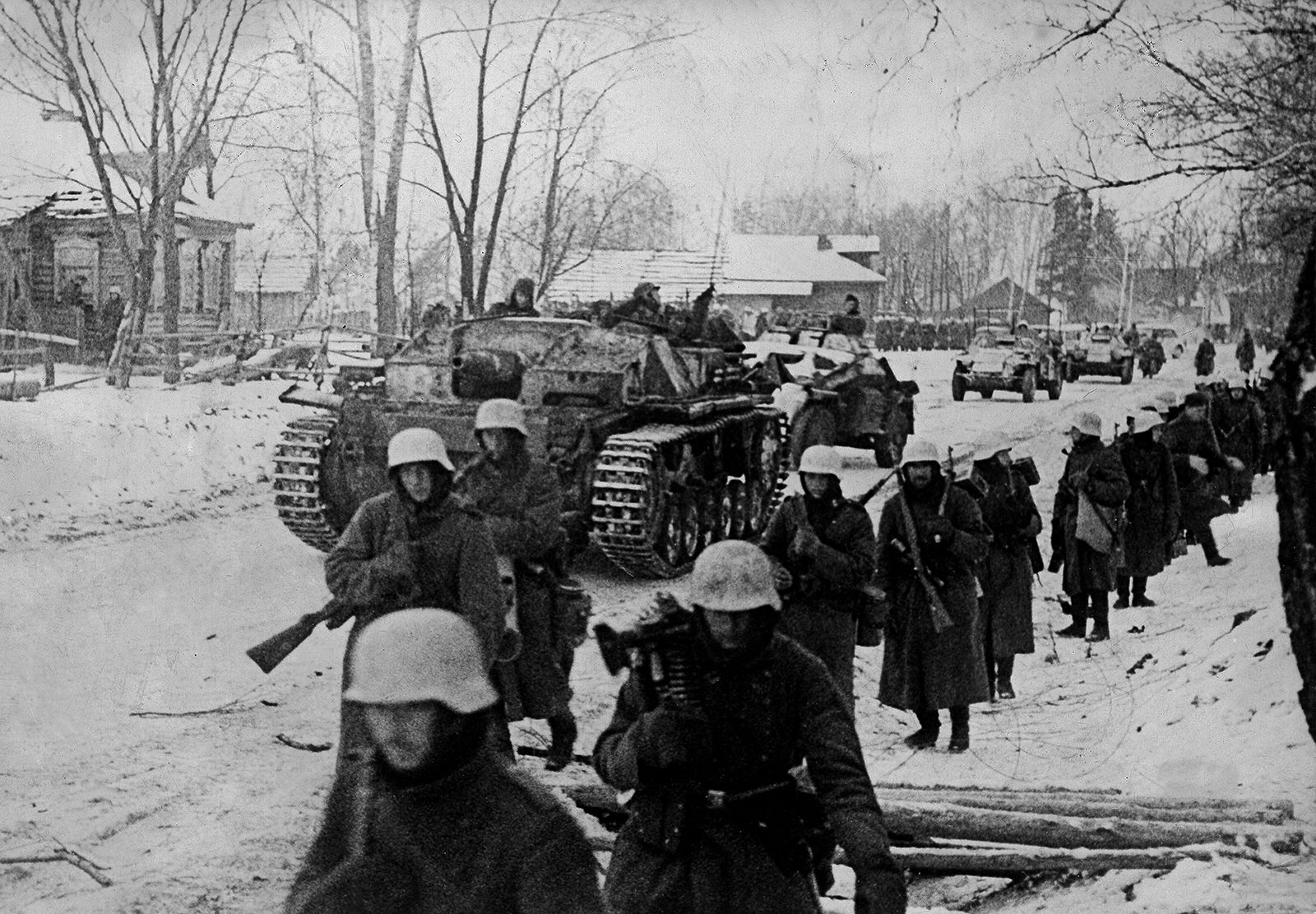
History’s biggest battle was fought in World War II. However, it is not history’s best known battle, nor even the best known battle of WWII. It was the Battle of Moscow, fought between the Soviet Red Army and the German Wehrmacht from October, 1941, to the following January.
History’s Biggest Ever Battle

The Battle of Moscow was not only WWII’s biggest battle, but history’s biggest ever battle. More men fought to seize or defend Moscow in 1941 than in any other battle before or since. At its peak, almost two million Germans soldiers were pitted against one million and four hundred thousand Red Army defenders. From the start of the battle to its end, more than seven million soldiers took part. The casualties numbered two and a half million men, of whom almost two million were from the Red Army. Despite lopsided losses of roughly four to one, the Battle of Moscow was a strategic Soviet victory. It was the Second World War’s single most important battle.
It was also the battle that could have produced the most radically different alternate history had it turned out differently. At the gates of Moscow in 1941 was the closest the Germans ever came to winning WWII. They would never come that close again. Operation Barbarossa, which kicked off Germany’s invasion of the Soviet Union months earlier in June, 1941, had been wildly successful. The Red Army lost tens of thousands of tanks and airplanes, and millions of soldiers. However, no matter how hard the invaders bludgeoned them, the Soviets staggered on, and scrapped together enough new soldiers who although badly led and almost untrained, mounted a fierce resistance.
The Titanic Struggle in Front of Moscow

The Germans ran wild in the early months of the invasion until Operation Barbarossa finally lost its momentum. So the invaders had to halt in order regroup and refit. Although they had inflicted horrific and lopsided losses upon the defenders, the Germans had bled too. Not as much as the Soviets, but enough to reduce their effectiveness from its peak at the start of the invasion. Nonetheless, the Wehrmacht still had enough power left for one more offensive before winter brought operations to a halt. Hitler decided that offensive should be aimed at Moscow. So in October, 1941, the Germans launched Operation Typhoon, a thrust at Moscow from the direction of Smolensk.
There was nothing brilliant about the resultant battle, a straightforward, smash mouth, bloody slog. Operation Typhoon brought the Germans quite close – literally within sight of the Kremlin’s spires – to victory. However, between ferocious and desperate resistance by the Red Army, combined with the harsh Russian winter for which the Germans were unprepared, the attack was halted. Then the Soviets, who had kept significant forces in the east to defend against a possible Japanese invasion, received intelligence that Japan would not attack them. So they shifted forces from the east to Moscow for a counterattack.
WWII’s Most Important Battle

In December, 1941, the Red Army counterattacked along the front lines of Moscow with fresh soldiers from Siberia and the Far East, and pushed back the exhausted Germans about one hundred miles. Then Stalin got carried away, and against the advice of his military professionals, insisted on a general offensive to destroy the invaders. That only led to needless Soviet casualties. Nonetheless, the Battle of Moscow’s final outcome was a Soviet strategic victory, as the Germans had failed to achieve their objective and seize their enemy’s capital.

The outcome belied the perception that the Red Army was only able to win when it swamped the Germans with vastly superior numbers. In a rarity on the Eastern Front, the Germans actually outnumbered the Soviets throughout most of the Battle of Moscow. Despite that, the Red Army stopped the Wehrmacht in the defensive phase, then counterattacked and pushed the Germans back. It was the first time that the blitzkrieg had failed. It was also the closest that Hitler ever came to winning the war on the Eastern Front.
The Consequences of Germany’s Defeat in the Battle of Moscow

The German defeat at the gates of Moscow destroyed the Fuhrer’s dreams of an early victory. It doomed his armies to a war of attrition against an industrial and manpower giant whose resources Germany could not match. If the Soviets had lost the Battle of Moscow, it would have been difficult for them to continue the fight. In addition to the hit to morale if they had lost their capital, the Moscow region was a major Soviet industrial and armaments production center. Moscow was also the Red Army’s most important communications and transport hub. Its loss would have severed effective contact between the Soviet armies operating in the north of the USSR with those in the south.
_________________
Some Sources & Further Reading
Stahel, David – Operation Typhoon: Hitler’s March on Moscow, October 1941 (2013)

