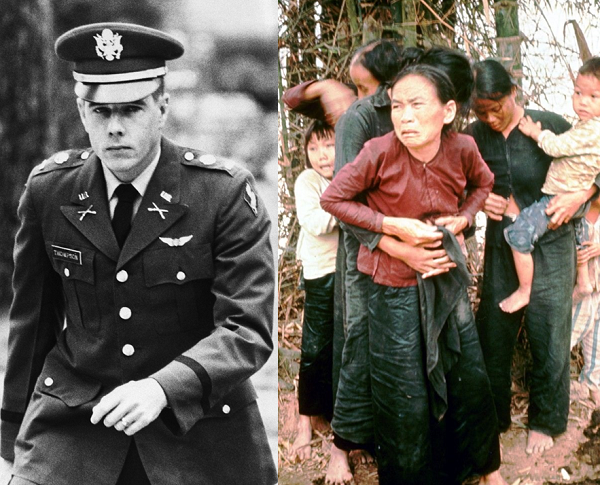
Hugh Clowers Thompson Jr. was one of the few men who stood against the tide of atrocity during the Vietnam War. His actions during the My Lai Massacre on March 16th, 1968, transformed him into a symbol of moral courage. Despite the enormous pressure of war, the culture of obedience, and the hostility of his peers and superiors, Thompson chose humanity over blind allegiance.
A Strong Moral Foundation

Hugh Thompson Jr. was born on April 15, 1943, in Atlanta, Georgia, and grew up in Stone Mountain. His father was a World War II veteran who instilled in him a sense of duty and compassion. Thompson was raised in a religious family whose children had integrity and discipline instilled in them from an early age. The Thompsons stood out in the segregated South for their opposition to racism, and for standing up for and helping their black neighbors. Hugh was a Boy Scout, and after he graduated from high school, he briefly worked in a funeral, then enlisted in the US Navy in 1961. He served for several years, before he was honorably discharged in 1964. However, when the Vietnam War heated up, Thompson felt a moral obligation to serve his country, so he returned to the military.
This time, Thompson joined the US Army, and trained as a helicopter pilot. Upon completion of his training, he was assigned to the 123rd Aviation Battalion, Americal Division, based in South Vietnam. Thompson piloted an OH-23 Raven observation helicopter in a reconnaissance unit responsible for enemy position identification and ground troop support. Known for his professionalism and calm demeanor, he was respected among his peers and crewmen, crew chief Glenn Andreotta and door gunner Lawrence Colburn. Nothing in his training, however, could have prepared him for what he would witness in the Vietnamese hamlet of My Lai, site of the My Lai Massacre, an atrocity that occurred in South Vietnam’s Quang Ngai Province.
Hugh Thompson Jr. at the My Lai Massacre

The My Lai Massacre occurred during Operation Muscatine, a search-and-destroy mission aimed at rooting out Viet Cong (VC) fighters. The area had been plagued by repeated ambushes, and the soldiers of Charlie Company, 1st Battalion, 20th Infantry Regiment, were on edge after suffering casualties from mines and snipers. The company, led by Captain Ernest Medina and Lieutenant William Calley, was told that My Lai was a Viet Cong stronghold and that any civilians would have left for the market by the time of the assault.
When the soldiers arrived on the morning of March 16th, 1968, they found no armed resistance. All they encountered were unarmed civilians: old men, women, and children. Despite that, the troops began to kill indiscriminately. They burned homes, destroyed livestock, forcibly had their way with women, and massacred villagers. Over a period of several hours, more than five hundred civilians were slaughtered. Hugh Thompson Jr. was flying reconnaissance in the area that morning. From the air, he expected to see combat between US troops and Viet Cong forces. Instead, he saw bodies of civilians scattered across rice paddies and irrigation ditches.
The Moral Courage to Act

Initially, Thompson thought that a battle had taken place. As he circled the area, however, the evidence of a massacre became undeniable. From his helicopter, he and his crew watched as soldiers shot unarmed villagers and executed groups of people, including women and children. Thompson landed his helicopter multiple times to investigate. At one point, he approached Lieutenant Calley and asked what was happening. Calley replied that he was “following orders”. When Thompson saw a group of civilians, including women and children, hiding in a bunker, he realized he had to act.
Thompson landed his helicopter between approaching soldiers and the villagers. He ordered his crew to train their machine guns on the American troops, and confronted the soldiers directly. He demanded that they stand down and allow the civilians to be evacuated. Thompson radioed for two other helicopters to assist in airlifting the survivors to safety. His quick decision and moral clarity saved at least ten to twelve Vietnamese civilians that day. Before he left the area, Thompson saw more bodies in a nearby ditch – men, women, and children who had been systematically executed.
A US Army Cover Up

Hugh Thompson Jr. returned to base furious and shaken by the events at My Lai. Soon as he landed, he filed a report with his superiors, denouncing the massacre and demanding an investigation. His report met resistance and was buried by the chain of command. The US Army attempted to cover up the massacre, and claimed that 128 Viet Cong and 22 civilians had been killed in combat. His report was ignored, and he continued his service, haunted by what he had witnessed.
Thompson was later reassigned to another unit, and completed his tour in Vietnam. He earned several commendations for bravery in flight operations unrelated to My Lai. The truth about what had happened at My Lai began to emerge over a year later in 1969, when Ron Ridenhour, an American soldier who had heard accounts from witnesses, sent letters to members of Congress and the Pentagon in which he described what had happened. That prompted an official investigation led by General William Peers.
Doing the Right Thing Derailed Thompson’s Military Career

The Peers Inquiry, conducted in 1970, confirmed that hundreds of unarmed civilians had been massacred at My Lai. It also revealed that a cover up had occurred at multiple levels of command. Hugh Thompson Jr. and his crew were called to testify, and their accounts helped uncover the atrocity’s full extent. Although Thompson’s actions were heroic, he faced hostility rather than praise in the years following his testimony. Many Americans, still deeply divided over the Vietnam War, viewed him as a traitor who had betrayed his fellow soldiers.
Thompson was ostracized within the US military, and received many death threats. Some commanding officers refused to speak to him, and his once-promising career stalled. Despite that, Thompson knew that he had done the right thing. His duty was to protect life and uphold the laws of war. Although more than five hundred civilians had been massacred at My Lai, there was only one significant conviction. Lieutenant William Calley was found guilty of premeditated murder for the deaths of twenty two villagers. He was sentenced to life in prison, but President Richard Nixon commuted that to house arrest after only three years. That only deepened the sense of injustice surrounding My Lai.
Belated Recognition

Hugh Thompson Jr. continued to serve in the Army until 1983, and retired as a warrant officer. He then worked as a helicopter pilot for the Veterans Administration, providing medical evacuation services. Thompson’s heroism in the My Lai massacre went largely unacknowledged by the military establishment for decades. However, attitudes toward the Vietnam War and the My Lai episode began to shift in the 1990s. Historians, journalists, and veterans reexamined the actions of individuals like Thompson, Andreotta, and Colburn, and recognized their extraordinary moral courage.
On the 30th anniversary of the My Lai Massacre in 1998, the US Army formally awarded all three men the Soldier’s Medal, the highest decoration awarded by the US military for bravery not involving direct combat. Tragically, Glenn Andreotta did not personally receive that award. He had been killed in action just three weeks after My Lai, so the medal was presented posthumously to his family. At the ceremony, Thompson stated, “We took an oath to defend the Constitution and the country, not a person. I think we were doing our job”.
The Legacy of Hugh Thompson Jr.

Thompson’s humility and conviction stood in stark contrast to the silence that had followed the massacre for so long. He spent his later years speaking about ethics, in warfare and the importance of moral courage. He lectured at military academies and universities, and emphasized the responsibility of soldiers to question illegal orders and to protect civilians even – or especially – amidst the fog of war. His story became a case study in military ethics, used to teach future generations the importance of humanity amid conflict.
Hugh Thompson Jr. died of cancer on January 6th, 2006, aged sixty two, in Alexandria, Louisiana. He was buried with full military honors at Lafayette Memorial Park. Surviving Vietnamese villagers attended his funeral, and paid tribute to the man who had once risked his life to save them. Thompson’s actions at My Lai were among the most courageous acts in American military history. Not because he fought an enemy, but because he confronted his own side when it was the moral thing to do. His bravery forced the US military and the nation to confront uncomfortable truths about war, obedience, and responsibility. Though vilified at first, Thompson ultimately became a symbol of integrity and conscience. He demonstrated that valor is not only measured by violence. It can also be measured by the strength to stand against violence from one’s own side when necessary.

_________________
Some Sources & Further Reading
Americans Who Tell the Truth – Hugh Thompson Jr.
Angers, Trent – The Forgotten Hero of My Lai: The Hugh Thompson Story, Revised Edition (2014)
Bilton, Michael, and Sim, Kevin – Four Hours in My Lai (1993)
Encyclopedia Britannica – My Lai Massacre
If you liked this article, you will also like History Halls – The Tomb of the Unknowns: Final Resting Place of America’s Most Highly Decorated Serviceman

