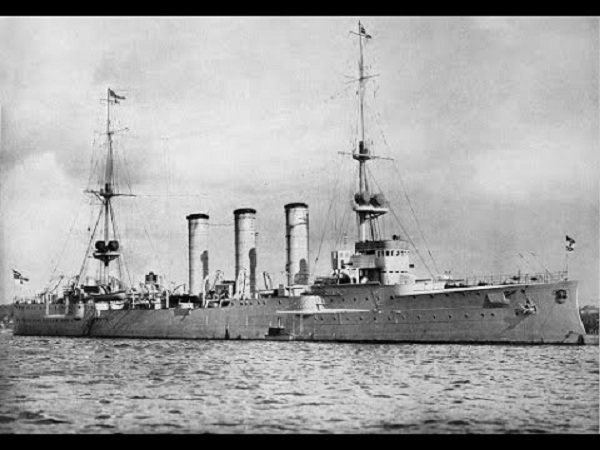
SMS Emden was an Imperial German Navy light cruiser. Completed in 1909, she was sent to join the German East Asia Squadron in Tsingtao, China. She displaced about 4300 tons, and packed a nice punch for a ship of her size: ten 4.1 inch guns, and two torpedo tubes. At the start of the First World War, she had 18 officers and 343 crewmen. They were commanded by an intrepid captain, Karl von Mueller. In a two month cruise, the Emden captured or destroyed over 30 ships, bombed Madras, raided Penang in the Malay Peninsula, and sank an enemy cruiser and destroyer. She was eventually cornered, pounded to pieces, and forced to run aground. However, even that did not end her story: some of her crew sailed their way to freedom in an epic journey that captivated friend and foe alike.
The Emden Goes Solo

As war clouds gathered in the summer of 1914, the Emden was the only German cruiser in East Asian waters. It was feared that hostilities break out at any moment. So Captain Mueller took the precaution of sailing out to the high seas, lest the Emden be surprised at port, and cornered and sunk by more powerful foes. It turned out to have been a wise move.
A powerful joint British and Japanese assault that the Emden would have had no chance to resist fell upon her home port of Tsingtao soon after the war began. On August 3rd, 1914, one day after Germany declared war on Russia, the Emden captured a Russian ship and sent her back to Tsingtao. There, the captured vessel was converted into an auxiliary commerce raider.

After the capture of her first prize, the Emden sailed to the Marianas Islands in the Pacific. There, the rest of the German East Asia Squadron had been assembled, preparatory to further action. There, the squadron learned that Japan was about to join the Entente and declare war on Germany. It became clear that the odds against German naval operations in East Asian waters had grown too great.
So the squadron’s commander decided to sail his ships across the Pacific, around South America, and into the Atlantic. However, the Emden was detached from the squadron to operate independently as a commerce raider. Captain von Mueller then disguised his ship by rigging a dummy fourth smokestack. That made the Emden look like the roughly-same-sized British cruiser HMS Yarmouth.
The Start of a High Seas Solo Rampage

The disguised Emden usually approached target vessels with no colors flying. She was often mistaken for a British warship. When she got close enough, the German cruiser would suddenly fire a warning shot while simultaneously hoisting the German flag and signaling her prey: “Stop at once! Do not use wireless!” Within a few days, the Emden seized or sank 15 ships. The total number of her victims eventually exceeded 30. As panic gripped the region, few ships dared venture from harbor. So Captain von Mueller expanded his operations, and began to shell targets on land. On the night of September 22nd, 1914, the Emden steamed into the port of Madras. She turned her guns on the fuel depots, and in a half hour barrage, set the massive fuel tanks ablaze.
The German cruiser then sailed to the British port of Diego Garcia, and sank six more ships along the way. When the Emden arrived, the Germans were surprised to discover that the locals were unaware that war had been declared. They kept mum, and rather than wreck the place, took the opportunity to re-provision, repair, and even repaint the Emden. There was still room for chivalry and decency early in the war, and von Mueller refrained from destroying the still-unsuspecting port when he left. He even had his crewmen help repair a local’s vessel. From Diego Garcia, the German cruiser sailed to Penang in British Malaya. It arrived at dawn on October 27th, and found an anchored Russian cruiser and a French destroyer. The enemy warships were caught off guard, and promptly destroyed by the Emden.
A Sea Ghost’s Guerrilla Campaign

The Emden’s actions sowed chaos and panic throughout the Indian Ocean’s merchant shipping community. The sea lanes were disrupted, and no ship dared voyage between India and Singapore. That greatly embarrassed the Entente’s navies, especially the mighty British Royal Navy, and galled Winston Churchill, then First Lord of the Admiralty. Churchill fumed that the Emden’s rampage gave the Royal Navy a black eye, and made it look ridiculous for its inability to prevent a single enemy ship from causing so many problems. In a bid to bring the German cruiser’s depredations to an end, a massive multinational fleet scoured the seas in search of the Emden.
For months, their efforts proved fruitless. The Emden continued to wage naval guerrilla warfare, and operated almost like a wraith that appeared from nowhere to strike, then vanished into the mist. A silver lining, at least, was the chivalry and gallantry exhibited by the German captain – traits that grew rare, steadily banished by bitterness as the war’s costs in blood and treasure mounted. Captain von Muller treated prisoners with decency, and refrained from wanton destruction and needless cruelty. After the successful raid on Penang, he cruised to the Cocos Islands in the eastern Indian Ocean, to destroy British wireless installations located there.
Cornering the Emden

The Emden arrived at the Cocos Islands on the morning of November 9th. Its attempts to jam radio signals failed, and the locals managed to transmit a message: “Unidentified ship off entrance“. It was received by the Australian light cruiser, HMAS Sydney, sixty miles away. Bigger, more heavily armed and armored, and faster than the Emden to boot, the Sydney immediately made for the Cocos Islands.
In the meantime, an Emden landing party of about fifty officers and men disembarked on Direction Island. They were commanded by Lieutenant Hellmuth von Mucke, who had been ordered to destroy the island’s wireless installations and to bring down the radio mast. Three hours later, while the landing party was ashore, the Emden’s luck finally ran out: lookouts spotted HMAS Sydney bearing down upon them at full speed.
Destruction of the Emden

The German cruiser was in a terrible bind. For starters, the Sydney was a significantly more powerful warship than the Emden. To make matters worse, a significant part of the Emden’s crew was ashore, just when a heavier and better armed and armored enemy came bearing down on the German raider with bad intentions. There was no time to recover the landing party, who were abandoned as von Mueller ordered his cruiser into action against the Sydney.
The Emden put up a spirited fight, but her 4.1 inch guns were outmatched by the Australian cruiser’s heavier 6 inch guns. The Emden was pounded to pieces, and she was run aground to keep from sinking. By sunset, the situation was hopeless, and with 133 of the Emden’s crew already killed, she struck her colors. The survivors were taken prisoner. It was the end of the Emden, but not the end of the Emden saga. The crewmen who had landed at Direction Island, and were stranded there when their ship was destroyed, sought to make their back to Germany across thousands of miles of hostile seas.
[This is the first of two articles about the SMS Emden. For the conclusion and to find out the fate of her stranded crew, click here]
_________________
Some Sources & Further Reading
History Halls – World War I’s Greatest Escape Odyssey: The Flight of SMS Emden’s Stranded Crew
Military History Now – The Kaiser’s Pirate Ship: The Astounding Voyage of SMS Emden
Naval History Net – HMAS Sydney v SMS Emden Action, November 9, 1914
Parramata Heritage Center – the Exploits of the German Cruiser SMS Emden

