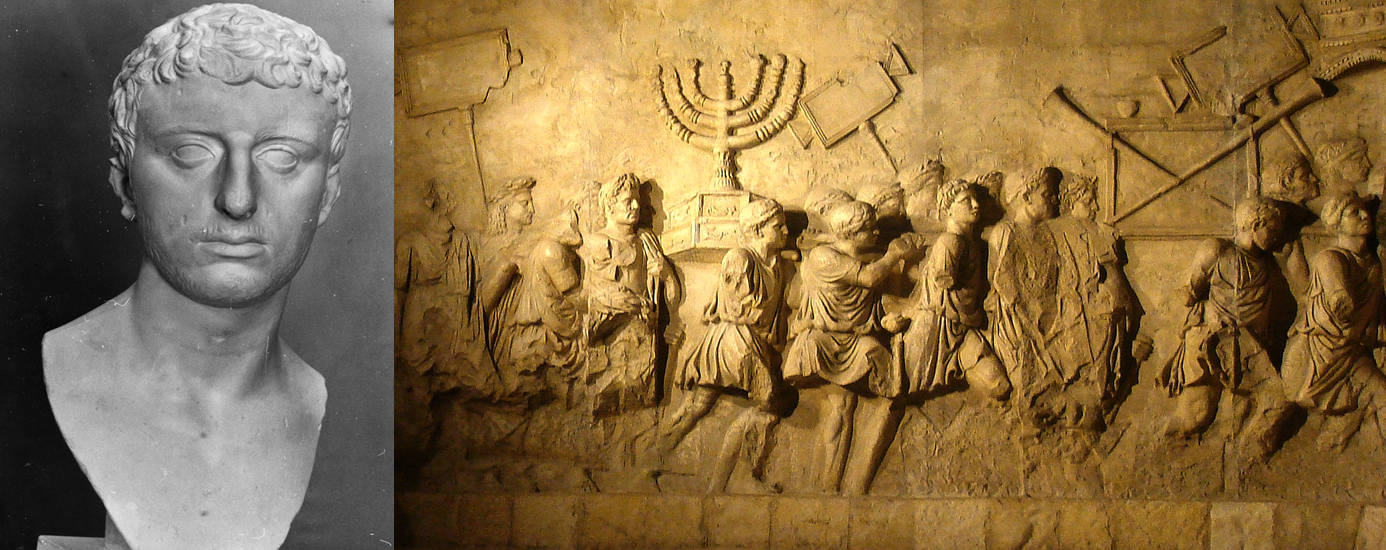
Titus Flavius Josephus, birth name Yosef ben Matityahu, was a Jewish general and leader who commanded rebel forces at the start of the Great Jewish Revolt (66 – 73 AD). As seen below, he switched sides after he was captured, and joined the Romans.
The Youthful Rebel Leader

The Great Jewish Revolt initially started with tax protests in 66 AD. In response, the Romans arrested prominent Jews and looted the Jerusalem Temple. That heavy handedness transformed the protests into a full blown rebellion, which forced the Romans to flee Judea. Rebels seized strongholds across Judea, and a national military government was established in Jerusalem after it fell to the insurgents. At the time, Josephus (37 – 100 AD) was a twenty nine year old priest, and he was chosen to lead the rebel forces in Galilee.
Josephus was a wily operator who did not rely on brute force alone. For example, he bluffed the town of Tiberias to surrender with a display force by parading 230 boats. What the Tiberians did not know was that the boats did not carry more than five men each. With such guile, he brought Galilee under the rebels’ control. The Romans did not remain idle for long, however. After early setbacks, the Empire struck back and sent a savvy general, Vespasian, to crush the rebellion.
Defeat

Accompanied by his son Titus, Vespasian marched with his legions from Syria down into Judea. Galilee was his first stop en route to Jerusalem. Josephus gathered his forces to face Vespasian, but the rebels were not a professional army, and their undisciplined ranks panicked, broke, and fled as soon as they saw the formidable Roman legions advancing upon them. They holed up in the hilltop town of Jotapata, but did not find safety there for long. Vespasian besieged Josephus and his men, and after forty seven days, stormed and captured Jotapata in July, 67 AD.
Josephus and the rebel leaders fled to a secret lair down a well, but a prisoner betrayed their location to Vespasian’s men. The Romans shouted an offer down the well for Josephus to surrender, as Vespasian wanted him alive. That was music to Josephus’ ears, and he was eager to surrender, but the other leaders insisted upon death before dishonor, and demanded that all should commit suicide instead. Balked, Josephus convinced them that if that was what they wanted, they ought at least do so in an orderly manner.
Rigging a Lottery to Live

The holed up insurgency leaders drew lots, and the loser of each round was slain by the others. Josephus rigged the lots, and one by one, the other leaders were killed. When only two men were left alive, Josephus convinced that last leader that they should surrender, which they did. The Romans promptly executed the other man, but Josephus was kept alive and taken in shackles to Vespasian. Brought before the Roman general, Josephus claimed to be a prophet, and said that he had a vision in which he saw Vespasian as emperor.
Vespasian believed Josephus’ gift of prophecy to be divine, so he spared his life and kept him as a slave. In 69 AD, after Emperor Nero was ousted from power and driven to suicide, rival generals and governors vied for power and the imperial crown. Three generals, Galba, Otho, and Vitellius, followed each other in quick succession as Roman emperors, and the year was already known as “The Year of the Three Emperors”. Vespasian, who had imperial ambitions of his own, figured why not “The Year of the Four Emperors”?
Joining the Romans

Vespasian had himself declared emperor, and led a successful revolt against the latest emperor in Rome, defeated him, and secured the throne. Recalling Josephus’ prophecy, he ordered him freed. While the new emperor sailed off to Rome, Josephus stayed behind with Vespasian’s son and right hand man, Titus, who was left in charge of besieging Jerusalem and ending the uprising. Josephus acted as a negotiator and tried to talk the rebels into surrender, but to no avail. After a gruesome siege, the city fell in 70 AD, and Titus ordered Jerusalem’s complete destruction.
Tens of thousands of prisoners were sold as slaves or forced to fight to death in games for Titus’ amusement and to celebrate his victory. Titus took Josephus back with him to Rome, where he held a triumphal parade that featured captive rebel leaders chained to models of their towns on floats that paraded down Rome’s street, before they were whisked off to their execution sites. Josephus joined Vespasian’s household, and spent the rest of his life as a historian who penned The Wars of the Jews, a valuable record of the Great Jewish Revolt.

_________________
Some Sources & Further Reading
Encyclopedia Britannica – First Jewish Revolt
Gonick, Larry – Cartoon History of the Universe II (1994)
History Halls – The Ancient Sicarii Sect: History’s First Terrorists
Josephus – The Wars of the Jews

