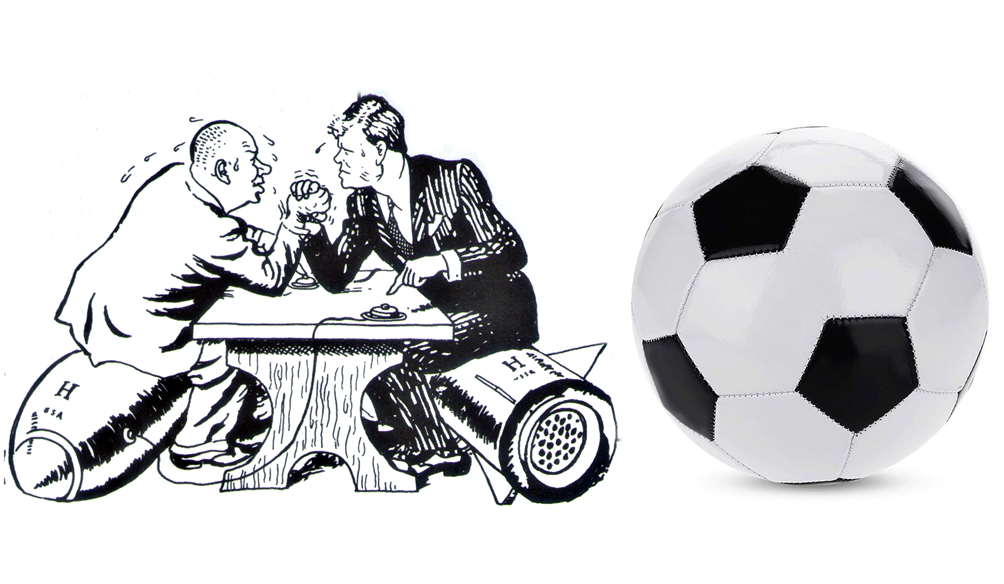
America might have invented baseball, but Cubans love it more than we do. Baseball used to be America’s national pastime, but it has been displaced by other sports for some time now. In Cuba, beisbol became a national pastime way back in the nineteenth century, and remained so ever since. Unlike much of the rest of Latin America, the Cubans never really got into soccer. Apparently, the love of beisbol did not leave much space in Cuban hearts for futbol. As seen below, that played a key role in the Cuban Missile Crisis and its aftermath.
The Significance of Baseball in Cuba

Fidel Castro might not have liked the yanquis, but he and his countrymen were madly in love with the yanqui sport of beisbol. Cubans’ passion for that imported game – and their relative disinterest in soccer – played a significant role in a chain of events that led up to the 1962 Cuban Missile Crisis, the closest humanity ever came to nuclear Armageddon. Cuba’s association with baseball and disassociation from soccer impacted more than the 1962 crisis. It played a role in other instances in later years that threatened to turn the Cold War hot.
In the spring of 1961, shortly after President John F. Kennedy made it to the White House, he gave the go-ahead for the Bay of Pigs Invasion. The attempt to overthrow Castro’s regime ended in failure and a humiliating fiasco that left JFK wary of any further entanglements in Cuba. That changed in September, 1962, when a CIA photo analyst noticed soccer fields popping up in Cuba. Cubans did not commonly play soccer. But do you know who plays soccer? Russians.
The Role of Soccer in the Cuban Missile Crisis

The presence of soccer fields in Cuba was a tell-tale sign that there were Russians there. CIA analysts deduced that the soccer fields indicated the presence of Soviet military camps nearby. Between that and other intelligence, JFK authorized U2 spy planes to fly over Cuba and gather proof. The aerial reconnaissance photos they brought back confirmed more than just a significant Soviet presence in Cuba. They also revealed the presence of Soviet missiles that could reach much of the continental United States, including Washington, DC, within a few minutes.
The result was the 1962 Cuban Missile Crisis. The Cold War superpowers came eyeball to eyeball over the Soviet missiles in Cuba, fingers hovering above nuclear triggers, until the Soviets blinked first. To get out of a potential nuclear Armageddon, President Kennedy and Soviet premier Nikita Khrushchev struck a deal. The Soviets agreed to remove their missiles from Cuba, and in exchange the United States agreed to not invade the island. Things then calmed down in Caribbean for eight years, until soccer and Cuba helped trigger another crisis.
“Cubans Play Baseball. Russians Play Soccer”

In 1970, Cuba began to expand its naval facilities in Cayo Alcatraz, an island in the port of Cienfuegos. American intelligence gatherers noticed the expansion at the same time that they detected a flotilla of Soviet nuclear missile submarines headed towards Cuba. That September, an excited Henry Kissinger, President Nixon’s National Security Advisor, burst into the office of H. R. Haldeman, the president’s chief of staff, clutching photos that showed the Cuban naval expansion at Cienfuegos, and the soccer fields nearby. He slapped them down on Haldeman’s desk and exclaimed: “Those soccer fields mean war, Bob. … Cubans play baseball. Russians play soccer”.
All of a sudden, after years of relative calm in the Caribbean, things threatened to escalate into a Second Cuban Missile Crisis. Evidence that Cayo Alcatraz was being developed as a Soviet base was based not only on what the reconnaissance images revealed, but also on what they did not show. The new facilities included a soccer field, plus tennis, volleyball, and basketball courts – sports that Cubans did not commonly play, but that the Soviets did. The biggest giveaway was the absence of facilities for the one sport that Cubans were passionate about: there were no baseball diamonds.
Soccer Fields Prevented the Soviets From Setting Up a Naval Base in Cuba
The CIA backed that assessment, and in a congressional briefing, the agency’s Director Richard Helms told the legislators: “clinching the case that all this was for Soviet — not Cuban — use, there are sports facilities for soccer, tennis and volleyball only, and we have yet to see a major Cuban military installation that does not provide for ‘beisbol’”. Under US pressure, the Soviets were forced to back down, the crisis fizzled, and the Cubans left the Cayo Alcatraz naval base unfinished.

_________________
Some Sources & Further Reading
Haldeman, H. R. – The Ends of Power (1978)
History Halls – Alfred Redl, the Spy Catcher Who Turned Out to Be a Spy

