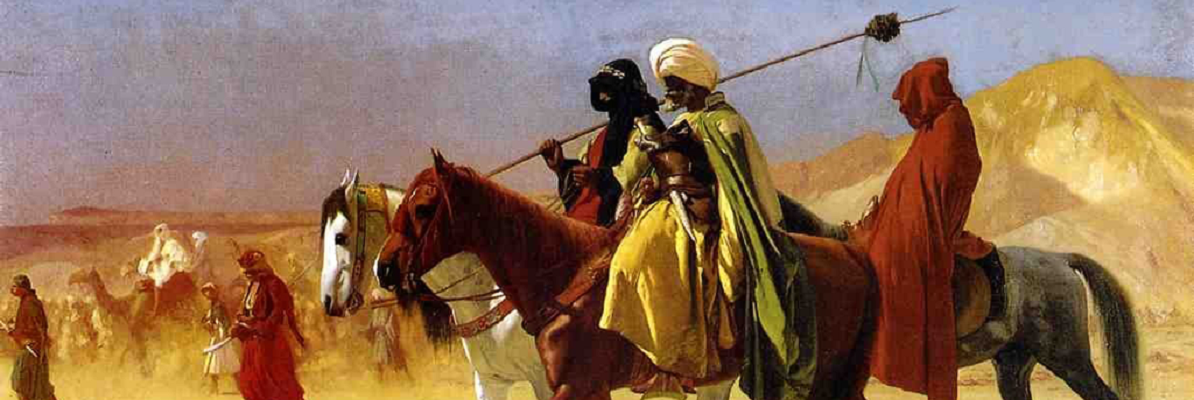
Al Qaeda and like-minded modern Islamic terrorists trace their philosophical origins back to medieval extremists known as the Khawarij. Anglicized as Kharijites, they emerged during a bitter succession dispute that followed the death of the Prophet Muhammad. Below are some interesting facts about those medieval terrorists.
Early Islam’s Succession Crisis

After the Prophet Muhammad died, the question of succession led to heated debate that eventually ended in bloody civil strife. One faction claimed that leadership of the Muslim community should be confined to Muhammad’s family and bloodline. Another reasoned that the leadership should be open to whomever the Muslim community chose to lead. The former, a minority, coalesced around Muhammad’s cousin and son in law Ali. They became known as the Shiites, or faction, of Ali. The latter, the majority, became known as the Sunnis.
Muslims elected the first three caliphs, or successors of the Prophet, from outside Muhammad’s family, and bypassed Ali each time. The fourth time around, after the third caliph was murdered, Ali was finally elected. However, the slain caliph’s family accused Ali involvement in his predecessor’s murder. So they engineered the election of a different caliph, Mu’awiya. The rivals went to war, but before the issue was settled in battle, Ali agreed to arbitrate the dispute. Those who became the Khawarij, a word that means “Outsiders” in Arabic, opposed arbitration. Until then, they had supported Ali, but once he agreed to arbitrate the dispute, they turned on him.
The Birth of Islam’s First Radical Extremists

The Khawarij viewed the Caliphate as the collective property of the Muslim community as a whole. They argued that Ali had no authority to make any decision about who gets to be caliph. The sole legitimate means for a caliph to become caliph was through election by the Muslim community, reasoned the Khawarij, and the Muslim community had already elected Ali. When he accepted arbitration to decide who would be caliph, Ali had acted beyond his authority, and tried to make a decision that was not his to make.
Ali ignored the Khawarij, and went ahead with the arbitration. In hindsight, he probably wished that he had not: it turned into a fiasco and backfired on him. It did not settle the dispute or produce any result other than to weaken him politically. The Khawarij soured on Ali, whom they now viewed as much of a usurper as his rival. So they decided to get rid of both, and hatched an assassination plot to kill the Caliphs on the same day during Friday prayers. The assassins sent after Ali got their man, but those who went after his rival Mu’awiya only wounded him. He survived, and by default became sole caliph.
Early Islam’s Medieval Terrorists

The Khawarij rose in rebellion against Mu’awiya, the caliph whom they had failed to assassinate. He was now Islam’s sole ruler thanks to a helping hand from the Khawarij’s botched assassination plot that had killed his rival, Ali, but left him alive. They contended that he was illegitimate because he gained the caliphate by force of arms, rather than election by the Muslim community. Their democratic and egalitarian principles might have been commendable, but they were more than counterbalanced by a fierce fanaticism that turned off to many.
The Khawarij were fundamentalist extremists, who reserved to themselves the right to decide who was or was not a good Muslim – or even a Muslim at all. They argued that any of plethora of sins, such as drinking alcohol, fornication, missing the daily prayers, failure to fast on the holy month of Ramadan, or even idle gossip, rendered the sinner an apostate who deserved death. The Khawarij launched a program of terror not only against Caliph Mu’awiya’s supporters, but also against Muslims who did not meet their purity standards. As the struggle intensified, they grew in viciousness, and eventually came to see even neutral Muslims as enemies.
A War Against All

As a theological and philosophical justification for their actions, the Khawarij developed an ideology in which a concept now known as takfir, loosely translated as “making infidels”, featured prominently. Takfir basically boiled down to the Khawarij reasoning that Muslims who committed any of a number sins ceased to be Muslims, and as such were deemed to have become apostates and kafirs, or infidels. That meant they were no longer protected by the religious prohibitions against shedding the blood of other Muslims.
It goes without saying that the Khawarij reserved to themselves the right to define just what is and is not a sin, and to decide which sinful acts transformed other Muslims into apostates and infidels. Unsurprisingly, it did not take long before “sinful” became synonymous with “disagrees with us”. As the Khawarij saw it, Muslims who failed to support them despite the glaringly obvious (in Khawarij eyes) righteousness of their cause proved their apostasy by such failure. That made them kafirs and not fellow Muslims whose blood the Khawarij were prohibited from shedding.
The Medieval Terrorists Who Created Al Qaeda’s Philosophical Foundations

The takfir concepts developed by the Khawarij in the Middle Ages provide the theological and philosophical foundations for modern terrorists such as Al Qaeda, ISIS, and their ilk. To enforce their vision, the Khawarij engaged in a campaign of widespread terror, in which atrocities abounded. That ranged from torture to the massacre of entire villages and towns. That was not extreme enough for some Khawarij. An even more radical faction splintered off to form the Azariqah sect in southern Iraq, which separated themselves from the entire Muslim community.
The Azariqah declared death on all sinners. They defined “sinners” whose sin made them apostates as all who did not share the Azariqah’s puritanical beliefs, along with their families. Their rebellion was eventually crushed, but embers remained. The Khawarij and the factions that splintered off from them became the anarchists of Islam’s first centuries, an ever present irritant and menace. They rejected the authority of the caliphate, and waged a campaign of terror and assassinations. That was combined with a low level insurgency in backcountry regions that flared up every generation or two into major rebellions that required considerable expense and effort to defeat.

_________________
Some Sources & Further Reading
Ayoub, Mahmoud – The Crisis of Muslim History: Religion and Politics in Early Islam (2005)
Crone, Patricia – God’s Rule: Government and Islam (2004)
History Halls – The Ancient Sicarii Sect: History’s First Identifiable Terrorists
Past & Present Society No. 167 (May, 2000) – Ninth-Century Muslim Anarchists

