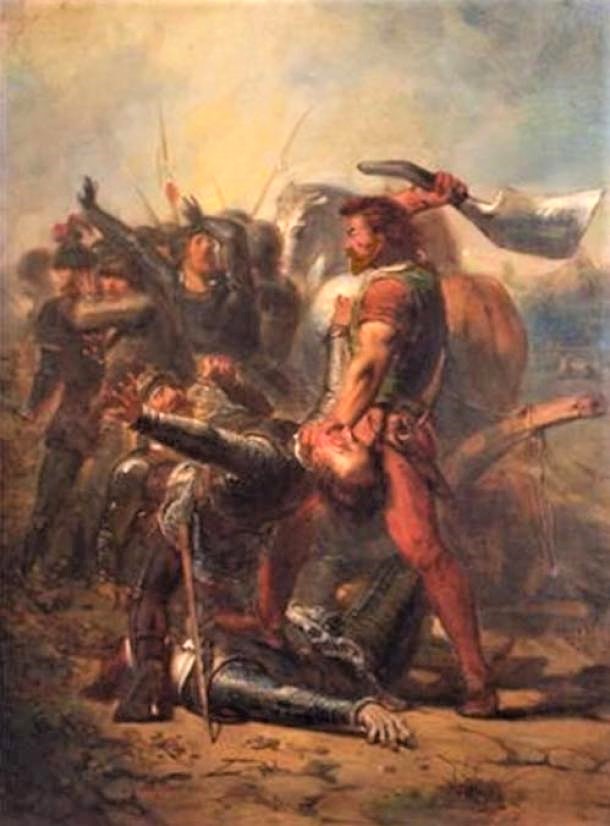
Frisian folk hero Pier Gerlofs Donia (circa 1480 – 1520) occupies a fascinating place in Dutch and Frisian history. A giant of a man who reportedly stood seven feet tall, he is better remembered by his popular nickname Grutte Pier (“Big Pier” in Frisian). Donia became a symbol of Frisian and Dutch resistance against foreign oppression in the early sixteenth century. Accounts of his life blend history and legend, and he became a champion for his people whose deeds have been recounted for centuries.
The Turbulent Politics of Friesland

Donia was born around 1480 in Kimswerd, a village in Friesland, now a northern province of today’s Netherlands. He belonged to a relatively prosperous of farmers who although not aristocratic, were sufficiently well off to own their own land. He married Rintsje Sytsma, and the couple lived a relatively peaceful life as farmers before Donia was drawn into the turbulent conflicts that beset Friesland in those days. At the time, Donia’s homeland was caught in a struggle between local factions and foreign powers.
Friesland had a long tradition of independence and self-rule, but in the late fifteenth and early sixteenth centuries, outside forces, most notably the Saxons and the Habsburgs, sought to exert control. External pressures combined with internal rivalries between rival Frisian aristocratic factions, the Vetkopers and Schieringers, to create instability. Donia, like many ordinary Frisian farmers, was initially not directly involved in politics. His transformation into a rebel leader came only after tragedy struck his family in 1515, a pivotal event that changed Donia’s life forever.
The Tragedy That Created an Avenger

In 1515, Landsknecht mercenaries – German soldiers in the service of Duke George of Saxony, who claimed authority over Friesland – raided Donia’s village of Kimswerd. They plundered his farm, had their way with his wife then murdered her, and destroyed much of what he owned. Devastated and understandably outraged, Donia was transformed from farmer to implacable avenger. Motivated by personal loss and the broader injustice faced by his fellow Frisians, he gathered a band of rebels to fight against Saxon and Habsburg forces.
Donia’s imposing physical presence and charismatic leadership drew men to his cause. Soon, he became the leader of the so-called Arumer Zwarte Hoop (“Black Band of Arum”), a guerrilla force composed mainly of dispossessed peasants and fellow Frisian freedom fighters. Grutte Pier’s reputation as a fearsome warrior quickly grew. He and his band targeted enemy garrisons, mercenaries, and especially soldiers and sympathizers of Saxony. They also turned their attention to the waterways, where Donia’s skills as a sailor and leader came to the fore.
The Rise of a Rebel Leader

Donia became infamous as a pirate on the Zuiderzee, a large inland sea in the Netherlands. At the head of a mostly Frisian fleet, he captured ships that belonged to Hollanders – supporters of Habsburg authority. He reportedly forced captured sailors to prove their Frisian identity by making them recite a shibboleth: “Bûter, brea, en griene tsiis: wa’t dat net sizze kin, is gjin oprjochte Fries” (“Butter, bread, and green cheese—whoever cannot say that is not a true Frisian”). Those unable to pronounce the phrase correctly were executed, often by drowning.
Although the historical accuracy of that account is debated, it illustrates how Donia became a symbol of fierce Frisian nationalism. Grutte Pier also won several notable victories on land. In 1517, he and his followers captured the city of Medemblik in North Holland, and put significant parts of it to the troch in retaliation for attacks on Frisian villages. Though he achieved some successes, his campaign was largely one of raids and reprisals rather than a sustained war of liberation.
A Giant With a Gigantic Reputation

Contemporary accounts emphasize Donia’s extraordinary size and strength. Chroniclers describe him as nearly seven feet tall, and strong enough to wield a massive two-handed sword that, like its gigantic owner, measured nearly seven feet from tip to hilt, and weighs 14.6 pounds, or 6.6 kilograms. This sword survives today and is displayed at the Fries Museum in Leeuwarden, where it stands as one of the most tangible reminders of his legendary stature. The angry giant was reportedly able to behead multiple men at once with his gigantic sword. He slaughtered many enemies in numerous battles, and made it a habit to personally execute those he captured. After one naval victory in which captured 28 enemy ships, he killed every single captive either by beheading them or tossing them overboard to drown.
Grutte Pier’s reputation spread not only because of his military actions but also because he embodied a kind of Robin Hood–like figure: a farmer-turned-avenger, who fought against powerful overlords and defended local freedoms. Whether Donia truly performed all the feats attributed to him is unclear, but his myth grew rapidly after his death. In real life, unlike the purely heroic depictions of later folklore, historical sources indicate that his piracy and raids were often brutal and destructive, and impacted innocent people as well as his intended enemies.
Grutte Pier’s Lasting Legacy

By around 1519, Donia’s health began to decline. Tired and reportedly ill, he retired from active leadership of the rebel movement and handed over command of the Arumer Zwarte Hoop to fellow Frisian rebel leader Wijerd Jelckama. Without Donia’s charisma and prowess, however, the movement weakened. Jelckama lacked Grutte Pier’s ability to inspire loyalty, and within a few years the rebellion collapsed under Habsburg pressure. He passed away peacefully in 1520, in his hometown of Sneek. Despite his violent life, he was buried with honor in the Martinikerk (St. Martin’s Church) in Sneek, where his grave can still be visited.
In the centuries after his death, Donia was transformed into a larger-than-life folk hero in Frisian culture. Songs, tales, and poems celebrated his immense size, strength, and fierce resistance against foreign domination. Donia came to symbolize the Frisian struggle for independence and identity. He became a cultural emblem of defiance against larger powers. Modern historians approach Donia more cautiously, and recognize both the mythology and realities of his life. He was indeed a formidable leader and pirate. He was also a man driven by personal vendetta and shaped by his era’s violent politics. Still, his sword, his legendary phrase, and his dramatic story ensure that his memory endures.
Pier Gerolf Donia’s Legacy
Pier Gerlofs Donia – Grutte Pier – was not simply a warrior but a symbol. His transformation from farmer to rebel captain epitomized the turbulence of early sixteenth century Friesland. It was a land caught between local independence and submission to greater foreign powers. Though his rebellion ultimately failed, his legend grew far larger than his brief career. Today, he remains a towering figure in Frisian history: a giant in both stature and story. He is remembered as a folk hero who fought for freedom in a world of mercenaries and monarchs.

_________________
Some Sources & Further Reading
Ancient Origins – Pier Gerlofs Donia: The Giant Frisian Rebel, Warrior, and Pirate
History Halls – The Paratrooper Who Led His Men Into Battle Carrying an Umbrella
Sicking – Neptune and the Netherlands: State, Economy, and War at Sea in the Renaissance (2004)

