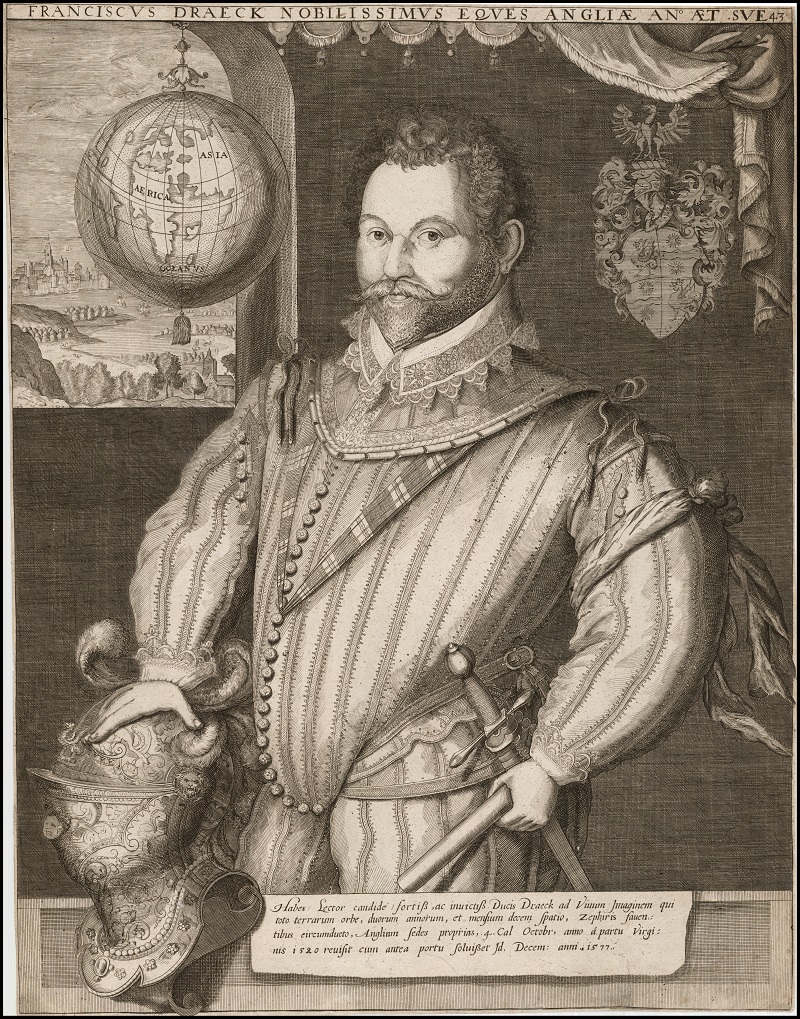
Francis Drake was the greatest of Queen Elizabeth I’s “Sea Dogs” – explorers and privateers authorized by the queen to raid her enemies. He was also her favorite pirate, and for good reason. The Virgin Queen invested in English pirates like modern venture capitalists invest in startups, and she made out like a bandit from the returns on Drake’s high seas hijinks and predations. Below are some interesting facts about this fascinating Elizabethan Sea Dog.
An Early Start as a Seafarer

Sir Francis Drake (circa 1540 – 1596) led one of history’s most adventurous seafaring careers. He preyed upon Spanish ships and coastal settlements, and became the greatest pirate of his day. Drake also became the second man to circumnavigate the globe after Magellan’s expedition. In the process, he combined exploration with opportunistic plunder. He further cemented his place in history when he played an instrumental role in defeating the Spanish Armada in 1588.
Drake got started on his seafaring career at an early age. As a teenager, he was enlisted by his relatives the Hawkinses, privateers who preyed upon French coastal shipping. By the 1560s, Drake had risen to command his own ship and entered the slave trade. He grew rich smuggling shackled captives illegally into Spain’s New World possessions. In one such voyage, Drake was cornered by Spanish authorities. He narrowly escaped, with heavy loss of life among his crew. To the Spaniards’ misfortune, that experience left Drake with a lifelong hatred of Spain.
Drake’s Circumnavigation of the World

Drake received a letter of marque and reprisal – a governmental license for private individuals to attack a country’s enemies – from Queen Elizabeth in 1572 that authorized him to plunder Spanish property. With that license in hand, he raided Panama. However, he was wounded and forced to retreat. When he recovered, he raided Spanish settlements around the Caribbean. He returned to England in 1573 with a rich haul of gold and silver. In 1577, he led an expedition of five ships to raid the Pacific coast of Spanish South America, undefended in those days.
Drake braved storms to pass through the Straits of Magellan in his flagship, the Golden Hinde. He then sailed up the coasts of Chile and Peru. Near Lima, he captured a Spanish ship that yielded 25,000 gold coins. Soon thereafter, he captured a fabulously rich prize, the Cacafuego. A Manila galleon, it yielded a treasure of eighty pounds of gold, thirteen chests of coins, and twenty six tons of silver. With his holds full of loot, Drake crossed the Pacific, sailed the Indian Ocean, and rounded the tip of Africa on his way back home.
Becoming Sir Francis Drake

Drake made it back to England on September 26th, 1580. There, he was knighted by Queen Elizabeth aboard the Golden Hinde. Henceforth, he became Sir Francis Drake. In addition to the riches he brought back home, Drake had enhanced English seafaring by having circumnavigated the world during the course of his expedition. He was the first pirate to do so, and only the second captain to have ever accomplished that feat since Ferdinand Magellan’s expedition, over half a century earlier.
In 1585, Drake was put in charge of a fleet that harried Spanish shipping, captured Santiago in the Cape Verde Islands, and plundered Spanish settlements in Florida and Hispaniola. In 1587, with King Philip II of Spain threatening to invade England, Drake led daring preemptive raids against Spanish fleets assembling in Cadiz and Coruna for the invasion. He inflicted significant damage, which prevented the Spaniards from sailing that year. As contemporaries described it, Drake had “Singed the King of Spain’s Beard”.
The Blurry Line Between Pirate and Privateer

In 1588, the combined Spanish fleet, the famous Armada, finally set sail to invade England. Drake played a key role in its dispersal and eventual destruction. Particularly on the night of July 29th, 1588, when he organized fire ships that were sent against the Spanish ships assembled in Calais, forcing them out of that port and into the open sea. There, the Armada was scattered by a combination of English warships and bad weather. Drake’s eventful life finally came to an end in 1596. After a series of failed raids and attacks against Spanish America, he caught dysentery while anchored off Portobelo, in Panama, and died.
Sir Francis Drake’s career, with its turns from soldier and sailor to outright pirate, illustrates the Elizabethan era’s murky lines between outright piracy and legalized piracy, also known as privateering. In the years to come, the difference between a pirate liable for the hangman’s noose, and a privateer likely to receive official acclaim and adulation, was no more than a piece of paper. Those like Drake who plundered the seas while wielding letters of marque were lionized, while those who did the same without such a fig leaf of legality were hanged as pirates.

_________________
Some Sources & Further Reading
Botting, Douglas – The Pirates (1978)
History Halls – French Buccaneer Montbars ‘The Exterminator’ Earned His Nickname, and Then Some
Kelsey, Harry – Sir Francis Drake, the Queen’s Pirate (1998)
Lane, Kris E. – Pillaging the Empire: Piracy in the Americas, 1500-1750 (1998)

