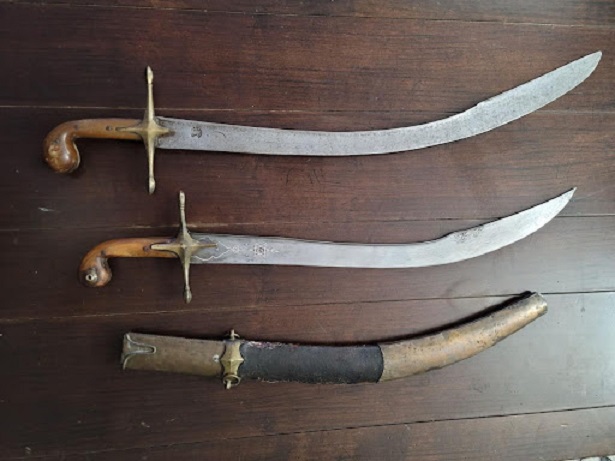
Few swords are as aptly named as the kilij, derived from a Turkic verb that means “to kill”. Below are some interesting facts about that lethal sword.
The Aptly Named Kilij

The kilij was the traditional scimitar of the Turks and related cultures. It was wielded by the Seljuks, the Timurids of Tamerlane, the Mamluks, and the Ottomans. The kilij was also used by warriors of various Turkic states that rose and fell in the Eurasian Steppe. The kilij is a single-edged sword intended for one-handed use. It belongs to the family of curved swords that include the South Asian tulwar, the Afghan pulwar, and the Persian shamshir. All trace their origins to Turkic nomads who roamed the Central Asian Steppe. The design was first used by warriors of the nomadic Xiongnu Empire in the third century BC.
There was a key design difference that set the kilij apart from other Turkic curved swords. It had extra metal added to the final foot or so of the blade. That gave the kilij more mass and weight toward the front. The additional weight near the tip shifted the center of gravity towards the front edge. That gave the kilij’s blade greater momentum, and thus greater hacking and chopping power, at the point of likely impact. That made the kilij the best cutting sword in history. It was better even than the katana at chopping things, as can be seen on various online videos, including one from a Deadliest Warrior episode in which a kilij cutting the carcass of a full grown hog in half in a single swing.
The Influential Sword of the Turks

Curved swords of Turkic origin were used in all lands conquered or influenced by Turkic peoples. Even when the Turks left or their influence waned, their blade design continued to influence the evolution of swords in those places. The kilij was a mean sounding and mean looking sword, that conjured images of mean people using them to do mean things. Famous kilij users include the Transylvanian ruler Vlad III, better known as Vlad the Impaler – the real life figure who gave rise to the fictional Dracula. All in all, the kilij was not a sword that inspired warm and fuzzy feelings.
As with all sword designs, there were tradeoffs, and the kilij’s devastating cutting power came at a price. It was an excellent sword for use from horseback to deliver downward strokes on infantry, and was optimized for power and effective cutting. However, it was not an agile sword if used in other types of combat than that for which it was designed. The kilij was not good for one-on-one duels, especially if an opponent was armed with a lighter sword. An unhorsed kilij wielder who found himself in such a situation would be in serious trouble if his adversary was competent and knew what he was doing.

_________________
Some Sources & Further Reading
History Halls – Swords Across the Millennia and From Around the World
Interesting Swords – The Kilij and Shamshir: Turkish and Persian Sabers

