In 1835, astronomy was in the air in America. There was excitement about the expected return of Haley’s Comet that fall. People were interested in an expected transit of Mercury, in an era when astrology was more popular than today. Famous astronomer Sir John Herschel was mounting an expedition to map the stars of the Southern Hemisphere. The Reverend Thomas Dick, a popular author, was making novel claims about life in other worlds. It was against that backdrop that news arrived of the discovery of life on the Moon. America’s mild excitement in astronomy was suddenly ramped up into a frenzy.
1835’s Most Exciting Discovery

Excitement swept the United States in the summer of 1835 when a New York newspaper, The Sun, announced that life and civilization had just been discovered on the Moon. It ran a series of six articles, the first of which was published on August 25th. The newspaper described a discovery of Sir John Frederick William Herschel, the world’s most famous astronomer. He had used a powerful telescope to get a clear glimpse of the Moon’s surface. What he saw astonished him, and threatened to upend the entire corpus of human knowledge.
Even before his discovery of life on the Moon, Herschel’s accomplishments had been nothing short of amazing. As described in The Sun, he had: “By means of a telescope of immense dimensions and an entirely new principle”, discovered the existence of planets in other solar system. In addition, Herschel came up with new and revolutionary theories that promised to forever change astronomy. He had also “solved or corrected nearly every problem of mathematical astronomy”. More important than all of that, the famous astronomer’s telescope revealed that the Moon teemed with life.
The Discovery of Life on the Moon

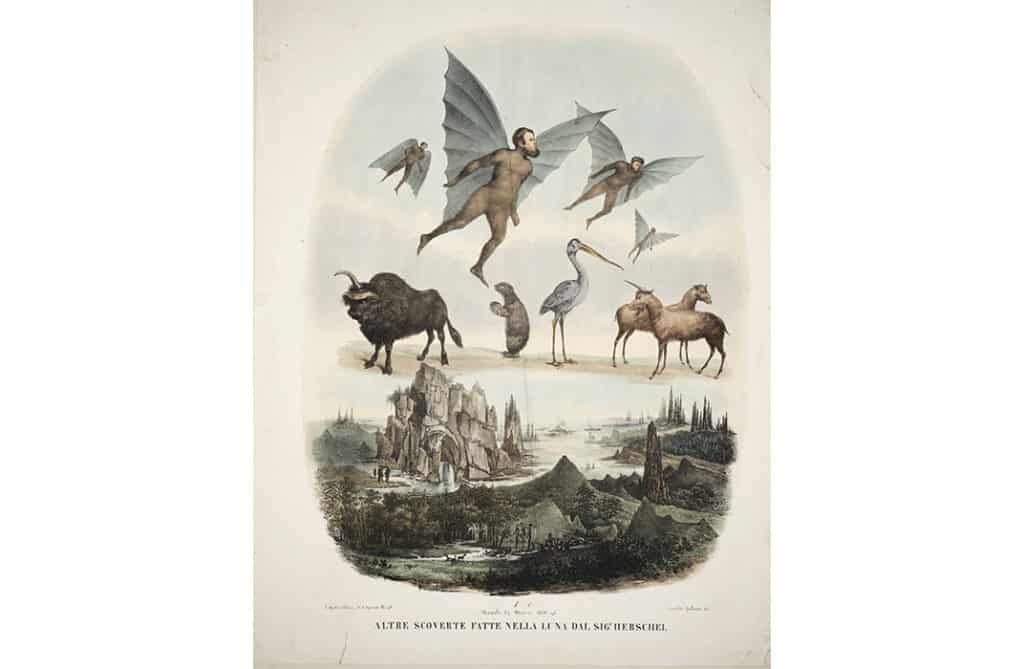
With his telescope from an observatory in the Cape of Good Hope, Herschel saw that the Moon had oceans, rivers, and trees. Numerous animals roamed its surface, including goats, buffalos, walking beavers, and unicorns. Flying above them all were human-like creatures with bat wings who built houses and temples. In a 17,000 word article reprinted from The Edinburgh Journal of Science and published in six installments, The Sun informed its readers that the famous astronomer had travelled to the Cape in 1834 to catalog the stars of the Southern Hemisphere.
Herschel discovered far more than stars when he turned his powerful telescope to the Moon. When he focused the image, he detected hints of vegetation. As he brought the image into sharper focus, he saw a body of water, a beach, and a string of pyramids. As the focus was adjusted for even sharper detail, herds of bison-like animals were seen, and blue goats that looked like unicorns. The third article announced the discovery of more lunar creatures, such as beavers that walked upright. It was the fourth installment, however, that contained the most shocking news of all. Herschel had discovered hominids on the Moon. They stood about four feet tall, and flew with bat-like wings.
Intelligent Life on the Moon

Herschel reportedly said of the lunar hominids: “We scientifically denominated them as Vespertilio-homo, or man bat; and they are doubtless innocent and happy creatures”. What had already been great and steadily mounting excitement until then, suddenly exploded into a fevered frenzy. That was when The Sun’s editors discovered that they had greatly underestimated the public’s gullibility. The articles had been intended as satire, which the authors thought was obvious. Instead, they were accepted as gospel truth. To get out of the jam into which they had written themselves, the authors wound down the story with the news that Herschel’s telescope was accidentally destroyed. It had been left exposed to the Sun, whose rays caused its lens to act as a burning glass. That started a fire, which burned down the telescope and the observatory.
Needless to say, Sir John Herschel had never announced any of the discoveries attributed to him, nor had he made any of the lunar observations published in The Sun. Of course, we now know that there is no life on the Moon. Before we dismiss 1835 Americans as gullible dupes, though, it should be pointed out that unlike us, they did not have the evidence and benefit of multiple NASA Moon missions. So it was not unreasonable for many back then to think that it just might be possible that there was life up there on the Moon.

_________________
Some Sources & Further Reading
History Halls – The Cardiff Giant Hoax
Smithsonian Magazine, July 2nd, 2015 – The Great Moon Hoax Was Simply a Sign of Its Time

