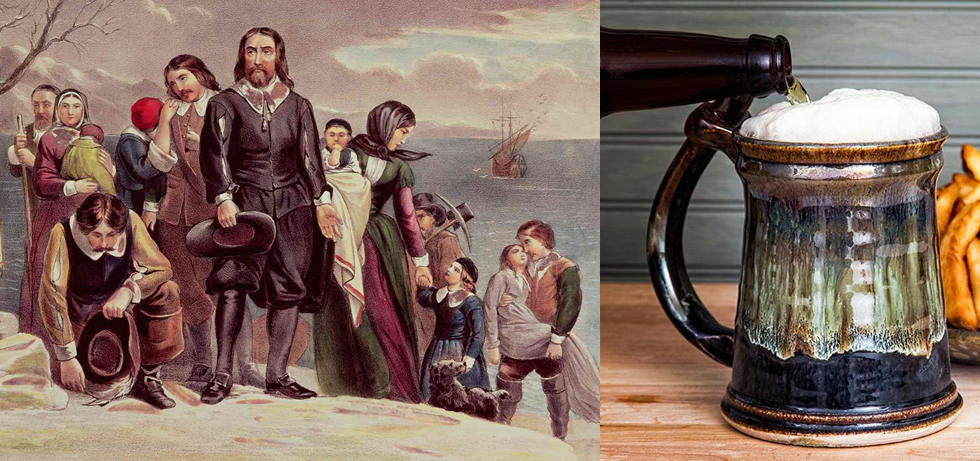
Running out of beer can wreck a party. However, running out of beer has seldom led to consequences as great as what happened in the summer of 1620, when the Pilgrims aboard the Mayflower ran low on beer. Their intended destination when they left England was Virginia. They ended up in Massachusetts instead because they were running low on beer. That might seem like a trivial reason for such an important decision. Back then, however, beer was a serious matter. Below are some interesting facts about the role of beer in the decision to land the Pilgrims on Plymouth Rock.
The Massachusetts Pilgrims Initially Set Sail for Virginia

As every American schoolchild is taught, the Pilgrims crossed the Atlantic Ocean to the New World in the Mayflower. They landed at Plymouth Rock, and established Plymouth as a settlement, about forty miles south of modern Boston. However, Plymouth, at roughly 42° latitude N, had not been the Pilgrims’ intended destination. When they left England, they had aimed for a spot hundreds of miles down the eastern seaboard in the Virginia Colony, at roughly 40° latitude N. They encountered many setbacks, though.
The Pilgrims had planned to sail from England in July, 1620. However, most of them were living in Leiden, in the Netherlands, at the time. So the plan was for a sister ship, the Speedwell, to sail from England to the Netherlands, pick up the passengers, return to Southampton, join the Mayflower, and then the two ships would sail together in convoy to Virginia. As seen below, a combination of the weather’s vagaries, the hardships of crossing an ocean in a seventeenth century ship, and running low on beer led them to change their minds about where to settle.
A Rough Voyage

On August 5th, 1620, the Mayflower and the Speedwell sailed from England to the New World. However, the Mayflower’s sister ship was unfortunately named, and was neither speedy nor well. The Speedwell sprang a leak, so the Pilgrims docked in Dartmouth for repairs. They set out again on August 21st, but after a few days at sea, the Speedwell started leaking again. The voyage’s leaders concluded that the Speedwell was simply not up to crossing the Atlantic. So they decided to ditch her in England, and sail to the New World in the Mayflower. After supplies were transferred from the Speedwell, the Mayflower finally set out on September 6th — more than a month behind schedule. The voyage proceeded smoothly at first. That changed, as the ship encountered bad weather and worse storms during the second half of the trip.
The Pilgrims had hoped the voyage would take a month. However, it was not until November 9th, 1620, sixty six day after they left England, that they finally spotted land at today’s Cape Cod. They were about two hundred and fifty miles north of their original aiming point. All else being equal, they would have simply continued to sail down the coast until they reached their intended destination. All else was not equal, however, and the Pilgrims faced a serious problem: they were low on beer. In those days, drinking water aboard ship was liable to go bad, especially on long voyages. Sea voyagers relied on beer because it would not spoil. So running out of the brewed stuff was a big deal.
The Far-Reaching Consequences of Running Low on Beer

When the Mayflower set sail, a gallon of beer per day had been rationed per each person aboard ship. However, the voyage took twice as long as had been hoped for. That screwed up the calculations. The ship’s captain was worried because he still had to sail back to England after dropping off his passengers. For that, he would need a certain quantity of beer for the crew. Seen from that perspective, the Pilgrims’ making of a momentous decision because of beer makes sense. When the Pilgrims set sail, their initial destination had been a Virginia Colony island teeming with wildlife and natural resources. The site had a huge natural harbor, and a navigable river that led deep into the interior. At the time, the Virginia Colony’s borders were not the same as those of today’s Virginia.
Back then, the Virginia Colony’s northern boundary was about 225 miles farther north than Virginia’s current border. The island where the Pilgrims had intended to establish their colony is today called Manhattan. Lack of beer led them to explore the coastline of Cape Cod and the nearby mainland region, until they finally decided upon a site. On Christmas Day, 1620, the Pilgrims founded Plymouth Plantation as their new colony – and the site where they would brew up a fresh batch of beer. If not for the Pilgrims’ running low on beer, we might be referring to them today as the Virginia or Manhattan Pilgrims, instead of the Massachusetts Pilgrims.

_________________
Some Sources & Further Reading
Argus Leader, November 16th, 2016 – Beer Played an Important Part in Pilgrim Life
Smithsonian Magazine, November 22nd, 2011 – The True Story Behind Plymouth Rock

