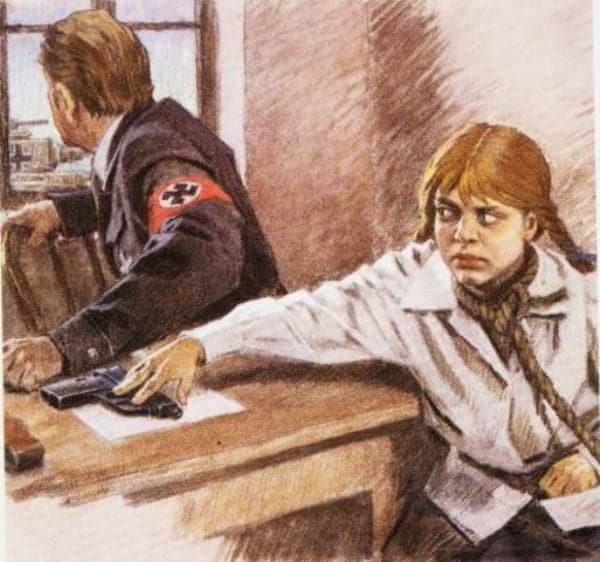
Teenaged Belorussian partisan Zinaida Portnovna became a Soviet national heroine for her fight – and ultimate sacrifice – against the Nazis in World War II. She became the youngest female recipient of a Hero of the Soviet Union award, the USSR’s highest distinction for heroic service to the country and society. Unfortunately, as seen below, it was a posthumous award.
A Teenage Girl’s Life Under Nazi Occupation

For Zinaida Martynovna Portnovna, as for most Soviet citizens, the sudden German invasion that thrust the USSR into the Second World War came as a shock. Born in Leningrad in 1926 to Belorussian parents, fifteen-year-old Zinaida was hundreds of miles away from home, at a summer camp near her grandparents’ home close to the Soviet-German border in Belorussia in June, 1941. When the Nazis invaded on June 22nd, German panzers rattled past Zinaida’s summer camp. She found herself cut off behind enemy lines.
Life under Nazi occupation was a series of daily terrors and insults. Zinaida became radicalized when a German soldier struck her grandmother while confiscating the family’s cow. She joined the underground Komsomol, the Communist Party’s youth division, and its resistance group, “The Young Avengers”. Zinaida gradually worked her way up the resistance rungs. At first, she distributed anti-German propaganda leaflets, collected and hid weapons for the partisans, began to spy on and report on enemy troop movements, and sabotaged enemy vehicles when the opportunity presented itself. When she demonstrated her steadfastness, she was allowed to take part in direct action and combat against the occupiers.
A Teenage Girl’s Heroism and Ultimate Sacrifice

The partisans taught Zinaida Portnova how to use weapons and explosives. She then began to participate in raids and sabotage operations against power plants, pumps, and a brick factory in the vicinity of Vitebsk, in which an estimated one hundred German soldiers were slain. In 1943, she got a job in a kitchen that served the German garrison of Obol, and poisoned the food. When suspicion fell upon her, Zinaida convinced the Nazis of her “innocence” by eating the food to demonstrate that it was not poisoned. When she did not exhibit immediate ill effects, she was released. She became violently ill soon thereafter, but survived.
Zinaida fled Obol, joined another partisan unit, and served as its scout. In late 1943, contact was lost with the Obol partisans, and since she was familiar with the city, Zinaida was infiltrated back in to investigate. She was captured almost immediately. During her interrogation, she grabbed a pistol her German interrogator had carelessly left atop his desk and shot him to death. She also shot and killed two guards who rushed in which they heard the gunfire. Zinaida escaped the building, but was eventually tracked down and recaptured. This time, there would be no escape. The Nazis tortured Zinaida, and executed her on January 15th, 1944. She was seventeen.

_________________
Some Sources & Further Reading
Sakaida, Henry – Heroines of the Soviet Union, 1941-45 (2012)

