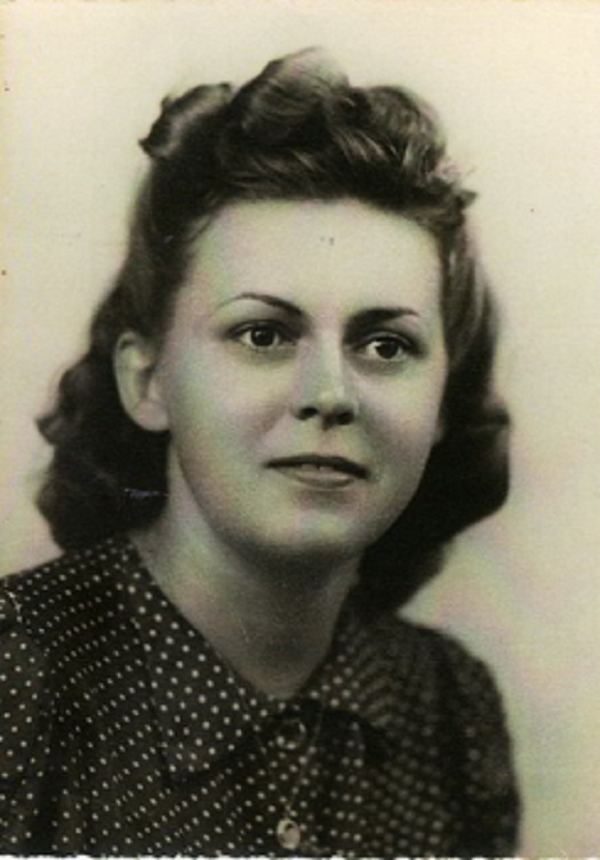
As D-Day, the Allied invasion of France in World War II, drew ever nearer, it became ever more urgent for the Allies to find out as much as possible about German military deployments in Normandy. Aerial reconnaissance provided some information, but nothing beats eyes on the ground to see what the enemy was up to. So the Allies mounted a hazardous operation to send specially trained spies into German-occupied France. Those courageous individuals risked their all – and quite often sacrificed their all – to uncover the information necessary for the liberation of France to succeed. Below are some interesting facts about that operation, and one of those agents, Evelyne Claire Clopet, who made the ultimate sacrifice to help beat the Nazis.
The Desperate Need for Information Before D-Day

Desperate for information about the details of Germany’s military presence in Normandy as D-Day approached, the Allies mounted Operation Sussex to spy on the Nazis before and after the 1944 Normandy landings. It was an ambitious joint venture of Britain’s Secret Intelligence Service (SIS), America’s Office of Strategic Services (OSS), and the Free French Bureau Central de Renseignements et d’Action (BCRA). 104 spies volunteered for the hazardous mission to infiltrate into occupied France, and report their on-the-ground observations about the Wehrmacht’s deployments.
Twenty two year old Evelyne Claire Clopet was among the volunteers. Born in Pornic, France, the daughter of a merchant marine captain, Clopet joined her parents in Morocco early in WWII. After the Allied Torch landings liberated French North Africa, she joined the Free French intelligence arm. Commissioned as a second lieutenant, Clopet spent a year on transmissions and communications duties in Algeria. When word arrived that the Allies desperately needed spies for hazardous duty in occupied France, she volunteered for Operation Sussex.
A Young Woman Parachuted Behind Enemy Lines

Flown to England in February, 1944, Clopet was taught lethal close combat skills, sabotage, the identification of enemy units, radio communications, how to send and decipher coded messages, and how to parachute from an airplane. After months of intensive training, she was finally ready for infiltration behind enemy lines. On the night of July 7-8, 1944, Clopet and her fellow spies were airdropped from a B-24 Liberator into Nazi-occupied France, a month after the D-Day landings.
By then, an Allied beachhead had been successfully established in Normandy. In the weeks since, however, things had not gone well. German resistance was fierce, helped in no small part by unfavorable bocage. Dense hedges that proliferated throughout Normandy they were a nightmare to fight through. As a result, the Allies found their hoped-for rapid breakout from the beaches reduced to a bloody crawl. Aerial reconnaissance of enemy positions helped, but much about enemy deployments remained hidden.

Internal Rivalries Delayed this Spy Mission for Weeks

Allied commanders desperately needed to know just where the Germans were, and what they were up to. For that, only human intelligence gathered on the ground by trained observers, such as Clopet and other Operation Sussex spies, would do. Unfortunately, the intelligence services of the Allies did not always get along with each other. As a result, frictions and rivalries delayed the launch of Operation Sussex for weeks.
Initial “Pathfinder” teams had been parachuted into occupied France in February, 1944, to establish local networks, and scout out suitable drop zones for more spies and supplies. Their task turned out to be tougher than anticipated. It took until April before the first Sussex teams were ready to report back with their observations. The operation’s start might have been messy, but by D-Day, things had smoothed out somewhat. Various teams of Sussex spies furnished Allied intelligence with a flood of useful information. As seen below, Operation Sussex proved vital for the success of the D-Day landing and the subsequent Allied breakout from Normandy.
The Spies Who Helped Annihilate One of Germany’s Most Powerful Panzer Divisions

Operation Sussex spies tracked the movements of the Panzer Lehr Division, one of Germany’s best and most powerful armored formations. Between air strikes called down from the skies and sabotage by Resistance operatives on the ground, the division was prevented from arriving in time to thwart the Allied landings on June 6th, 1944. Sussex spies continued to track the Panzer Lehr until late July, when it was virtually annihilated in Operation Cobra, the Allied breakout from Normandy.
As Bill Donovan, head of the OSS, put it: “As long as we had the Sussex teams ahead of us it was like we had a brightly lit path, but beyond it was like advancing into a dark tunnel”. It was a highly hazardous existence, however, with potential doom at any moment. Such was the fate of Evyelyne Clopet. After she parachuted into Nazi-held territory, her Sussex team set up an intelligence-gathering network in central France.
Beating the Nazis Came at a High Cost, Often Paid by the Likes of Clopet

Clopet and her team contacted Resistance agents, and connected them with Allied intelligence. By early August, information supplied by Sussex spies had helped the Allied break through German defenses, burst out of Normandy, and storm through France en route to eventual victory. Sadly, Clopet was not destined to see the final triumph. Her luck ran out on August 8th, 1944, exactly one month after she had parachuted into occupied France. Clopet and five other Sussex spies, disguised as laborers, were halted at a roadblock in a stolen German army truck. Discovered among their possessions were clandestine radio transmitters and equipment.
One of the Sussex agents jumped off the stolen truck and managed to escape amidst a hail of gunfire. Clopet and the others were captured, however. All were savagely interrogated by the Germans, tortured, and eventually shot. Martyred at age twenty two, Clopet’s name was inscribed in war memorials in Casablanca, Loir-et-Cher, and the Tempsford Memorial in Bedfordshire. A street in her hometown of Pornic is also named after her.

_________________
Some Sources & Further Reading
History Halls – Fighting Women: Queen Mawiyya of Arabia’s Revolt Shook the Roman Empire
Les Fussiles – Clopet Evelyne, Claire

