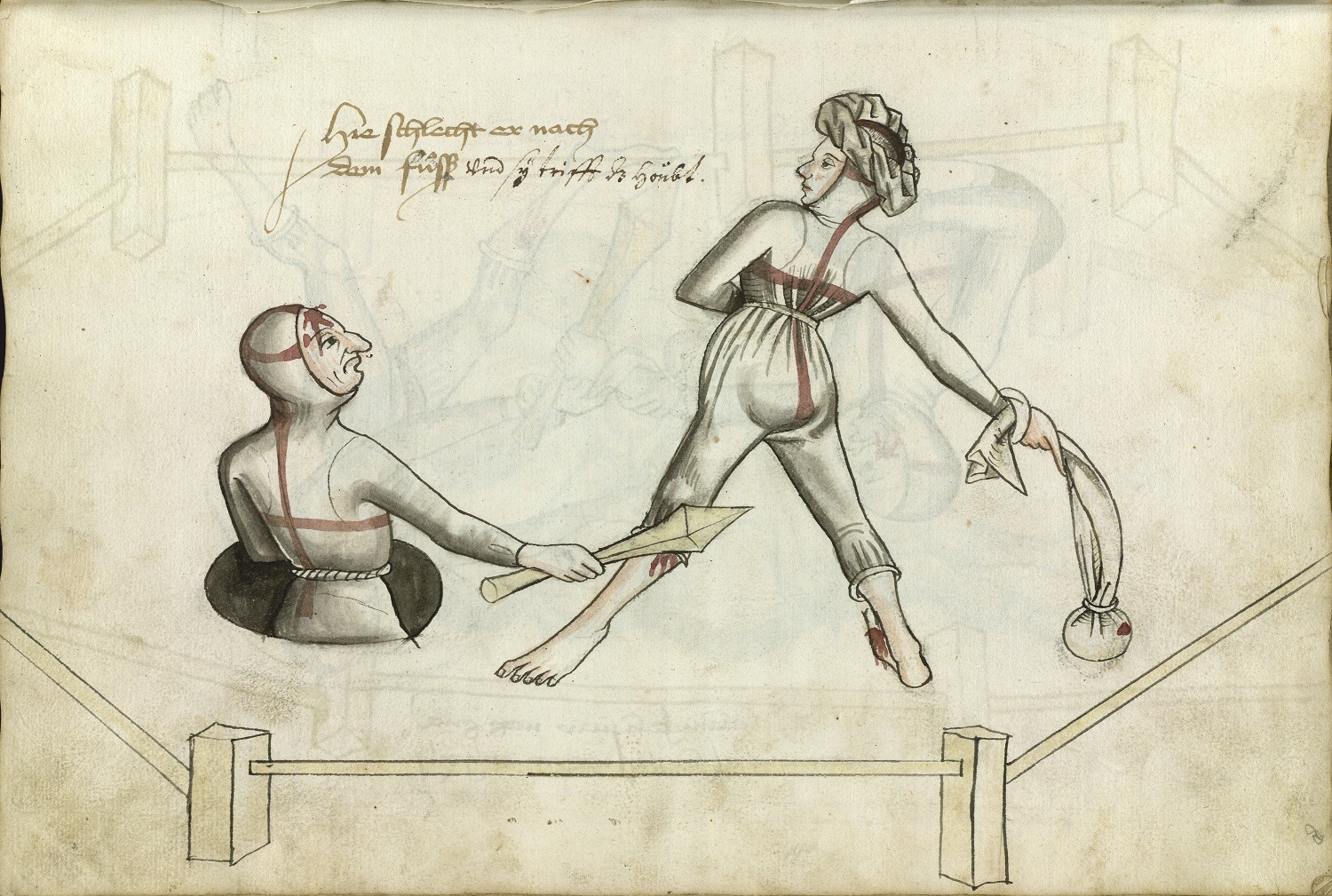
Divorce was not always as easy as it is today. Indeed, it was so hard to secure a divorce in medieval Europe that estranged couples sometimes had to fight divorce duels to get out of unhappy marriages.
Impotence vs Virility Were Key to Medieval Annulments

In centuries past, getting a divorce in Europe was so hard that even a King, Henry VIII, had to take his kingdom out of the Catholic Church, and form a new national church with himself at its head to secure a divorce. And he was a king. For common people, divorce was nearly impossible, and the only exit from an unhappy marriage was annulment or death. In France, to annul a marriage, a wife often had to allege that her hubby was unable to “perform”. For a husband to contest that, he would have to undergo an awkward public examination. In short, he had to demonstrate that he could get it up.
For a husband to contest a claim of impotence, he had to publicly prove that he could get an erection. The unfortunate man had to pull out his family jewels in a courtroom, in front of witnesses and legal experts, get hard enough to the satisfaction of “honest women” appointed by the authorities to check, and ejaculate. No pressure. If a husband did not want to prove his virility by “expel[ing] reproductive fluids on demand” in public, there was an alternative: challenge his wife to a divorce duel. Such contests were common enough that there was an entire chapter about divorce duel tactics in a popular medieval dueling manual.
Divorce Duels as Alternatives to Awkward Virility Examinations

German combat instructor and court adviser Hans Talhofer wrote about judicial duels in his 1467 Fechtbuch, or “Fencing Book”. It contains illustrations of the best tactics for couples fighting divorce duels. They were surprisingly fair, and there are numerous accounts of women who won. To make things fair, men were handicapped to balance out their natural size and strength physical advantages. A husband was armed with three clubs, but his mobility was restricted by having to fight with one hand tied to his body, from inside a waist deep hole about three feet wide.
The rules prohibited him touching the hole’s edge, and penalized him with the loss of a club for each violation. Three violations, and he would end up unarmed. If that happened, he would have to try to grab his wife, wrestle her into the hole with him, and there finish her off with his bare hands before she bashed his head in. As to the wife, her mobility was unrestricted. She could freely move around the hole, armed with rocks that weighed up to five pounds, that were tied in a cloth and swung around like a morning star flail. The contestants’ weapons had to be of equal length.
Divorce Duels Were Not Fought to the Death, But Were Fatal Nonetheless

The Fechtbuch contained advice about how to win a divorce duel. It discussed the most suitable clothes, the best tactics for use by either the hubby or the wife, and step-by-step instructions on how to take advantage of the other side’s weaknesses. Medieval divorce duels were not fought to the death, but death was the ultimate outcome for the loser. That was because judicial combat like divorce duels was a way of “proving” which side was telling the truth. The winner was presumed to have won because God helped whoever was in the right to emerge victorious.
The central issue in the contested divorce was the husband’s virility. The winner in a divorce duel was thus presumed to have told the truth, while the loser was presumed to have lied. And not just lied, but lied under oath. In the proceedings leading up the duel, both sides would have had to swear that they were telling the truth, and swearing falsely was a serious sin and crime. If the wife won, it meant that she had told the truth and that her husband had sworn falsely about his virility. So he was executed for that. If the husband won, it meant that he had told the truth, and that his wife had sworn falsely that he was impotent. So she was buried alive as punishment.

_________________
Some Sources & Further Reading
History Halls – Animals That Acted Up in Middle Ages Europe Were Criminally Tried in Court
Medievalists – Erectile Dysfunction in the Middle Ages – Cases From 14th Century York
Wiktenauer – Talhoer Fechtbuch

