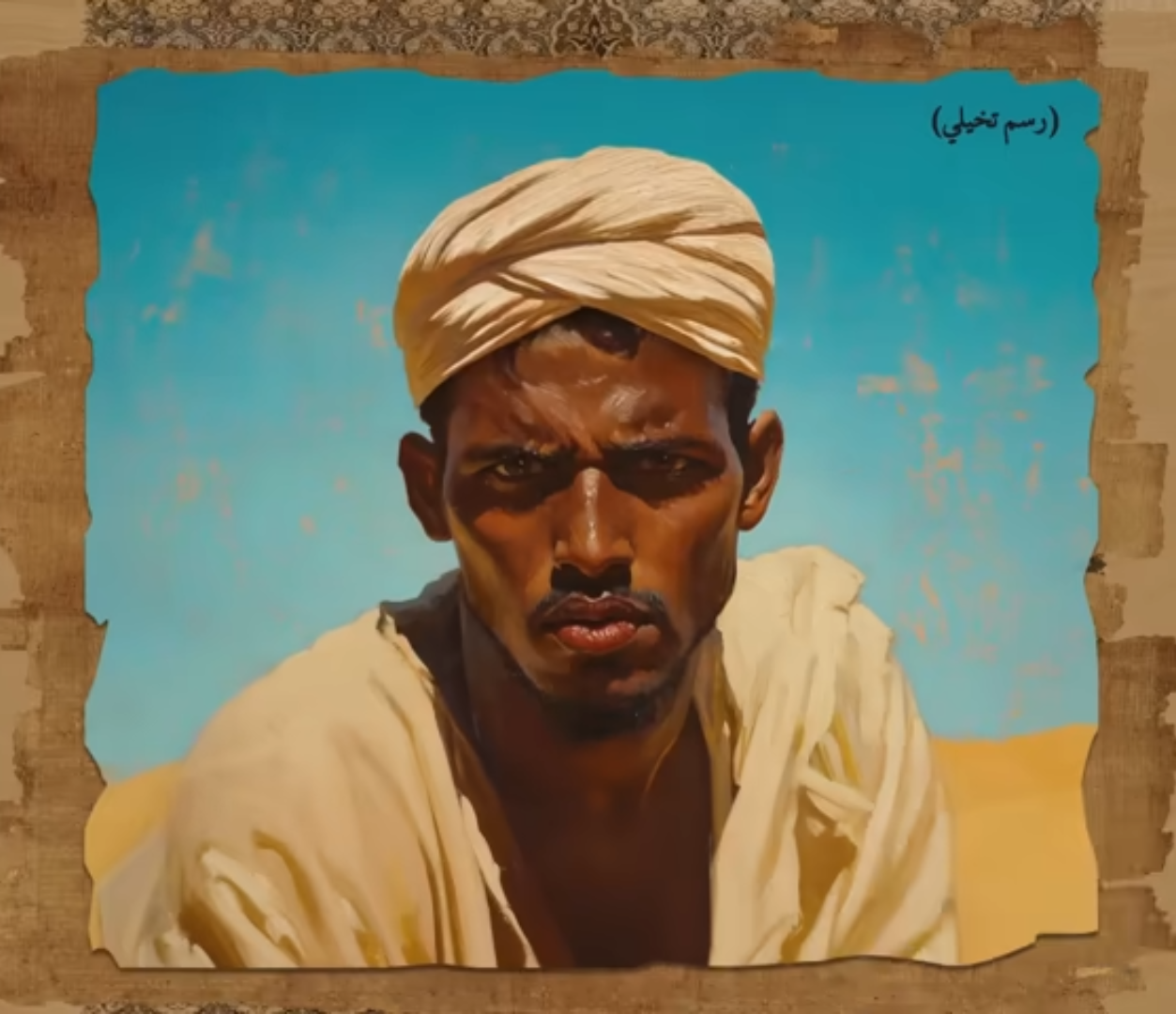
Thabit ibn Awas (died circa 525 AD), better known by his epithet Al Shanfara (Arabic: الشنفرى, “Big Lips”), was an ancient Arabian bandit and poet. He was a pioneer of the Sa’alik phenomenon – Robin Hood-esque outlaws with a poetic bent. They operated for generations throughout the Arabian Peninsula. Celebrated in Arabian folklore, his verses include one of his era’s greatest poems – one that revolutionized Arabic poetry forever after. Below are some interesting facts about that ancient bandit.
A Bandit’s Vendetta

Sources differ on Al Shanfara’s origins. One of the most common accounts is that he was born into the Azd tribe of southern Arabia. In early childhood, he was captured by the Salaman clan of eastern Arabia’s Fahm tribe in a raid. Other accounts have it that he was was given to them to settle a feud. Either way, he was raised in the Fahm tribe unaware of his origins, until he angered a young maiden. She slapped him, and told him he was not one of them. He eventually got her father to let him marry her. Unfortunately, Arab tribes were extremely sensitive about status, and the marriage proved problematic.
Some were offended that a nobody like Shanfara had wed a woman of Fahm. So they slew his father-in-law for having consented to a match that dishonored the tribe. Shanfara vowed to kill a hundred men of Fahm to avenge his father-in-law, and headed out to the desert, where he became a notorious outlaw. He earned his keep as a highwayman and bandit, robbing travelers and caravans, and raiding settlements and camps. Shanfara was fond of preying on those of the Fahm tribe. He was especially fond of preying on those of its Salaman clan, of whom he took no prisoners.
A Bandit’s Poetic Legacy

Shanfara became an early pioneer of the Sa’alik, ancient Arabian vagabond bandits with a bent for poetry. He became famous both for his ferocity and his verse. He is credited with one of the greatest Arabic poems of the pre-Islamic era, Lamiyyat al Arab (Arabic: لامية العرب, “L-Song of the Arabs”). It was transformative for its departure from traditional poetry that had followed set patterns and revolved around boasts about the poet’s tribe. The Lamiyyat abandoned traditional forms, and focused on the poet’s individual exploits, rather than the collective ones of his tribe. It recounts Al Shanfara’s life and adventures, starting with his exile from his tribe, and his defiant retort that he would rather live in the desert anyway, where the wild beasts are more loyal.
Al Shanfara boasts of his prowess, and that he can handle hardships and danger, unlike his soft tribe. He goes on to liken himself to a wolf in his ferocity and ability to withstand hunger. He also compares himself to a desert grouse for his capacity to withstand thirst. The poet goes on to lament his years of warfare, injustices faced, and the pain of exile, which he can handle with his limitless endurance. As to individual prowess, he boasts of his courage in raiding camps on stormy nights, and of his ability to go about bareheaded in the scorching desert heat. The poem closes with Al Shanfara alone atop a mountain after a day of walking through the desert, admired by the wild beasts.
Continuing a Vendetta After Death

Over the years, Shanfara steadily piled up the corpses of men from the Salaman clan corpses, until folklore has it that he reached ninety nine victims – one short of his vow of one hundred to avenge his father-in-law. Before he hit the century mark, however, he was captured in an ambush as he sought to draw water from a well. Taken back to the Salaman settlement, he was tortured to death amidst great rejoicing – and no doubt relief at the end of the clan’s nightmare.
Although dead, Shanfara was still not done with killing his foes. His corpse was left out in the open be abused by anyone who wanted to, and sometime after his death, a man of the Salaman passed by Shanfara’s skull and kicked it. One of the deceased’s teeth – or a fragment of his shattered skull; accounts differ – lacerated his leg. The wound became gangrenous and killed him – and Shanfara thus fulfilled his vow, even after his death, to kill one hundred men of the Salaman.

_________________
Some Sources & Further Reading
Allen, Roger – The Arabic Literary Heritage: The Development of Its Genres and Criticism (2005)

