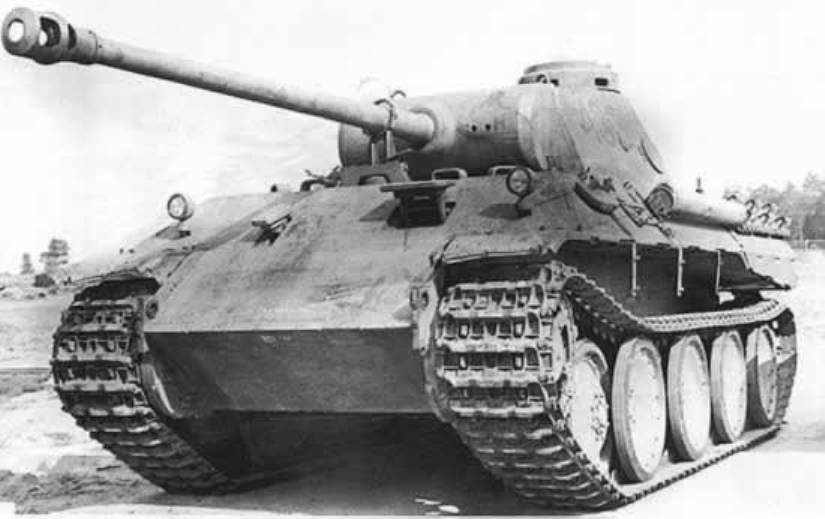
The Panzerkampfwagen V Panther was designed in 1942 as a counter to the Soviet T-34, and entered service in 1943. It was intended to become Germany’s main medium tank and replace the Panzers III and IV. Panthers were significantly cheaper than Panzer VI heavy Tiger tanks, whose performance they equaled in many respects, and were only slightly more expensive than Germany’s workhorse tank, the Panzer IV, which Panthers excelled by a wide margin. Nonetheless, technical issues, Allied bombing, and production bottlenecks prevented Panthers from being manufactured in sufficient numbers to replace Panzer IVs. So Panthers had to serve alongside the older tanks until the end of World War II. As seen below, the Panzer Vs that were produced and saw service demonstrated that the Panther was Germany’s all around best tank of the war.
Was the Panther Better Than the Panzer VI Tiger?

A German commission that examined captured Soviet T-34 tanks in 1941 noted the effectiveness of their sloped armor. That, combined with a powerful 76.2 mm gun, wide tracks, and good power to weight ratio, made the T-34 almost the perfect medium tank. So the Germans set out to make their own perfect medium tank by borrowing the T-34’s main characteristics.
However, the Germans recoiled from the T-34’s crudity, and sought to improve on it. They were Germans, and as such wanted an excellent tank, instead of a good-enough one like the T-34. As a result, the Germans over-engineered things, and the resultant Panzer V Panther tank ended up plagued with mechanical issues throughout its career.

The Panther vs the Tiger
The Panther had the same engine as the Panzer VI Tiger heavy tank, but was twelve to sixteen tons lighter. That made Panthers faster and better at crossing rough terrain. The Panther’s sloped armor was as effective as the Tiger’s thicker flat armor, and the Panther’s 75 mm gun actually had greater armor penetration power than the Tiger’s bigger 88 mm.
That made the Panthers deadlier than the heavier Tigers against enemy tanks. However, the Panther’s smaller shells were less effective when they fired high explosives. With its near perfect blend of firepower, armor, and mobility, sophisticated targeting sights, and use of technology far ahead of its time such as infrared vision, the Panther was Germany’s overall best tank of the war.

Some argue that the Panther was WWII’s best tank, period, and that it was better even than the Soviet T-34. Were it not for unreliability issues that were never ironed out, that latter claim might have been true. However, although the Panzer V was a formidable tank when it worked, a major drawback of the German medium tank was that the Panther often simply did not work.
The Panzer V Panther engines had a notoriously short lifespan. In addition, their overlapping road wheels fared badly in the snow and mud of the Eastern Front, and their off road range was a mere 62 miles. After the war, some captured Panther tanks continued to serve in foreign armies, most notably the French, who used Panthers until 1952.

Some Sources & Further Reading
Anderson, Thomas – Panther (2017)
History Halls – American Tanks of World War II: The M4 Sherman Medium Tank
Zaloga, Steven – Armored Champion: The Top Tanks of World War II (2015)

