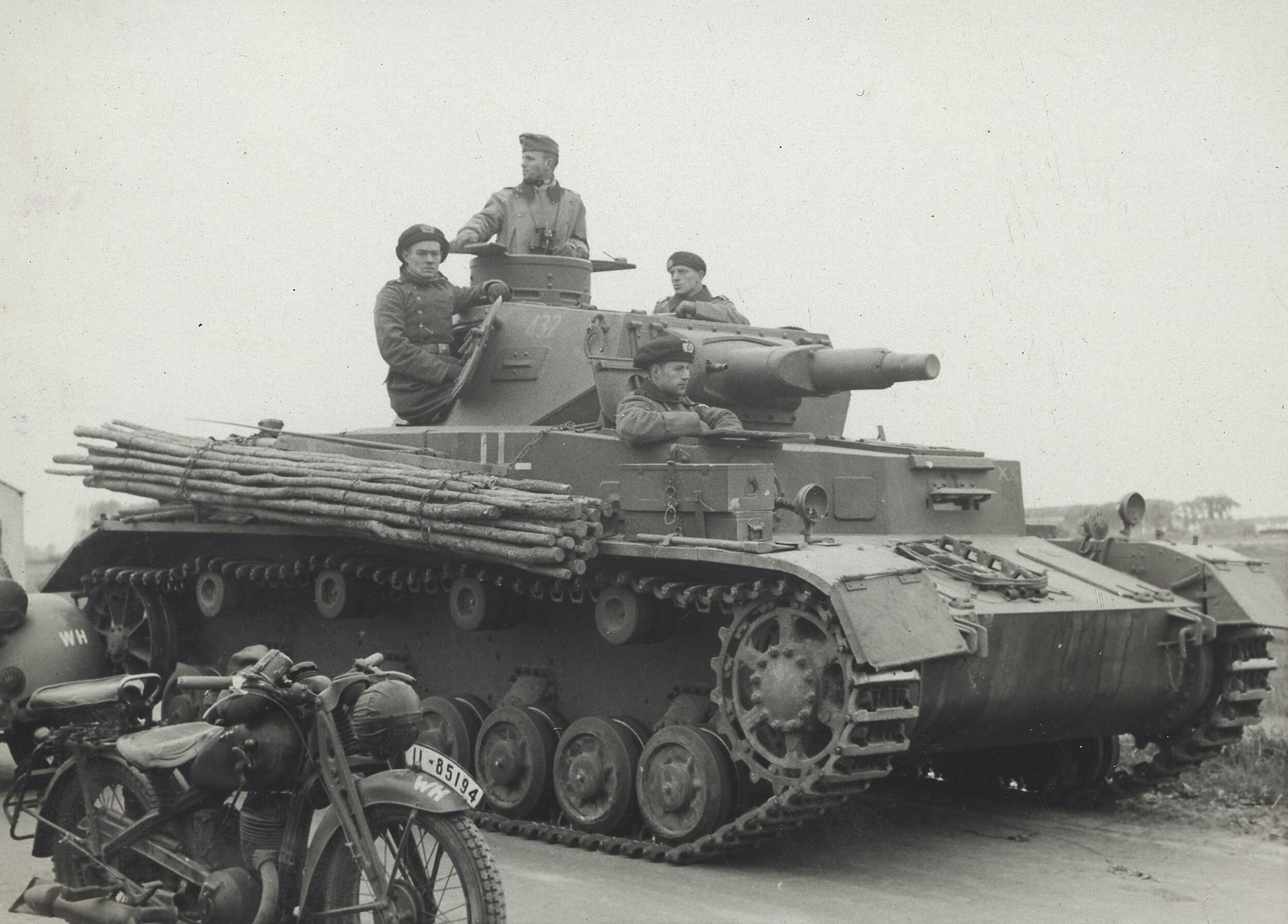
The Panzerkampfwagen IV was Germany’s main tank of World War II, and served in all theaters from the war’s start in 1939 until Germany’s surrender in 1945. No other tank of the war saw such continuous front line service, or performed so credibly for so long. Far as longevity, the Panzer IV was the most successful tank of the war, and the reason for its longevity was an excellent design. Key was a solid basic platform that lent itself to continuous adaptations and improvements as the war progressed, such as bigger guns and additional armor. Because of such adaptability, 8500 Panzer IVs rolled out of factories by war’s end, more than any other German tank of WWII. Below are some interesting facts about Germany’s workhorse WWII panzer.
The Panzer IV Started Off as a Specialized Tank

German armored warfare doctrine in the 1930s expected two primary tasks from tanks. First, was to take out antitank guns and deal with infantry strong points, using high explosive shells. Second, was to take on and defeat enemy tanks and armored vehicles with armor piercing shells. Thus, Germany developed two complementary tanks: the Panzer III and Panzer IV.
Panzer IIIs, armed with a 37 millimeter gun, were intended to be the armor-killing tanks. They were to be supported by Panzer IVs, more heavily armored and armed. Panzer IVs had a short-barreled howitzer-type 75 mm gun intended to fire high explosive shells. They were intended to operate alongside German infantry, and destroy enemy strong points and antitank guns.

From Specialized Tank to Jack of All Trades Armored Workhorse
German tank battalions’ table of organization called for three Panzer III companies, supported by one heavy Panzer IV company. The Panzer IV was operated by a five man crew that consisted of the commander, gunner, and loader in the turret, and the driver plus radio operator, who also served as machine gunner, in the hull. All were connected together via intercom.
The Panzer IV’ short-barreled 75 mm was a low velocity gun that fired high explosive shells. However, it could also fire armor-piercing rounds when necessary. A coaxial machine gun was mounted alongside the main gun, while a second machine gun was mounted in the hull’s front plate. Things went according to script at first, and Panzer IVs functioned as anti-infantry and anti-antitank weapons. Then came the invasion of the Soviet Union in 1941.

In the USSR, the Germans discover that their tank-killer tank, the Panzer III, was outclassed by Soviet KV and T-34 tanks, against whom the Panzer III’s 50 mm gun was ineffective. A bigger and more powerful gun was needed, but the Panzer III’s platform did not readily lend itself to such an upgrade. The Panzer IV’s platform did. Thus, Panzer IVs took on the antitank role in addition to their anti-infantry one.
Panzer IV versions that swapped their short barrel 75 mm howitzer-like guns for 75 mm antitank guns took over from the Panzer IIIs. Panzer IVs were eventually succeeded, at least partially, by Panzer V Panthers, which were specifically designed to counter the formidable Soviet T-34s. However, Panzer IVs continued to serve until Germany’s surrender. After WWII, some Panzer IVs continued in foreign service as late as the 1967 Six Day War.

_________________
Some Sources & Further Reading
History Halls – American Tanks of World War II: The M4 Sherman
Perrett, Bryan – Panzerkampfwagen IV Medium Tank, 1936-45 (1999)
Zaloga, Steven – Armored Champion: The Top Tanks of World War II (2015)

