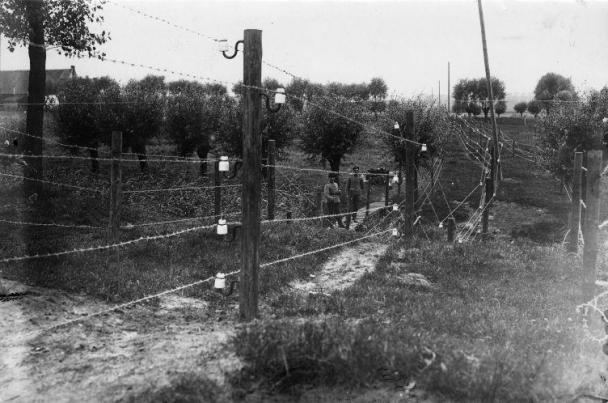
In World War I, decades before the Cold War’s deadly Iron Curtain divided East and West Germany, the Germans erected a lethal electric fence along the border between Belgium, which they had occupied, and the neutral Netherlands. The Germans called it a Grenzhochspannungshindernis, which means “High Voltage Border Obstacle”. It became better known as the “Wire of Death” after its popular Dutch name, Dodendraad, which means “Death Wire”.
The Porous Border Between German-Occupied Belgium and the Netherlands

Germany invaded both Belgium and the Netherlands in World War II. In WWI, however, the Germans invaded only Belgium, and the Netherlands remained neutral. That left a long border between the two countries. Within five months of Germany’s occupation of Belgium, more than a million Belgian refugees had fled to the Netherlands. Belgian refugees were not the Germans’ chief concern, however. Spies, saboteurs, and smugglers slipped back and forth across the porous border, and prisoners of war escaped to freedom. Most galling, volunteers who wanted to fight the Germans were able to cross to the Netherlands. From there, they made their way to join what was left of the Belgian Army in Flanders.
The war had been greeted with great enthusiasm by millions when it started in August, 1914. Cheering crowds expected that it would last for only a few weeks or months, and be over by Christmas. Instead, the belligerents ended up in a horrific bloodbath. The war stalemated in attritional combat as millions of soldiers faced each other across no man’s land between the Western Front’s trenches, which stretched for hundreds of miles from the North Sea down to the Swiss border. Millions more fought in the vast expanses of the Eastern Front. The Germans wanted all men who could be spared for the front lines, and guarding the Belgian-Dutch border took many soldiers who were desperately needed elsewhere.
A Severe Manpower Shortage

All combatants in WWI faced a manpower shortage, but it was especially bad for the Germans. Their entire strategy at the start of hostilities had depended on a short and decisive conflict, but now they found themselves in a war of attrition against foes who significantly outnumbered them. To address their manpower shortage, the Germans examined everything that used up men who could be sent to the fighting fronts. One task that used up plenty of men was the Belgian-Dutch frontier, which took many soldiers to secure.
The Germans cast about for ways to economize on the manpower necessary to guard that border, in order to free up soldiers for the front lines. Their solution proved tragic for many. In early 1915, the Germans had erected an electric fence along a stretch of the Swiss border in order to isolate some Alsatian villages from Switzerland, and it proved effective. So they decided to repeat that, on a grander scale, along the border between German-occupied Belgium and the neutral Netherlands.
A Fiendish Solution

Construction of the lethally electrified barrier began in the spring of 1915. German engineers oversaw the erection of an electric fence that stood five to ten feet high, and covered more than 125 miles of the Belgian-Dutch border from the River Scheldt River all the way down to Aix-la-Chappelle. It was charged with 2000 to 6000 volt wires that ran through it. Those who were caught within 100 to 550 yards of the fence, and who could not explain their presence, were summarily shot.
By war’s end, roughly three thousand people had been killed along what came to be known as “The Wire of Death. Newspapers in the southern Netherlands carried almost daily reports of unfortunates who had been “lightninged to death”. The fence reduced border crossings, but it did not eliminate them. Many managed to cross the border with creative methods such as tunnels beneath the fence, the use of extra high ladders, pole vaulting, or tying porcelain plates to their shoes in order to insulate them.

_________________
Some Sources & Further Reading
Owlcation – World War 1 History: The Dutch-Belgian Wire of Death

