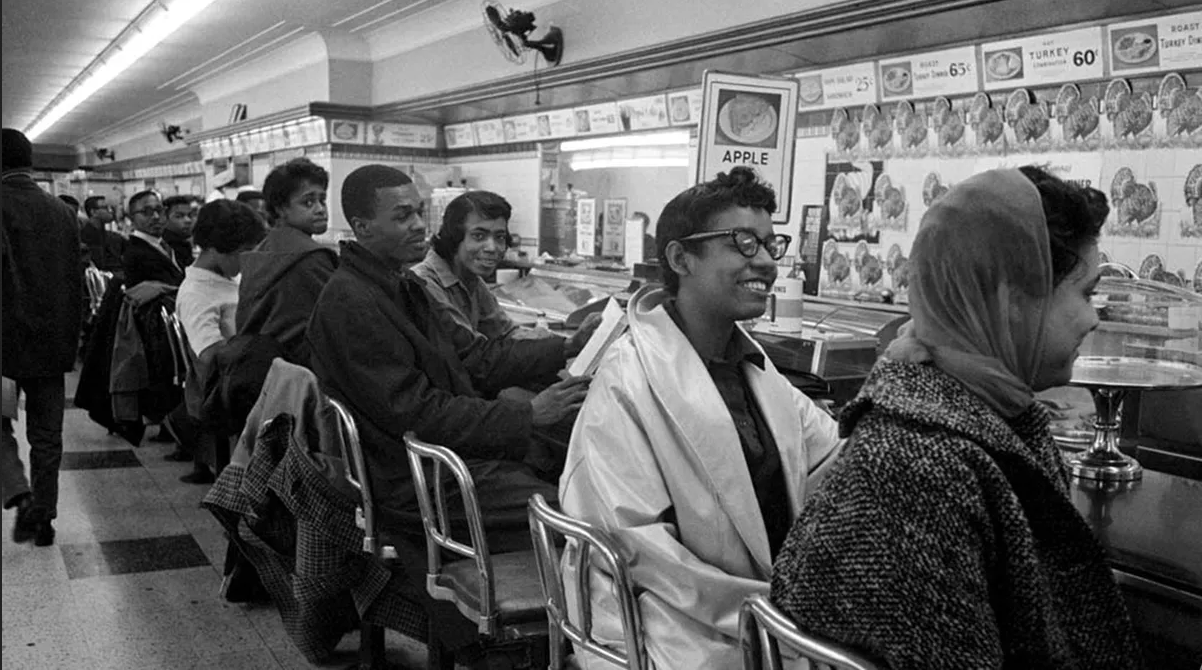
African Americans’ struggle for freedom, equality, and basic human dignity, stretches back centuries and took many forms. One was the nonviolent protest movement of the Civil Rights Era. Below are some interesting facts about one such protest that led to the desegregation of Nashville’s most prominent symbol of segregation: its lunch counters.
Challenging the Segregated South

African Americans endured the disadvantages and humiliations of segregation in the South for generations. They were barred from many public accommodations, constantly subjected to discrimination, and their children were taught in severely underfunded schools. Businesses were happy to take their money, but were unwilling to treat them with the same respect extended to white customers. Few examples were starker than dining establishments. Blacks could order and pick up their food from a window or backdoor, but were barred from the dinning rooms.
In the late 1950s, plans to challenge segregation through nonviolent protests were hatched. One of the most effective was the campaign of nonviolent sit-ins to desegregate the lunch counters of downtown Nashville, Tennessee. In 1958, civil rights activist James Lawson, who had studied nonviolent resistance while working as a missionary in India, organized workshops to teach anti-segregation nonviolent tactics. Blacks back then could shop in downtown stores, but could not eat in those stores’ lunch counters. So plans were made to desegregate them.
The Lunch Counter Sit-Ins

Starting in late 1959, black student volunteers made purchases at downtown stores, then sat at the lunch counters and ordered food. They were refused, eventually left, and returned at regular intervals to repeat the process. Early sit-ins attracted little media attention. That began to change in mid-February, 1960, when 124 volunteers ordered food from downtown store lunch counters. Again they were refused, and after a few hours, they left without incident. The following week, Nashville’s African American community joined the students in a city wide protest and boycott of stores that refused to serve black diners.
On February 18th, 1960, more than two hundred student volunteers repeated the process. This time, the lunch counters were immediately closed. Two days later, 350 volunteers staged another sit-in. White hecklers gathered, and violence was barely averted by police. On the 27th, a bigger sit-in occurred, and this time, the police were conspicuously absent. White segregationists headed to the stores, and violently attacked the African American student volunteers. Some were beaten, and others had cigarettes extinguished on their bare skins.
The Students Who Stood Their Ground, and Ended Nashville’s Segregation

When police finally showed up, none of the white assailants were arrested. However, eighty one black students were charged with disorderly conduct and loitering. They were fined $50 each, but refused to pay the fines and chose to go to jail instead. More student volunteers stepped up, and mounted more sit-ins. The arrests and trials finally got the media interested in what was going on in Nashville. As tensions mounted, the city’s mayor formed the Biracial Committee, comprised of local leaders. In April, 1960, it recommended that stores staff two lunch counters, one for blacks, and one for whites.
The proposal was unacceptable: the protesters declined to accept segregation, and insisted upon complete equality. On April 19th, a bomb was thrown into the house of a prominent civil rights activist. Rather than intimidate Nashville’s African Americans, the bombing led to a mass rally, and even more national and international media attention. Finally, an agreement was reached to gradually desegregate the lunch counters. Integration began on May 10th, 1960, and brought with it an end to the sit-ins and boycott.

_________________
Some Sources & Further Reading
Daily Beast – The Nonviolent Sit-Ins That Desegregated Nashville’s Lunch Counters
Vivian, Cordy Tindell – It’s in the Action: Memories of a Nonviolent Warrior (2021)

