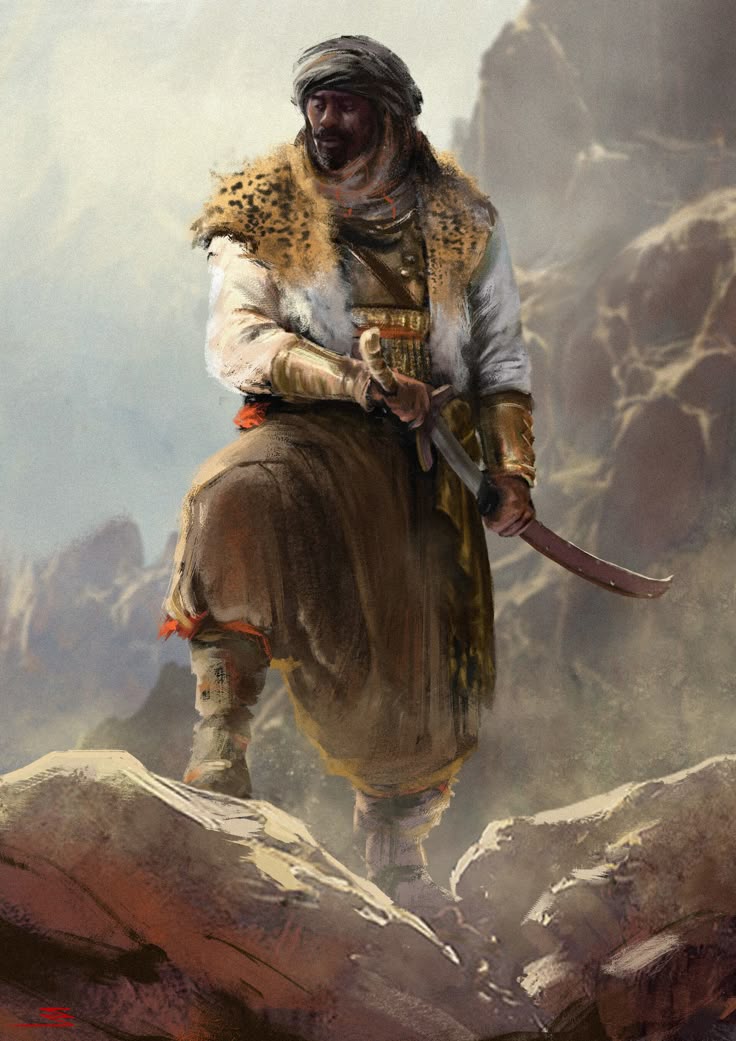
Ancient outlaw Ta’abbata Sharran (Arabic: تأبط شراً, “Carried Evil”) earned a place in Arab folklore as a Robin Hood type bandit who robbed the rich to help the poor, centuries before the fictional outlaw’s Sherwood Forrest exploits. He was the first prominent leader of a type of vagabond bandit poets known as the Sa’alik, who flourished in sixth century AD Arabia. Below are some interesting facts about that fascinating ancient brigand.
The Kid Who “Carried Evil”

Ta’abbata Sharran (“Carried Evil”), of western Arabia’s Fahm tribe, was born Thabit ibn Jabr. He got his epithet from his mother, an evil figure herself, when he was still a child. A struggling widow with eight children, she complained one day that all her sons, except Thabit, brought her something such as small game, a bird, fruit, or the like, whenever they returned from the surrounding wilderness. That upset little Thabit, who vowed to bring her something, then headed out into the desert.
He returned later that day with a sack secured tightly by his arm against his body, and handed it to his mother. Pleased, she opened it, only to immediately drop it and run shrieking out of her home: Thabit had brought back a sack full of serpents that he had captured in the desert, which now slithered throughout the house. When neighbors asked what was the matter, all the hysterical mother could do was point at Thabit and repeatedly scream “Ta’abbata sharran! Ta’abbata sharran!” (“he carried evil!”), which became his epithet.

A few years later, when Thabit was fourteen-years-old, his mother married a notorious highwayman named Abu Kabir al Hazaly. Ta’abbata resented his new stepfather, and often gave him dirty looks whenever he returned from his banditry to spend a few days with the teenager’s mother. When Abu Kabir told his new wife that he was too worried about her son to continue the marriage, she suggested a chilling solution: why not kill her son? She was probably still mad about the serpents.
Ta’abbata’s Mother Wanted Him Dead

Abu Kabir decided to do as his new wife suggested, and offered to take Ta’abbata with him the next time he went robbing, with the intention of doing him in out in the wilderness. The kid agreed, and left with Abu Kabir, who did not take any food on the expedition. When they made camp on their second night, it was within sight of a distant campfire. Abu Kabir said that he was hungry, and asked Ta’abbata to go to the other camp and ask the people there for some food. The kid went, but little did he know that his stepfather had arranged for two notorious killers to camp at that site, and murder Ta’abbata when he showed up. Minutes later, the night was rent with the sounds of fighting and screams, followed by silence.
Abu Kabir was pleased with himself, figuring he had solved the problem, and waited for the killers to come and collect their pay. To his shock, instead of two murderers, he saw Ta’abbata heading back to the camp, leading two camels. Feigning ignorance he asked what had happened, and the kid told him that soon as he approached the campsite, two men attacked him. So he fought them off, and killed both. He then collected their belongings, including food that he threw at Abu Kabir, loaded them on their camels, and returned. Amazed at what his stepson had managed to do such a young age, Abu Kabir was still hopeful that he might rid himself of the troublesome child by murdering him himself as he slept.
Ta’abbata’s First Foray Into Banditry

Abu Kabir and Ta’abbata eventually managed to steal some camels, then headed back home with their loot. For security, they had agreed to divide the night watch, with one of them staying awake half the night while the other slept, then switching. One night, while Ta’abbata slept, Abu Kabir decided to act. To make sure his stepson was sound asleep, he tossed a small stone in the direction of the camels to see if he would react to the sound.
Ta’abbata immediately sprang up, wide awake, asking what that noise was. His stepfather feigned ignorance, so Ta’abbata walked the camp’s perimeter to make sure, found nothing, and returned to sleep. Abu Kabir tried again sometime later, with a smaller stone, only for Ta’abbata to leap to his feet once again, and once again circle around the camp to make sure nobody was there. The persistent Abu Kabir tried again with a tiny pebble that made the faintest of sounds. It brought Ta’abbata jumping to his feet once more.
A Scary Kid

This time, after circling the camp, the fourteen-year-old looked his stepfather straight in the eye, and told him that if he heard one more sound that disturbed his sleep, he would kill him. Astonished at such self-confidence from one so young – and also terrified, knowing what the kid was capable of – Abu Kabir said later that he spent the rest of that night keeping vigilant watch over the camels, to make sure that none of them made any sound to wake up his homicidal stepson. Soon as they returned home, he told Ta’abbata’s mother that it was over, as he was too afraid of her son to stay anywhere near him.
The Ferocious Poet Bandit Leader

Ta’abbata by then had discovered that he rather liked banditry, and that he was good at it. As he grew up, so did his reputation as a ferocious highwayman. He was also known for his exceptional speed. Stories circulated that if he spotted a herd of gazelles when hungry, he would pick out the fattest, then run it down on foot until he caught up with and slew it with his sword. In due course, he joined up with and came to lead other outlaws in western Arabia.
Ta’abbata and his followers collectively came to be known as the Sa’alik – vagabond bandits, many with a bent for poetry. He became even better known as a poet than as a bandit leader. His verses often revolved around themes of defiance of established tribal norms, warfare, the hardships of the desert outlaw life, and his generosity and personal prowess in overcoming obstacles. Ironically for such a ferocious figure, Ta’abbata Sharran’s death came not at the hands of another fearsome warrior, but at those of a child.
The End of Ta’abbata Sharran
In his final raid, Ta’abbata fell upon an isolated encampment where he slew an old man and seized his camels and concubines. The only one to escape was a young boy. Ta’abbata, determined that none should get away, pursued him. The kid had a bow with only one arrow, but put it to good use. As Ta’abbata pursued him, he hid among some boulders and waited in ambush. When his pursuer drew near, the kid leapt up and let loose an arrow that pierced his heart, instantly killing him. The arc of Ta’abatta Sharran’s story began with his exploits as a child, and ended with the exploits of another child bringing about his death.

_________________
Some Sources & Further Reading
Allen, Roger – The Arabic Literary Heritage: The Development of Its Genres and Criticism (2005)

