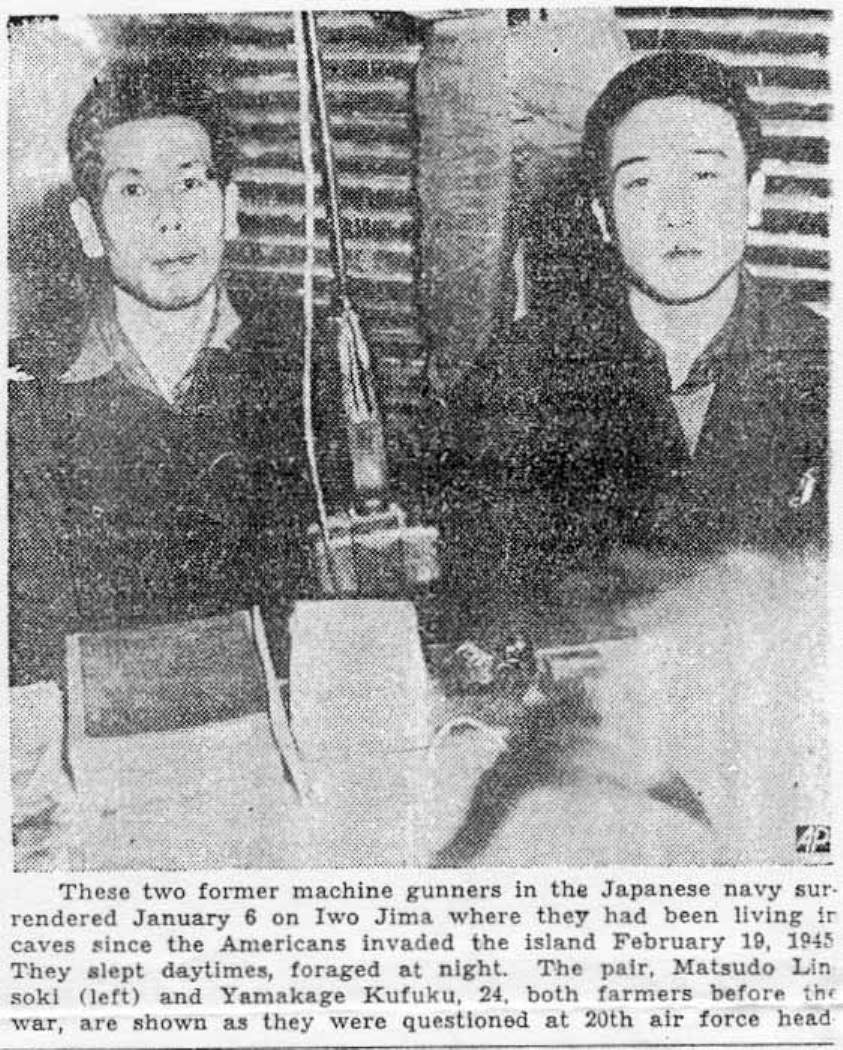
Japan’s surrender on September 2nd, 1945, brought World War II to an end, and shocked many Japanese servicemen to their core. Their leaders had drilled into them for so long that surrender was so shameful that death was preferable, that it was difficult to accept that those same leaders had themselves surrendered. Most got over it, eventually, and turned themselves in to be interred in Allied POW camps. Thousands, though, became holdouts and for a variety of reasons refused to surrender. Instead, they kept up the fight or eluded capture for months, years, or even decades. Two such, as seen below, hid in the barren island of Iwo Jima for years.
The Duo Who Hid for Years on a Tiny Island Surrounded by Thousands of Enemies

Matsudo Linsoki and Yamakage Kifuku were two Japanese machine gunners who had been posted to the volcanic island of Iwo Jima in WWII. In 1945, the island was invaded, and some of the fiercest and bloodiest fighting of the entire Pacific War ensued. The defenders fought fanatically, almost to the last man: out of 21,000 Japanese defenders, nearly 20,000 died before the island was declared secured. Linsoki and Kifuku were among the few Japanese survivors who were neither killed in combat, nor committed suicide.
The duo believed Japanese wartime propaganda that Americans tortured and killed prisoners. Too afraid to surrender, they went to ground – literally. They hid during the day in the warren of underground and mountain tunnels that honeycombed the rocky island. At night, they emerged to pilfer food and other necessaries from the American garrison’s supply and trash dumps. Once the guns fell silent on Iwo Jima, the American garrison had little incentive to scour the island’s harsh landscape for Japanese holdouts, so nobody was trying hard to find them. As a result, Linsoki and Kifuku managed to stay hidden and survive for a long time in a barren and inhospitable island bereft of vegetation and game.
The End of Linsoki’s and Kifuku’s Holdout

Linsoki’s and Kifuku’s holdout lasted until January 6th, 1949, when two US Air Force corporals in a Jeep spotted a pair of pedestrians in uniforms a few sizes too long, walking alongside a road. They mistook them for Chinese laborers. At the time Chinese businessman, whose country had not yet gone communist, were sending ships full of workers to Iwo Jima. There, they would scavenge the island and remove abandoned vehicles and other wartime debris that held any value for resale, repair, or recycling.
Although the pedestrians spoke no English and were uncommunicative, the corporals assumed they were hitch hiking to the island’s main base. So they kindly gave them a lift and dropped them off in front of the headquarters building. From there, Linsoki and Kifuku wandered around the base for hours. Eventually, an American sergeant realized that they were Japanese and took them in. After interrogation, they took their captors to their hideout. There, the Americans encountered a cave richly stocked with canned foods, flashlights, batteries, uniforms, boots and shoes and socks, and sundry goods that the duo had pilfered over the years.

_________________
Some Sources & Further Reading
History Halls – Why Did Many Japanese Soldiers Refuse to Surrender After World War II Ended
How Stuff Works – Japanese Holdouts
Trefalt, Beatrice – Japanese Army Stragglers and Memories of the War in Japan, 1950-75 (2013)
Wanpela – Japanese Holdouts: Registry

