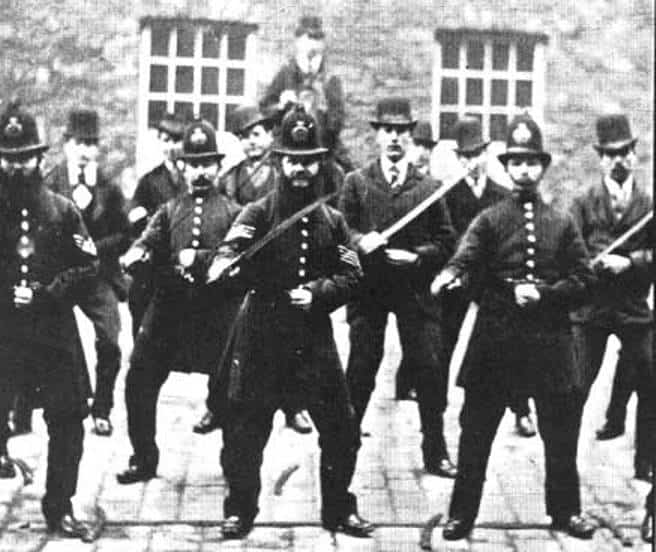
The officers of the Metropolitan Police Service, London’s lawmen, are generally respected and affectionately known as “Bobbies” today. It was not always so. For decades after the MPS was formed in 1829, many Victorians questioned the very legitimacy of police. They also doubted the need for their services. As a result, as seen below, there was quite a toxic relationship between the Bobbies and those they were sworn to serve and protect.
Police Were Despised by Much of the Victorian Public

In the Victorian Era, many Londoners disliked the newly introduced police force. Indeed, throughout much of the nineteenth century, officers of the Metropolitan Police Service (MPS) were held in low esteem by much of the public. They were routinely derided and disrespected while they did their jobs. They were also trolled, baited, and even attacked for kicks and giggles. There was an active anti-police ideology in the Victorian Era, communicated through a radical press that depicted the MPS as an unconstitutional infringement on English liberties.
The Bobbies or “Peelers” – nicknamed after their 1829 founder, then-Home Secretary and future Prime Minister Sir Robert Peel – were often referred to as “blue locusts” and “blue idlers”. That reflected a perception that they were parasites who lived off the taxes of honest men, and were excused by their position from honest work. Victorian police were particularly disliked by the working and lower classes. They resented the suppression of popular recreations and customs that were criminalized, such gambling, prize fights, public drinking, and various street games. Routine police work in poorer neighborhoods, such as patrolling and keeping an eye out for trouble, was often viewed as an intrusive and unprecedented surveillance regime.
Open Hostility Against Cops

Many Victorians developed an active antipathy towards police. So they did what they could to make the life of beat cops as miserable as possible. That often took the form of violence directed at the police. MPS officers who tried to arrest miscreants, especially in working class neighborhoods, were often set upon and attacked by the culprit’s neighbors, friends, and passersby, in order to rescue the detainee. The British working class acting out on its resentment of Victorian police for interfering with street life was bad enough.
Worse was the resentment felt whenever police became involved in crimes having to do with domestic affairs and affrays. Cops who approached private residences, regardless of the motive, risked a hostile reception. To even knock on doors to alert residents to security lapses, such as a door or window left open at night, was problematic. Such good deeds were seldom met with gratitude. Instead, Victorians often assailed the officers for their temerity in disturbing their peace.
Many Victorians Attacked Cops for Fun

The Bobbies’ reluctance to get involved in instances of domestic violence was well-founded. They often faced the wrath of both parties, who temporarily forgot their own squabble and united to attack the cops. Today, we take it for granted that it is a serious crime to assault a police officer. Victorians saw things differently. Violence was not just a means to an end, such as freeing somebody known to the assailants from the police. Sometimes it was an end in of itself.
Nineteenth century Bobbies were often attacked just for the sheer fun of it. Many Victorians liked to lead cops on merry chases, while others simply set upon them out of the blue. More creative were some gangs of working class youths, who often collaborated to set up ambushes for police. They would bait the policemen into chasing them down alleys and footpaths strung with trip wires. The wires’ release would spring Looney Tunes-type booby traps that caused bricks to smash into the cops, or tipped buckets of refuse to fall upon their heads.

_________________
Some Sources & Further Reading
History Halls – Animals That Acted Up in Middle Ages Europe Were Criminally Tried in Court

