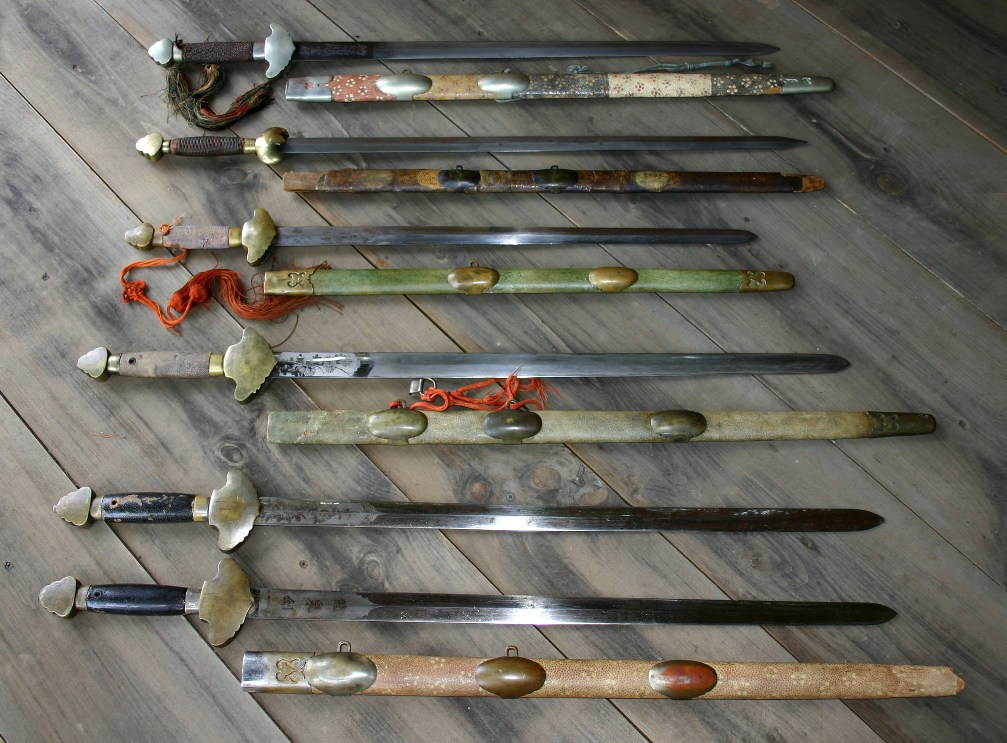
The Chinese jian sword has a double-edged, straight blade, and usually has a stingray-shaped guard. Jian grips are typically made of fluted wood or covered in ray skin. Handles have a pommel to balance the sword, to trap or strike an adversary, and to prevent the user’s hand from slipping down the hilt. Jian swords have been used for at least 2600 years, and the earliest recorded mention of them dates back to the Spring and Autumn Period, 771 – 476 BC.
“The Gentleman of Weapons”

Chinese bronze sword production techniques reached an advanced stage by the sixth century BC. Laminated bronze jians with copper sulphide and chromium oxide coatings to resist correction became common. The effectiveness of such anticorrosive techniques can be seen in the Sword of Goujian. Roughly 2600 years old, it was recovered from a tomb in 1965. Although the tomb had been soaked in underground water for more than 2000 years, the recovered sword resisted tarnish and still retained its sharp edge. The jian is considered one of China’s four traditional weapons, and is referred to as the “Gentleman of Weapons”. The other three are the single bladed dao sword, the “General of Weapons”, the qiang, or spear, the “King of Weapons”, and the bang, or staff, known as the “Grandfather of All Weapons”.
The blades of jian swords typically have significant distal taper, or decreased thickness. The edge is usually only half as thick as the base of the blade near the handle. That is combined with subtle profile taper, or decreasing width, from the blade’s base to it tip. The blades consist of three sections: the tip, middle, and root. Jian tips typically curve smoothly to a point, and are used to thrust, slash, or make quick cuts. The middle is for deflection, or for drawing and cleaving cuts. The root, the thicker part closest to the handle, is mostly used for defense.
Steel Replaced Bronze, and Jians Got Replaced by Simpler Swords

From the sixth to fourth centuries BC, jian blades were about two feet long. Their spines were made of bronze that had low tin content, which made them relatively softer and more flexible. Their edges were made with bronze that had a higher tin content, which made them harder. That combination resulted in a sword with a hard cutting edge, but that still had a flexible spine to absorb shock. By the fourth century BC steel jians began to replace bronze ones. The same strategy was used, with high carbon content steel used on the cutting edges to make them hard, while softer steel was used for the core to make them flexible.
The shift to steel had an impact on blade length. Bronze does not allow for long blades, because the metal is not strong enough to withstand stress. So by necessity, bronze swords had to be short and sturdy. Steel does not have such limitations, and its introduction allowed for longer blades. Steel jians, which now featured longer handles for two-handed use, grew to about three and a half feet. Some recovered samples measured up to five feet and three inches. By the first century AD, however, a simpler and easier to use sword, the dao, began to replace the jian. By the third century AD, the process was completed, and the jian became restricted to the Chinese aristocracy and to ceremonial court usage.

_________________
Some Sources & Further Reading
History Halls – Swords Across the Millennia and Around the World
Rodell, Scott M. – Chinese Swordsmanship: The Yang Family Taiji Jian Tradition (2005)
Zhang, Yun – The Art of Chinese Swordsmanship (1998)

