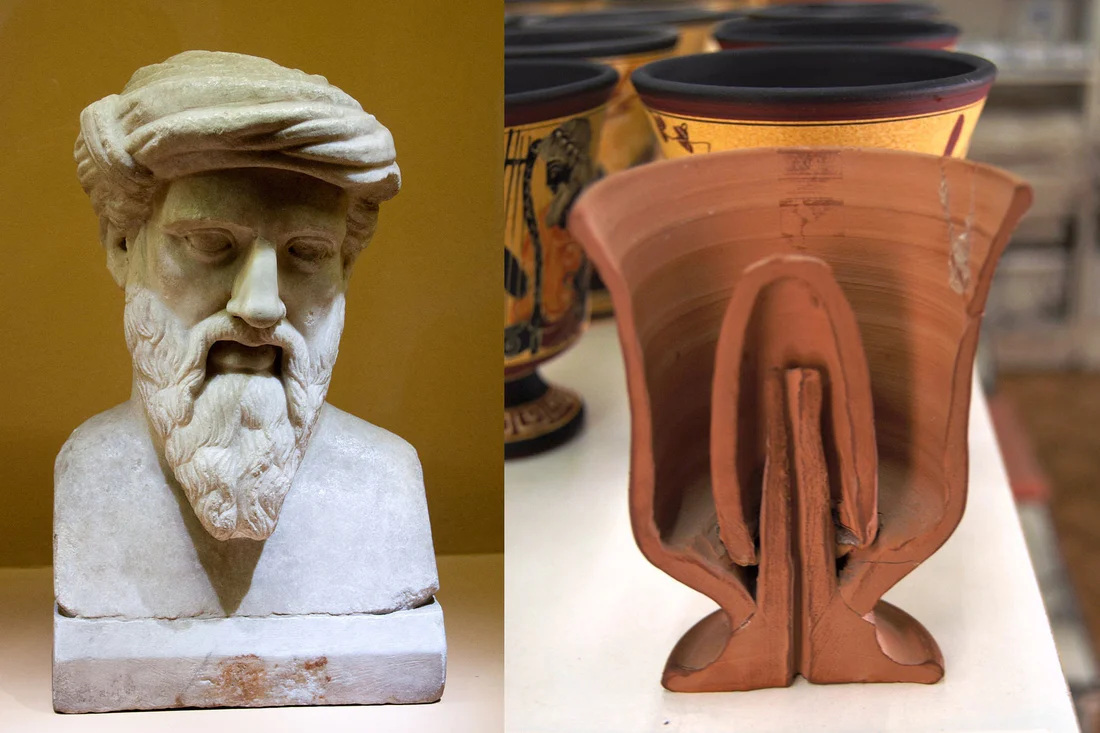
Nobody likes greedy folk who hog communal stuff at a party, and take way more than their fair share. Especially if the communal stuff we’re talking about is booze. Somebody who really didn’t like that was Pythagoras. As seen below, he invented a special cup to prank – and punish – greedy wine hogs at parties.
Pythagoras Had a Fun Side

The word “fun” is not usually associated with Pythagoras (circa 570 – circa 495 BC). The ancient Greek philosopher and mathematician is best known for his Pythagorean theorem, which has tormented school children for generations untold. To be sure, Pythagoras had some funny beliefs. For example, his detestation of beans because he thought that they contained the souls of the dead. Or his notion that people lost a part of their soul whenever they farted.
Thing though is that Pythagoras did not think those beliefs were funny: he was dead serious about them. Literally dead serious. When fleeing from pursuers out to slay him, his flight path ended at a field of beans. Rather than cut through the field and come in contact with the detested beans, he turned around to face his killers, who promptly did him in. However, the man did have a fun side. Some of that was manifested in his invention of a prank cup that spilled wine on drinkers.
A Philosopher Who Detested Wine Hogs

Among the fun activities that Pythagoras liked, drinking wine was high on the list. For that matter, drinking wine was high on the list of fun activities for most ancient Greeks. However, Pythagoras had a particular pet peeve when it came to drinking: he detested wine hogs. Specifically, he did not like it when greedy friends filled their cups to the brim, and took more than their fair share of the wine. So he invented a special cup that came to be named after him.
The Pythagorean Cup looks like a normal ancient Greek goblet. Inside, however, it has a column that sticks up the middle. You can drink from it like from any other goblet, so long as you do not fill it to the maximum. Pythagoras designed the cup so that if an unsuspecting drinking companion became a wine hog and tried to fill it, it would instead drain all the wine and spill it out the bottom. Presumably, getting wine spilled all over him – and the hassle of figuring out how to remove wine stains – would teach the greedy friend a lesson about moderation.
A Cup That Punished Greedy Drinkers

The Pythagorean Cup uses the basic principle of the siphon – same as that used to drain gas out of a car’s tank with a hose. The column inside the cup has a small hole at the bottom. The hole leads to an inverted U-shaped pathway inside the column. The pathway leads up from the hole at the bottom of the cup’s interior, to the top of the column, then loops back down to another hole at the base of the cup.
When wine is poured into the Pythagorean Cup, the column inside fills to the same level as that of the wine in the cup. So long as the cup’s wine level does not reach the top of the U, the Pythagorean Cup functions like any other cup. However, if the wine level tops the column, and thus the U bend within it, the cup’s special effect takes over. Soon as wine tops the U bend and spills into the part of the column headed towards the hole at the base of the cup, the cup becomes a siphon, and begins to drain. Once the siphon effect begins, it does not stop draining wine until the cup is empty.
_________________
Some Sources & Further Reading
Encyclopedia Britannica – Pythagoras

