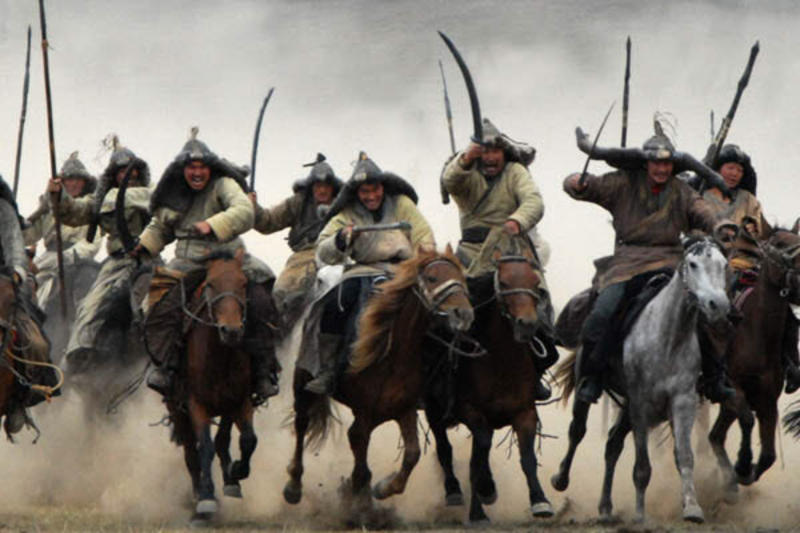
The Eurasian Steppe is a plains region stretches from Manchuria in the east, to Hungary and Croatia in the west. A harsh land of scorching summers and extreme winters, the Steppe’s saving grace was its abundant grasslands. They allowed the raising of vast herds of livestock. As a result, the region was inhabited for millennia by nomadic tribes, who wandered with their herds from pasturage to pasturage. The nomads often traded with their neighbors in the settled lands surrounding the Steppe. Whenever opportune, though, they were just as comfortable raiding them. Over the millennia, the Steppe birthed terrifying conquerors such as Attila the Hun, Genghis Khan, and Tamerlane, who devastated the settled lands surrounding Steppe. Below are some facts about key advantages Steppe warriors had went they went on the warpath.
Mobility Was Chief Among the Steppe Warriors’ Advantages Over Opponents From the Settled Lands

The Steppe nomads had some advantages that gave them a significant military edge against their settled neighbors. Chief among those was their mobility: nomads grew up with, and often on, horses. Accustomed to a life on the move, the nomads were seldom tied to a specific location. So they seldom needed to stand up and fight if they did not want to. After raiding into the settled lands, the nomads could often depart with their booty before civilized authorities mobilized a response.
If their victims pursued them into the Steppe, the nomads could choose when, where, and whether to fight. In addition to strategic mobility, Steppe nomads had some tactical advantages that gave them an edge over the armies of their civilized neighbors. First and foremost among those was that the nomad forces were entirely cavalry. Mounted on horseback, the nomads’ steeds gave them a battlefield mobility that made it difficult to force them to fight to the death.
The Steppe Nomads’ Composite Bow Was a Terrifying Weapon

If a battle started to go against Steppe warriors, they seldom had to make a do-or-die last stand. The nomads could and did simply ride away and retreat to lick their wounds – and live to fight another day. Another advantage enjoyed by Steppe nomads was their preferred weapon, the recurved composite bow. The Steppe bow was an ingenious marvel. It combined animal horn on one side for compression, and elastic sinew on the other for tension.
The recurved composite bow was able to store a significant amount of energy in a relatively compact weapon that could be used from horseback. It could pack a greater punch and shoot further than simpler wooden stave bows. That created tactical mismatches that often gave Steppe warriors a standoff distance from which to kill in relative safety. Steppe nomads could thus attrit less mobile armies with arrows until they were weakened and demoralized, before swooping in to finish them off.
The Steppe Was Constantly Pregnant With the Potential for Violence by Nomads Against Neighbors in the Settled Lands

Another military advantage enjoyed by Steppe nomads over their neighbors in the settled lands arose from the disadvantages of life in the Steppe. It was a harsh existence, much of it spent on horseback, that created a deep pool of hardy warriors. In the settled lands, only a minority could be mobilized as fighters, because most men of military age were needed to work in the fields and workshops. The Steppe nomads had no fields and little manufacture. Their main food source, their animal flocks and herds, could be cared for by children and women. That left nearly the entire adult male population of fighting age available as warriors.
To be sure, violence from Steppe was not a constant – generations could pass without conflict greater than petty raids and occasional skirmishes between nomads and settled peoples. Nonetheless, the above factors meant that, for millennia, the Steppe was constantly pregnant with the potential for violence against the surrounding settled land. Whenever the nomads got in a warlike mood and found the right leaders, they rode out of the vastness of their homelands, to raid, plunder, pillage, and otherwise terrorize the more civilized and prosperous lands on their periphery. If the nomads were unified under powerful warlords, things could escalate from mere raids – bad enough as those were – and into devastating invasions that could extinguish empires.

_________________
Some Sources & Further Reading
Burgan, Michael – Empire of the Mongols (2009)
Hildinger, Erik – Warriors of the Steppe: Military History of Central Asia, 500 BC to 1700 AD (1997)

