[This is the second of two articles about the accidental American attack on a Soviet airbase inside the USSR’s borders in 1950. For Part I, click here]
An Attack that was a Tactical Success – and a Strategic Blunder

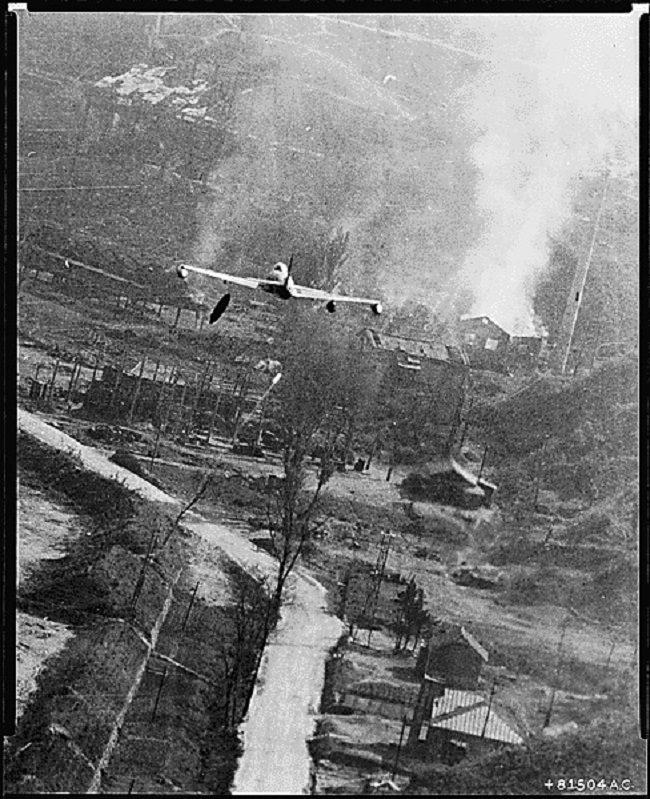
A few hours after they had successfully strafed an airfield on the afternoon of October 8th, 1950, Alton Quanbeck and his wingman Al Deifendorf were debriefed upon their return to base. The two pilots reported that they had conducted a strafing attack on enemy aircraft on the ground. They added that they had destroyed one airplane and damaged two others. Several months later, a Far East Air Force HQ intelligence officer told Quanbeck that “the airfield burned for a week”.
Unbeknownst to Quankbeck and Deifendorf, the airplanes they had left burning had apparently triggered secondary explosions, which reached other planes. Tactically, the attack was a great success. Unfortunately, it threatened to turn into a huge strategic blunder. Later that evening, Quanbeck and Deifendorf were summoned to headquarters by their commander Major General, Earle Everard Partridge. They went over the mission again, then Partridge laid out a large map. He pointed to an area within the Soviet Union southwest of Vladivostok, and asked if they could have attacked there.
“You’ll Either Get a Distinguished Service Cross or a Court Martial”

The region in North Korea where Alton Quanbeck and Al Deifendorf thought they had attacked an enemy airfield shared significant terrain similarities with the region southwest of Vladivostok. Quanbeck thought it was possible he could have strafed an airfield inside the USS. However, he did not it think it was probable. He was wrong. As the two pilots left his office, General Partridge told them: “You’ll either get a Distinguished Service Cross or a court martial out of this mission”. The following day, when Quanbeck returned from a mission, he was met by Deifendorf who informed him: “It’s hit the fan”.
Rather than cross the coast south of the USSR’s border the previous day, as they thought they had, Quanbeck and Deifendorf the duo had done so well to the north. They had not attacked an airfield on North Korean soil, but had instead strafed Sukhaya Rechka, a Soviet airfield on the outskirts of Vladivostok, almost eighty miles north of the border with North Korea. Unsurprisingly, the Soviets were alarmed, unclear whether the attack was a mistake, or a deliberate provocation by an America eager to start World War III. The following day, October 9th, 1950, the Soviet government presented an official note of protest to the United Nations.
Quanbeck and Deifendorf Got a Court Martial, Not a Distinguished Service Cross

Al Deifendorf was correct when he told Alton Quanbeck that “It’s hit the fan”. Back in Washington, President Truman held Douglas MacArthur responsible. He suspected his troublesome commander in Korea of deliberately attempting to provoke a war with the Soviets. The story became front page news, but both the Soviet and US governments, each for its own reasons, preferred to deescalate and put the incident behind them. On October 19th,1950, America’s ambassador to the United Nations admitted the attack, and stated that it was unintentional.
The US ambassador informed the UN Secretary: “The commander of the Air Force group has been relieved and appropriate steps have been taken with a view toward disciplinary actions against the two pilots concerned”. The pilots who carried out the attack were tried before a court martial. In a proceeding that was closed to the public, both were found not guilty. The findings were not released by the US Air Force, which wanted both the Soviets and Truman to assume that the airmen had been properly punished. However, although both were acquitted of the charges, neither Alton Quanbeck nor Al Deifendorf flew any more combat missions.

_________________
Some Sources & Further Reading
Military Matters – When the USAF Attacked a Soviet Airbase
Washington Post, March 4th, 1990 – My Brief War With Russia

