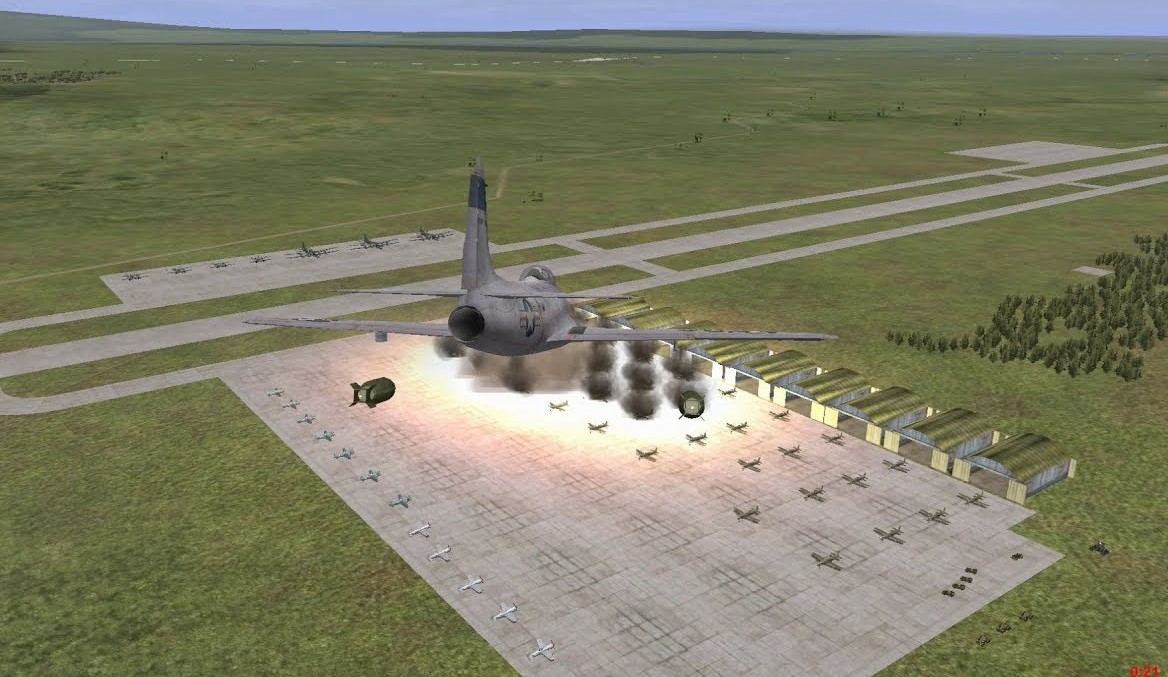
During the Cold War, humanity lived with the daily threat that the world might suddenly end in a nuclear holocaust. Thankfully, the Cold War never got hot, mostly because the rival superpowers fought each other via proxies. The Soviets bled us with the North Koreans and North Vietnamese. We returned the favor whenever possible, such as our support for the Afghan Mujahedeen. It was often messy, but it worked as we fought at a remove in other people’s homes. So long as they refrained from attacking us on US soil, and we refrained from attacking them on Soviet soil, both sides were willing to put up with a lot of from the other. As seen below, however, there was an exception to the no-direct-attack-on-each-other’s-soil. During the Korean War, US warplanes accidentally attacked a Soviet airfield.
Straying Into Soviet Airspace

Two American Lockheed F-80 Shooting Stars were flying over North Korea on the afternoon of October 8th, 1950. Their pilots, Alton Quanbeck and his wingman Al Deifendorf, were assigned a mission a mission: attack Chongjin airfield, on the far northeast of North Korea, forty miles south of China, and sixty miles southwest of the Soviet border. The day was overcast, and they could not see the ground below. As they skimmed the top of the clouds at 37,000 feet, Quanbeck and Deifendorf armed their .50 caliber machine guns in preparation for action, and began their descent.
When they got down to 10,000 feet, they saw a small hole through the clouds, and plunged through the opening. The duo found themselves over a broad river valley with mountains to each side. Following the river, the proceeded southwest, in a heading they thought would take them away from Soviet and Chinese borders. Unfortunately, the pair had strayed into Soviet airspace. That was bad enough, but as seen below, things were about to get way worse.
An Unexpected Juicy Target

As he flew his F-80, Alton Quanbeck was surprised to see the flashes of antiaircraft guns from a small town nearby. Both targets and enemy resistance had been scarce in the days before his mission. So the enemy gunfire was unusual and unexpected. A short while later, Quanbeck spotted a truck on a dirt road, and heard his wingman Al Deifendorf urge him over the radio: “Let’s go in and get it!” An instant later, Deifendorf changed his mind when he spotted a juicier target, and exclaimed: “Look at that airfield, it’s loaded!”
Decades later, Quanbeck recalled the moment when he saw what had gotten his wingman so excited: “It was the kind of target that fighter pilots dream about. Parked in two rows were about 20 aircraft of the P-39 or P-63 type. Thousands of them were built and flown by Americans in World War II, and some were sent to our Soviet ally. Those below us had large red stars surrounded by a narrow white border painted on the side of their dark brown fuselages”.
Overcoming Doubts, and Deciding to Attack

Alton Quanbeck did not have a lot of time to figure things out. In light of his airspeed, he had only a few seconds to decide what to do about the airfield below him. Between his low altitude and low hanging clouds, he could not see more than a mile or two in any direction. Even if he could have spotted any distinctive terrain features, it was unlikely that he could have related them to the crude maps carried on this mission. However, there were a few things that bothered him.
First, no P-39 airplanes had been seen in North Korea. Second, he was not exactly sure about his whereabouts. Last but not least, the airfield below did not match the description of the Chongjin airfield he had been sent to attack. However, Intelligence reports had predicted a movement of aircraft into northeast Korea. On top of that, the markings on the planes below were nearly identical to those used by North Koreans. Per Quanbeck’s dead reckoning, he had hit the coast well south of the Soviet border, so he overcame his doubts and decided to attack.
Doubts Begin to Creep In

As Alton Quanbeck described what happened: “I positioned our aircraft for a strafing pass on the northern line of aircraft, then made a sharp, banking turn to the left and fired on the southern line. I could see tracers carving through the aircraft and knew we were getting lots of hits, but there were no explosions. On my last pass, I decided to make sure of one clear kill. I concentrated my fire at one plane and saw it start to burn”.
He continued: “Dief followed me closely in each pass. We exhausted our ammunition and were down to minimum fuel — 400 gallons. Time to go home. As I pulled off the target, turning right to our homeward course, I saw an island off the coast. “Oh, oh,” I thought, “there’s no island near Chongjin”. The pilots hurriedly compared notes. They figured that they had not attacked Chongjin, but had instead struck an unimproved airfield at Rajin, forty miles north of Chongjin and twenty miles south of the Soviet border. They were wrong.

[The is the first of two articles on the accidental American attack on a Soviet airfield. For Part II, click here]
_________________
Some Sources & Further Reading
Military Matters – When the USAF Attacked a Soviet Airbase
Washington Post, March 4th, 1990 – My Brief War With Russia

