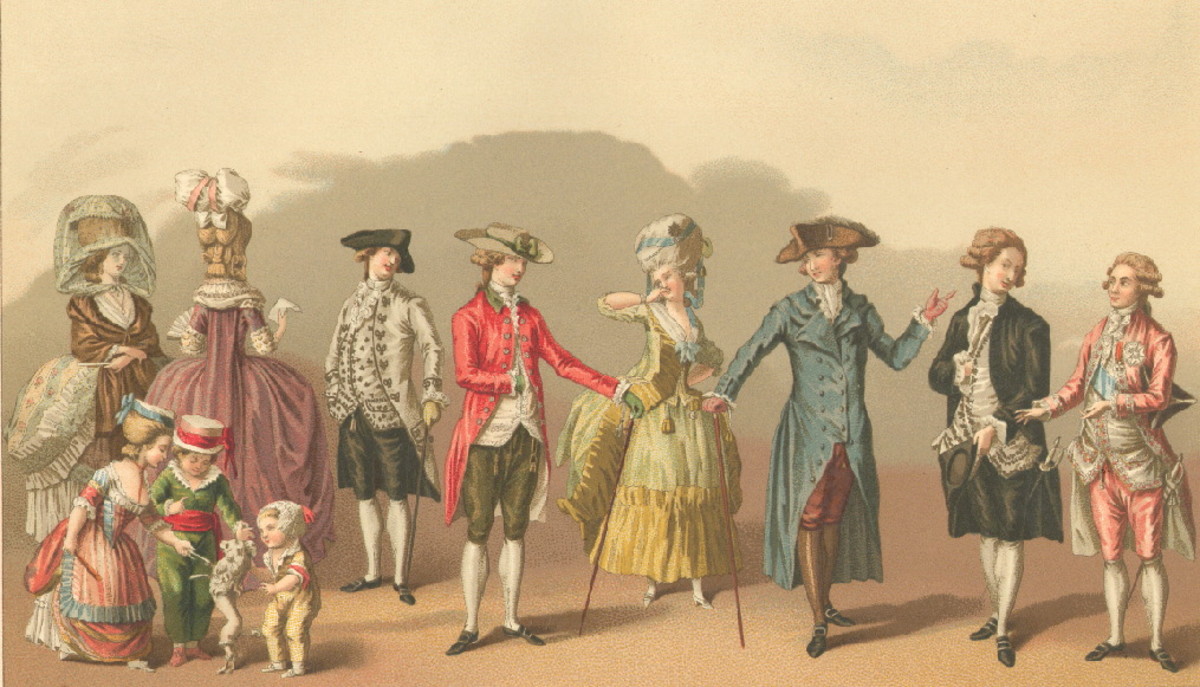
For millennia, clothing served as a visible marker of aristocratic privilege and social status. In France, prior to the 1789 Revolution, high fashion was derived from the French court’s dress code, based on unbending etiquette introduced by Louis XIV during the seventeenth century. During the eighteenth century, as the French court and government grew increasingly corrupt and outdated, the fashion associated with the regime came to be seen as outmoded symbols of corruption. Then came the French Revolution, which consigned the Ancien Regime’s elaborate fashions to the dustbin of history, and ushered in the modern era’s more simplified fashions.
How the French Revolution Did Away With Fru Fru Aristocratic Fashion

The fashion divide was stark early in the French Revolution, when the king called the Estates General – an assembly of the aristocracy, the clergy, and the commoners. The aristocrats of the Second Estate were clearly marked by their extravagant coats, cloaks, and vests, embroidered with gold; breeches; powdered wigs; and expensive hats adorned with feathers. The clergy of the First Estate were dressed in elaborate robes of purple, red, and gold. The Third Estate’s commoners were dressed in plain suits, with white shirts and simple hats.
When France’s Ancien Regime was overthrown, and as the Jacobins and radicals came to dominate the revolutionary ranks, a backlash developed against high fashion. Extravagant clothing and elaborate styles were out of style, because of their association with royalty and the despised aristocracy. They were replaced by a type of anti-fashion that emphasized simplicity and modesty for both men and women.
Fashion as a Political Statement

When the Revolution reached its highest fever pitch, fashion ceased being an expression of individual taste. What people wore became an important political statement that could mean the difference between life and death. Ignoring that could be dangerous. Dressing in the elaborate fashions of the Ancien Regime was a surefire way to mark the wearer as suspect. That was especially bad at a time when suspected often ended up beneath the guillotine.
In Revolutionary France, the extravagant fashions of the despised nobility came to be seen as expressions of counterrevolutionary intent. So the revolutionary leaders set out to suppress elements of dress associated with the aristocracy. The extravagant and elaborate outfits of yesteryear were to be replaced by simpler styles that better fit with the revolution’s egalitarian notions and goals.

The revolutionary leaders were serious about their goal to bring about a sartorial revolution. Expensive silks, velvets, and other pricey items of clothing were prohibited, as the revolutionaries set out to create a new order marked by fraternity, rather than privilege. Thus, during the Reign of Terror, the workaday outfits of the sans culottes (“without breeches” – the common people of the lower classes) came to the fore, as symbols of revolutionary egalitarianism.
The revolution in fashion was permanent. The Revolution itself went off track, and the revolutionary regime was replaced in turn by the Directory, the Consulate, the Empire, and finally, a restoration of the monarchy following Napoleon’s defeat. However, the extravagant fashions of the Ancien Regime did not return. Breeches did not make a comeback, and the elaborate powdered wigs and feathered hats for men were consigned to history.

_________________
Some Sources & Further Reading
Encyclopedia dot Com – Fashion During the French Revolution
History Halls – Fashion History: 1970s Fish Tank Shoes
Schama, Simon – Citizens: A Chronicle of the French Revolution (1989)
Unframed – French Revolutionary Fashion

