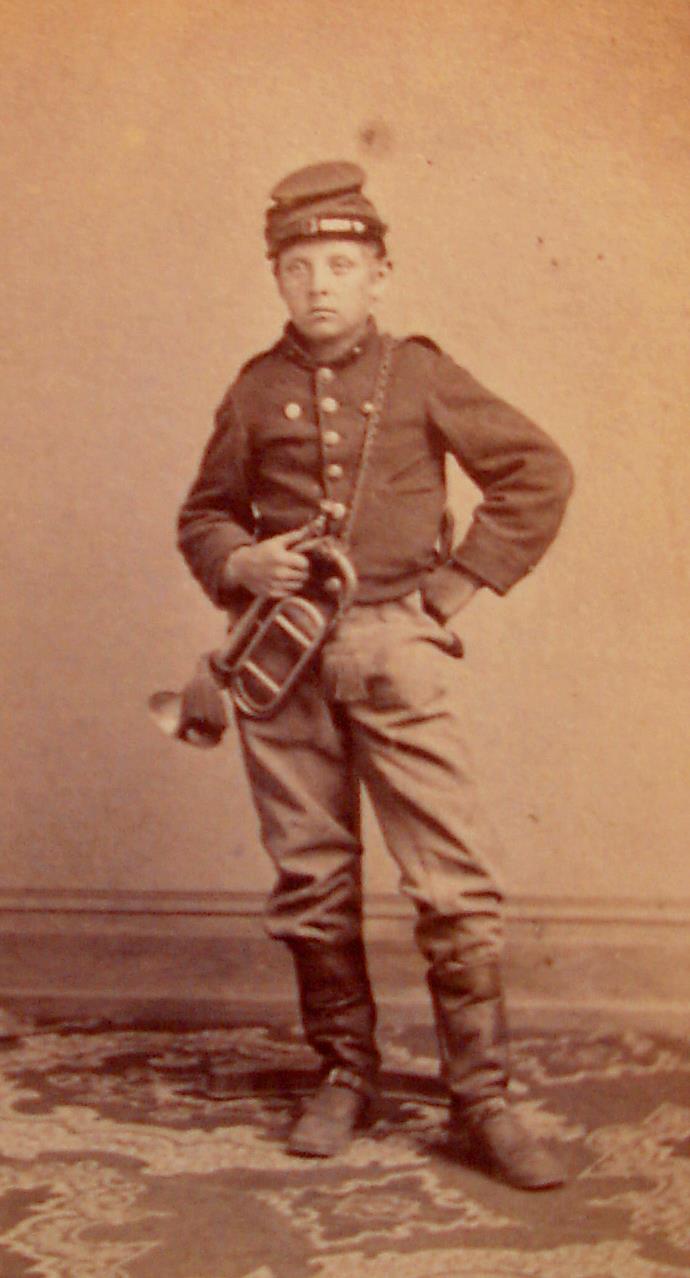
Gustav Albert Schurmann was born in 1849 in Westphalia, Prussia. The following year his father, a talented musician, decided to flee revolutionary Europe and emigrate to the United States, where he settled in New York City. In the US, young Gustav led an interesting life before he had even reached puberty. By the time he was fourteen, he had already saved a general, met Abraham Lincoln, spent a spell as a guest at the White House, befriended the president’s son, and been promoted to sergeant in the US Army.
An Eleven-Year-Old Soldier in the Mozart Regiment

As Gustav grew up, his father taught him how to play a variety of musical instruments. After the Confederates fired upon Fort Sumter in 1861, war fever engulfed the country. That spring, eleven-year-old Gustav was working the streets of New York City as a shoeshine boy. Like thousands who swarmed the recruiting stations eager to enlist, the young boy was swept up in the excitement.
Gustav wanted to get in on what seemed like the adventure of war, sought to join any regiment that would take him on as a drummer boy. His father had volunteered as a musician in the 40th New York Volunteer Infantry, later known as “The Mozart Regiment” because of the high percentage of musicians in its ranks, so young Gustav sought to follow in his father’s footsteps and join that regiment as well.

Rejected at first because of his age and small size, Gustav’s father asked the 40th New York’s colonel to at least hear the boy’s drumming. The lad being a musical prodigy who took after his father, the demonstration convinced the regiment’s commander to change his mind and add Gustav to the unit’s muster. Gustav’s regiment served in the Peninsula Campaign, during which the boy was loaned out to General Kearney for a day as an orderly during a grand review.
Impressed by the lad, the general ordered him to gather his gear from his regiment, and assigned him to his headquarters staff as orderly and principal bugler. Unfortunately, Gustav’s patron did not survive for long: General Kearney was killed in August of 1862. However, his replacement, General Birney, retained Gusav as orderly and bugler.
Catching the President’s Eye

After the bloody Battle of Antietam in the fall of 1862, Gustav was assigned to General Stoneman’s III Corps staff, and promoted to Corps bugler. After the Battle of Fredericksburg that December, the boy bugler was appointed to the staff of General Sickles, who promoted the then fourteen-year-old to sergeant as reward for gallantry displayed in combat.
During a grand review of the Army of the Potomac in April of 1863, Gustav caught President Lincoln’s eye, as well as the eye of the president’s youngest son, Tad. The two boys became fast friends, and Gustav was invited to the White House. Granted an extended furlough, young Gustav spent a happy period with Tad Lincoln and the rest of the president’s family.
The Child Soldier Who Saved a General

During the Battle of Chancellorsville, Gustav again displayed conspicuous courage, for which he was awarded a medal. Soon thereafter, at the Battle of Gettysburg, the lad again exhibited his bravery and coolness under fire. General Sickles had advanced his corps beyond the protection of supporting units. As a result, his men got cut to pieces by the Confederates. Amidst that chaos, Sickles’ leg was shattered by a cannonball.
Young Gustav helped save the general’s life by applying a tourniquet to stanch the bleeding. He went back with him to the hospital, and thence to Washington. There, President Lincoln figured the boy had already used up to too many of his lives. Lincoln ended Gustav’s Civil War service by ordering him back home to attend school, in preparation for West Point in a few years.
The End of Schurmann’s Civil War

Gustav Schurmann’s Civil War career had been quite eventful, to say the least. He had served as a bugler for five different generals, saw plenty of action, was recognized for his courage and was awarded medals, befriended the president’s youngest son and was guested at the White House. All in all, it was a generous dollop of the adventure and excitement the lad had sought when he enlisted.
After he received his discharge papers from the Union Army, Gustav returned to New York City to continue his education, in preparation for the US Military Academy at West Point. Lincoln’s assassination ended Gustav’s West Point prospects, so he went on with his life. Gustav Albert Schurmann settled in NYC, worked for the city in various departments, married, and raised a family. He died in 1905, at the age of 56.

_________________
Some Sources & Further Reading
Find a Grave – Gustav Albert Schurmann (1849 – 1905)
History Halls – Young Warriors: John Lincoln Clem, the US Army’s Youngest Sergeant
Keesee, Dennis M. – Too Young to Die: Boy Soldiers of the Civil War (2001)

