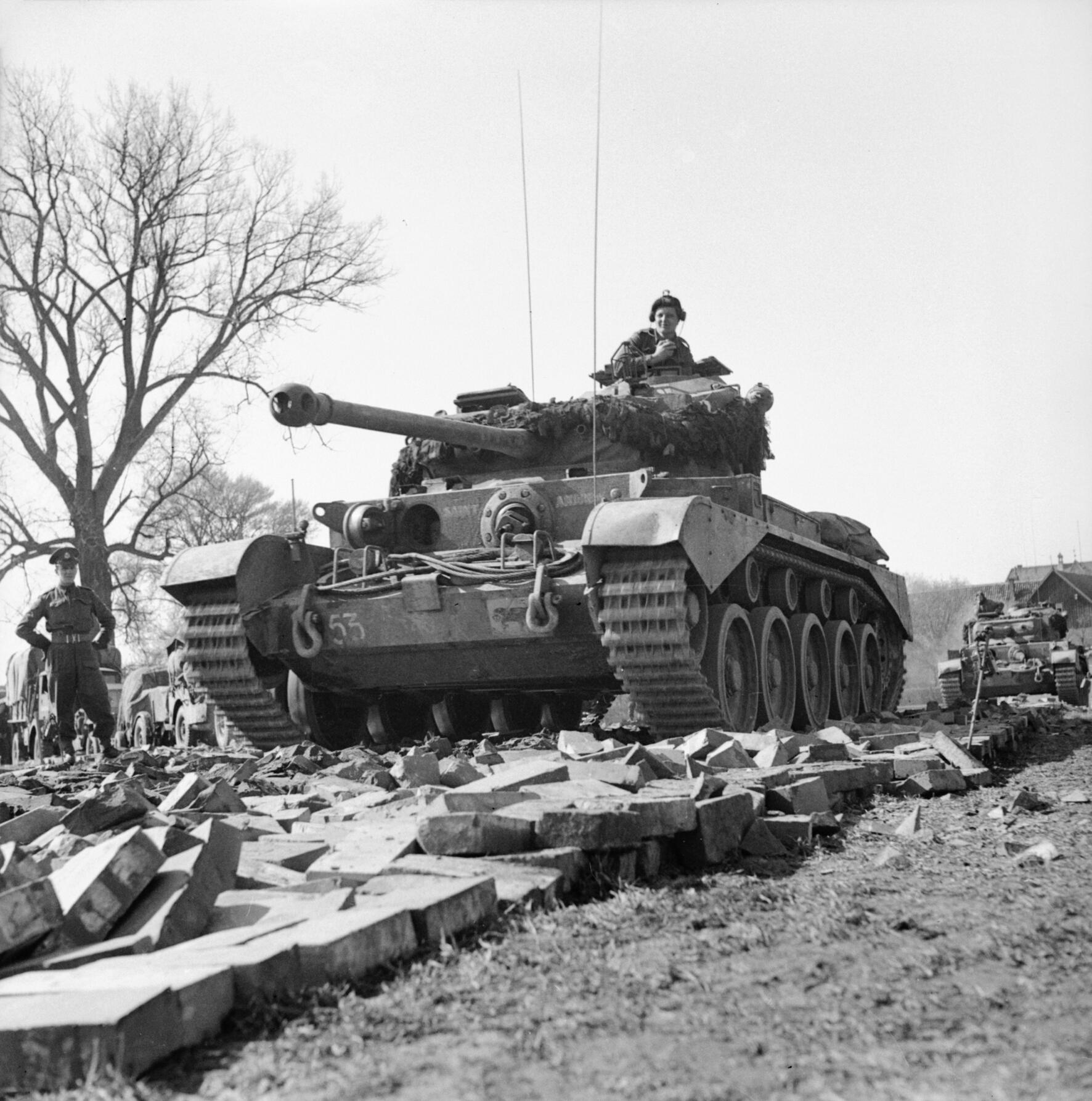
The British invented the tank in the First World War, and during that conflict and for years afterwards, British tanks were among the best in the world. By the 1930s, however, they were overtaken by the Germans and Soviets. When the Second World War began, British tanks were distinctly second rate, as they had not kept pace with new advances. In a historic irony, despite their poor reputation for tanks in World War II, the British ended that conflict with the world’s best tank – the one upon which all modern tanks are modeled. Unfortunately, for purposes of Britain’s war effort, it was fielded too late in the conflict to make much of a difference. Below are some facts about the British tank that arrived just too late to have a major impact on WWII.
The First Decent British Tank of WWII

The first British tank that combined decent armored protection with high speed – thanks to a reliable Rolls Royce Meteor engine – was the Cromwell, officially Tank, Cruiser, Mark VIII, Cromwell (A27M). By 1943, a new British tank was needed to handle the new Tigers and Panthers. The Cromwell’s turret was too small. It could not accommodate the best gun for destroying those panzers, the 77mm dual purpose high velocity (HV) gun. So it had to settle for an inadequate medium gun.
The result was the A34 Cruiser Tank Comet Mark I. It was arguably Britain’s best tank of the war, and its deadliest against enemy armor. The Comet was essentially an upgraded Cromwell. It was built on a modified Cromwell chassis with a larger turret ring. That allowed for a wider and bigger turret that could accommodate the 77mm HV gun. That gun was lethal against Panthers, the Comet’s German equivalent, and at most ranges, against Tigers as well. It was also superior to the Panther’s 75mm gun.

The Ancestor of the World’s First Main Battle Tank

When it entered service in 1944, the Comet’s superiority over the Panther was not limited to firepower. While the Panther had thicker armor, was roomier, and carried more ammunition, the Comet had a lower profile and was mechanically sounder. It also had a Rolls Royce Meteor engine – a conversion of the Merlin engine that powered P-51 and Spitfire fighter airplanes – that was far more reliable than the Panther’s Maybach engine. The Comet’s Christie suspension system was also more durable than the Panther’s.
The Comet weighed eleven tons less than the Panther, while powered by an engine that produced equivalent horsepower. That gave the Comet a better power to weight ratio, and afforded it greater acceleration that made the comet six miles per hour faster than the Panther. Comets continued in British service until 1958, and with other militaries until well into the 1980s. The Comet led directly to the development of the Centurion, Britain’s primary tank of the post WWII era, and the world’s first main battle tank – the concept upon which all tanks today are based.

Some Sources and Further Reading
Chamberlain, Peter, and Ellis, Chris – British and American Tanks of World War Two (2004)
History Halls – American Tanks of World War II: The M4 Sherman Medium Tank
Tanks Encyclopedia – A.34, Cruiser Tank, Comet

