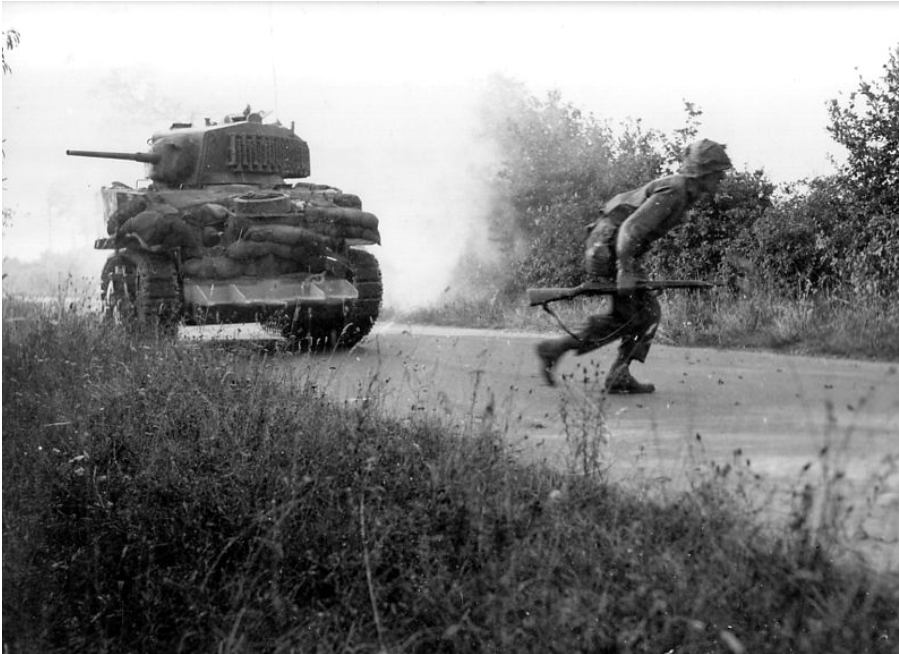
One of Hitler’s worst mistakes was to gratuitously declare war on the United States in December, 1941, after the Japanese attack on Pearl Harbor. The Fuhrer was under no treaty obligation to declare war on us just because the Japanese had, but he went ahead and did so anyhow. Less than four years later, American military might and industrial might, which entailed arming our forces and those of our allies tens of thousands of tanks, had helped grind the Third Reich to dust. Below are some fascinating facts about America’s WWII tanks.
The Stuart

After WWII began, American observers realized that the US Army’s standard light tank, the M2, had become obsolete. Its replacement was the M3 light tank, known as the Stuart. The Stuart designation referred to both the M3 and its derivative, the M5. The latter featured a new gun recoil system, an improved suspension, and thicker armor. It was initially armed with a 37mm gun, plus 5 machineguns: a coaxial affixed to the main gun, in ball mount to the right of the hull, in sponsons on the right and left of the hull, and atop the turret and pointing upward for antiaircraft duty.
The British gave the M3 the service name “Stuart” after US Civil War General J.E.B. Stuart. The designation was used both for the original M3, and its derivative, the M5. The British also nicknamed the Stuarts “Honeys” because the rode smoothly. Stuarts were heavily armored for light tanks of the era. M3 Stuarts were powered by a radial aero-engine, and were distinguished by a high silhouette. They had a prop shaft running through the middle of the crew compartment. That restricted space, and made for uncomfortably cramped fighting quarters.
A Formidable Light Tank

Because radial aero-engines were in high demand, the M3 was redesigned to use V8 engines, and furnished with an automatic transmission. That made driver training easier, and also made for a roomier, quieter, and cooler crew compartment. While they were at it, engineers gave the improved vehicle sloped glacis armor. The redesigned tank was designated the M5 Stuart, and began to replace the M3 in 1942. The Stuart holds the distinction of being the first American tank to take on enemy tanks during WWII.
In addition to serving with US ground forces, Stuarts were also furnished under Lend-Lease to the British, who used them in the North African Campaign. Nicknaming it the “Honey”, the British praised the Stuart’s mechanical reliability and speed. However, they failed to make good use of Stuarts, despite the fact that the Stuarts’ 37mm gun was equal to that of the most numerous German tank in the theater, the Panzer III, which the Stuart also matched in speed. It is notable that the “light” Stuart’s armor front and turret armor was even thicker than that of the medium German tank.

Shortcomings were revealed, however, such as limited range and a two man turret that reduced fighting efficiency. The Stuarts’ other main recipient, the Soviets, did not like them. On the Eastern Front, Stuarts were underarmored and undergunned; their aero-radial engines were gas hogs; were too sensitive to fuel quality; caught fire too easily; and consumed high octane gas which complicated logistics because other Red Army vehicles used diesel or low octane fuel. Additionally, the Stuart’s narrow tracks got stuck too easily in snow, and in the mud of the spring snow melt and autumn rains.
Some Sources and Further Reading
History Halls – German Tanks of World War II
Hunnicutt, R. P. – Stuart: A History of the American Light Tank (1992)
Tanks Encyclopedia – Light Tank M3 Stuart
Latest Articles
- The Johnstown Flood – Thousands Perished When A Dam Collapsed After Gilded Age Tycoons Modified it for their Private Resort
- The Jacquerie: The Medieval Peasant Uprising That Terrified France’s Aristocrats
- Things That Weren’t Thought Through: WWII’s Sticky Bomb Stuck to Users’ Hands Once Activated
- German Tanks of World War II – The Panzer 38(t), a Czech Tank in German Service
- Nicholas Alkemade: The WWII Airman Who Survived an 18,000 Foot Fall From a Bomber Without a Parachute

