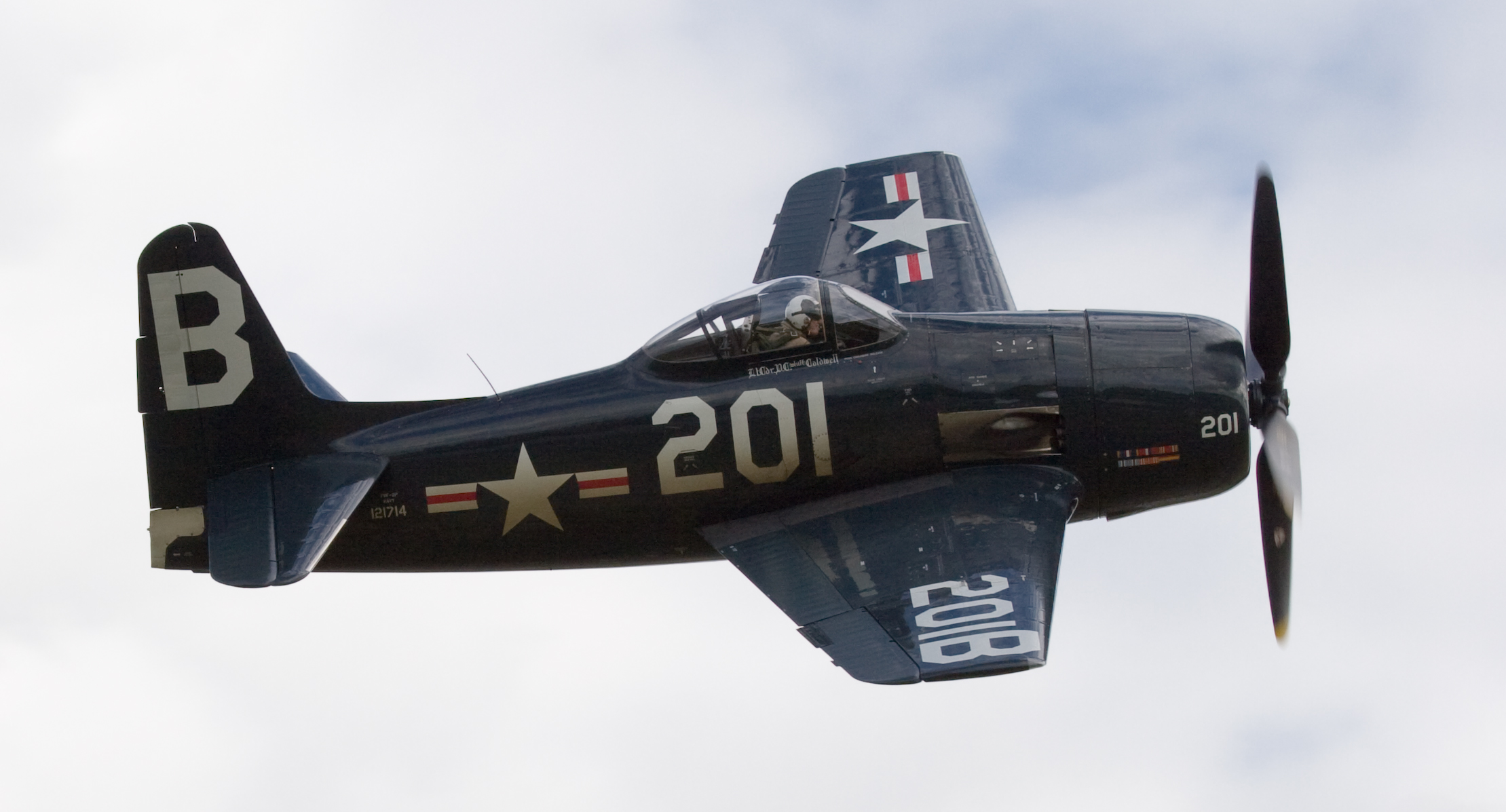
The Grumman F8F Bearcat was one of the last and most powerful piston-engine fighters ever built. Designed and produced in the war’s final stages, it was the pinnacle of World War II propeller-driven aircraft technology. The Bearcat embodied everything the US Navy had learned about air combat and carrier aviation. It entered service too late to see combat in WWII, but nonetheless became a legendary machine in postwar aviation circles for its blistering speed, incredible climb rate, and agility. It broke records as a racing aircraft, and became a favorite among naval aviators.
The F8F Bearcat Was Designed to be the Greatest Grumman ‘Cat’

The Bearcat’s development began in 1943, as the Grumman Aircraft and Engineering Corporation third “Cat” fighter. The company had designed and manufactured the F4F Wildcat, the fighter with which the US Navy started WWII, and was already producing its replacement, the F6F Hellcat, which became the Navy’s primary carrier fighter. The F8F Bearcat was intended as the Hellcat’s successor. The Hellcat was durable, effective, and highly successful, but it was also large and somewhat heavy. Grumman’s design team, led by Robert L. Hall and William Schwendler, envisioned a lighter, faster, and more agile aircraft that could outperform the Hellcat in every respect. The inspiration reportedly came from captured German Focke-Wulf Fw 190 fighters. Their compact size, high power-to-weight ratio, and exceptional roll rate impressed American engineers.
The Bearcat was conceived as an interceptor, optimized for rapid climb and close-range air superiority rather than long-range patrols. Grumman’s engineers set out to build the smallest possible airframe around the most powerful available engine. That was the Pratt & Whitney R-2800 Double Wasp, a two-row 18-cylinder radial that could produce up to 2,100 horsepower. To minimize weight, they reduced fuel capacity and armament compared to earlier fighters, and focused instead on speed and climb rate. The Bearcat’s wings were designed to be shorter and thinner than the Hellcat’s, with a manual folding mechanism for carrier storage. The fuselage was streamlined with a bubble canopy for excellent visibility, and the tail was enlarged for greater control at high speeds.
An Unmatched Combination of Speed and Agility

The prototype, designated XF8F-1, first flew on August 21st, 1944, with test pilot Bob Hall at the controls. From the first flight, it was clear the Bearcat was something special: the aircraft demonstrated extraordinary acceleration and maneuverability. The Bearcat was slightly slower than another Navy fighter, the F4U Corsair, but it was more nimble, and climbed much faster. Maximum speed was 424 mph at 20,000 feet, and it could climb to that altitude in just over four minutes. Such a combination was unmatched by any Allied piston fighter of the time. The Bearcat’s takeoff distance was remarkably short, ideal for carrier – and especially small escort carrier – operations. Pilots noted its excellent handling characteristics, and ease of control even at high speeds.
The Bearcat was about 20 percent faster and 30 percent lighter than the Hellcat. Yet, it still retained much of Grumman’s trademark ruggedness. The Navy was so impressed that it ordered production even before testing was complete. It was that confident that the aircraft would be an exceptional addition to the fleet. The Bearcat’s design combined simplicity with advanced engineering. The R-2800 engine, paired with a large four-bladed propeller, gave it superb thrust. Its light weight – around 9,000 pounds empty – contributed to a phenomenal climb rate of more than 4,500 feet per minute. The landing gear was exceptionally tall to accommodate the large propeller. Grumman’s engineers had to devise a clever mechanical locking system to ensure the gear’s durability during carrier landings.
Breakaway Wingtips

The aircraft’s armament consisted of four .50 caliber M2 Browning machine guns mounted in the wings. Bombs or rockets could also be carried under the wings for ground-attack missions. Some variants were equipped with 20 mm cannons, although that was less common in US Navy service. The Bearcat was the Navy’s first fighter with a bubble canopy. That offered superb all-around visibility – an important factor in dogfighting. The wings were foldable for ease of storage aboard carriers, but not close to the fuselage, as with other US Navy fighters with folding wings. That would have made the wings more sturdy, but also required a heavier wing folding mechanism. Saving weight was the name of the game with the Bearcat, so wings were made foldable towards the tips. That could be done with a lighter folding mechanism, and thus saved weight.
There was a cost, though: the wingtips could snap off under extreme stress of more than 7.5 Gs. The solution was a unique feature: breakaway wingtips, designed to shear off under extreme stress rather than cause catastrophic structural failure. That too came at a cost: if only one wingtip snapped off instead of both, it could send the plane into a fatal spin. So explosives were placed on the wingtips to ensure that both could be blown off if necessary. That was abandoned, though, after an accidental explosion killed a ground crewman. So Bearcat pilots were simply instructed to avoid maneuvers that could subject their airplanes to stresses greater than 7.5 Gs.
A Superb Fighter That Arrived Just Too Late for WWII Combat

Deliveries of the initial production version, the F8F-1, began in early 1945. Grumman produced around 770 Bearcats before war’s end. However, Japan’s surrender in August, 1945, meant that the F8F arrived too late to see combat in WWII. The improved F8F-1B variant featured cannons, and the F8F-2, introduced later, had a taller tail fin and improved engine cowling for better aerodynamics. The F8F-2 was capable of speeds up to 455 mph, which made it one of the fastest piston-engine fighters ever built. Grumman also produced photo reconnaissance and trainer models.
1,265 Bearcats were manufactured before production ended in 1949. It entered service with Navy and Marine fighter squadrons just after WWII, and became operational aboard carriers such as the USS Langley and USS Tarawa. Pilots praised the aircraft’s responsiveness and power: it could out-climb and outturn almost any opponent. In mock dogfights, it outperformed the vaunted P-51 Mustang and F4U Corsair. The Bearcat was so nimble that in 1946, it replaced the Hellcat on the Navy’s Flight Demonstration Squadron, the Blue Angels.
Impressive as the Bearcat was, jet fighters soon made it and all piston designs obsolete. By 1949, the Navy began a transition to jets like the F9F Panther, and the Bearcat was relegated to secondary roles. Though its US service life was short, the Bearcat saw combat in foreign hands. The French Air Force used Bearcats extensively during the First Indochina War, 1946 – 1954, where it proved highly effective in ground attack and close air support roles. The Royal Thai Air Force and the South Vietnamese Air Force also operated Bearcats into the 1960s.
The Bearcat Embodied Peak Piston Engine Fighter Design and Technology

While the Bearcat’s military career was brief, its postwar legacy was extraordinary. The aircraft’s raw power and agility made it a favorite among air racers in the 1950s and beyond. Many surplus Bearcats were purchased by private pilots and modified for racing, with stripped-down airframes and boosted engines. One of the most famous examples was “Rare Bear”, a heavily modified F8F that became a legend in the Reno Air Races. Rare Bear set several world speed records for piston-engine aircraft, including 528.33 mph in 1989.
It was a testament to the aircraft’s unmatched performance potential, even four decades after its debut. A handful of Bearcats survive today in museums and private collections, many restored to flying condition. They remain crowd favorites at airshows, where their thunderous radial engines and sleek lines capture the essence of late WWII aviation design. The Grumman Bearcat represented the culmination of the piston engine fighter era. Every lesson learned from earlier naval aircraft – the balance of strength, lightness, and agility – was distilled into this design.
Legacy of the Grumman F8F Bearcat

Although the Bearcat missed out on front line combat in WWII, it demonstrated just how far piston engine technology could be pushed before jet propulsion rendered it obsolete. In many ways, the Bearcat symbolized the transitional period of aviation history between propeller-driven warplanes and the dawn of the jet age. Faster and more powerful than its predecessors, it was nonetheless destined to be replaced within a few short years. The aircraft’s design philosophy of lightweight construction, high power-to-weight ratio, and excellent visibility, continued to influence jet fighter design for decades to come.
The Grumman F8F Bearcat was an aircraft born at the very edge of technological transition. Designed for a war that ended before it could prove itself, it nonetheless achieved legendary status through its performance, engineering brilliance, and later achievements in peacetime aviation. The US Navy’s last great piston engine fighter remains a masterpiece of aeronautical design, blending power, precision, and simplicity. In aviation history, the Bearcat stands as a symbol of the piston era’s final triumph before the roar of jet engines permanently changed the skies.

_________________
Some Sources & Further Reading
Chant, Christopher – Grumman F8F Bearcat Super Profile (1985)
Francillon, Rene J. – Grumman Aircraft Since 1929 (1989)
History Halls – World War II Fighters: America’s F6F Hellcat, ‘The Ace Maker’
Scrivner, Charles L. – F8F Bearcat in Action (1990)

