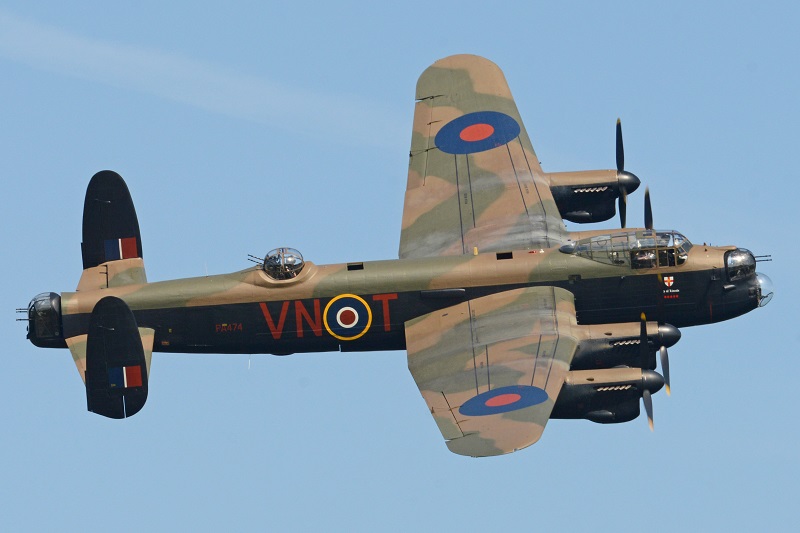
When most people picture World War II bombers raining destruction down on the Axis, what usually comes to mind are iconic famous American heavy bombers such as the B-17 Flying Fortress, the B-24 Liberator, and the B-29 Super Fortress. However, the bomber that dropped the most tonnage in the war was not American. It was the British Royal Air Force’s Avro Lancaster.
An Icon Born Out of Failure

The Avro Lancaster was one of WWII’s most important and iconic heavy bombers. It became synonymous with Britain’s strategic bombing campaign against Nazi Germany. Designed and built by A. V. Roe and Company (Avro), the Lancaster combined large bomb-load, long range, and robust construction. Those qualities made it the Royal Air Force’s principal night bomber from 1942 until the end of the war. Its operational history, technical features, and cultural legacy have ensured its lasting place in aviation and military history.
The Lancaster’s origins lay in failure. Its predecessor, the Avro Manchester, had been designed as a twin-engine heavy bomber powered by the new Rolls-Royce Vulture engines. In theory, the Manchester promised high performance with fewer engines. In practice, the Vulture proved unreliable and underdeveloped. Engine failures, insufficient power, and structural issues plagued the aircraft, which led to poor operational performance and heavy losses. Avro’s chief designer, Roy Chadwick, did not want to abandon the Manchester airframe, though, which was quite sound. His solution was to replace the two unreliable Vulture engines with four of the proven Rolls-Royce Merlin engines. That change transformed the design. The new aircraft, initially designated the Avro Type 683, first flew in January, 1941. It quickly demonstrated excellent handling and performance. It was named the Lancaster after the English county, following Avro’s convention of naming bombers after British regions.
The Avro Lancaster Could Carry WWII’s Heaviest Bomb Load

The Avro Lancaster was a large, mid-wing monoplane with an all-metal stressed-skin construction. Its four Merlin engines gave it a maximum speed of around 280 mph (450 km/h) at altitude and a typical operational ceiling of about 23,000 feet. However, that varied depending on load. The Lancaster had a wingspan of over 102 feet and a length of nearly 70 feet. That gave it an imposing presence both on the ground and in the air. It usually had a seven-man crew: pilot, flight engineer, navigator, bomb aimer, wireless operator, and two gunners (mid-upper and rear). That arrangement reflected the complexity of night bombing operations, which required constant coordination between navigation, engine management, and defensive awareness.
One of the Lancaster’s most defining features was its bomb bay. Most contemporary bombers used multiple smaller bays or structural divisions. The Lancaster had a long, unobstructed bomb bay that ran through much of the fuselage length. That allowed it to carry exceptionally large and heavy weapons. Initially, the standard bomb load was around 14,000 pounds, already impressive for its time. As the war progressed, the Lancaster was adapted to carry even larger bombs. That included the 4,000-pound “Cookie” high-capacity bomb, and later the 8,000 and 12,000-pound “Tall Boy” versions. No other bomber could carry such weapons without major modification. Indeed, with some modification, Lancasters could carry the 22,000-pound “Grand Slam” – the heaviest payload of any WWII bomber.
Lancasters Bombing at Night Became More Accurate than American Daylight Heavy Bombers

Defensive armament on the Avro Lancaster reflected RAF Bomber Command’s emphasis on night operations rather than daylight self-defense. Early versions typically carried eight .303-inch Browning machine guns mounted in three turrets: a two-gun nose turret, a two-gun dorsal (mid-upper) turret, and a four-gun tail turret. Later variants sometimes replaced the nose turret with a radar blister or removed it entirely to save weight. The Lancaster was not heavily armed by American daylight bomber standards. However, its defensive layout was considered adequate for night fighting, especially when combined with formation flying and electronic countermeasures. The Lancaster entered squadron service with the RAF in early 1942. It quickly proved itself superior to earlier bombers such as the Halifax, Wellington, Hampden, and Whitley. It became the backbone of Bomber Command.
Operating mainly at night, Lancasters participated in the strategic bombing offensive against Germany, targeting industrial centers, transportation networks, and cities. Those operations were intended to undermine German war production and morale. They also resulted in significant civilian casualties, and remain a subject of historical debate. By WWII standards, Lancasters were capable of great precision. Equipped with ground-mapping radar, by 1944 they could bomb at night with higher accuracy than American bombers could during daylight. In the runup to D-Day, Lancasters accurately bombed communications and transportation targets such as bridges and rail yards.
WWII’s Precision Heavy Bomber

The Lancasters’ precision allowed them to conduct one of WWII’s most famous operations, the 1943 raid on the Ruhr dams, officially known as Operation Chastise and commonly the Dambusters Raid. For this mission, specially modified Lancasters of No. 617 Squadron were used to deploy Barnes Wallis’s revolutionary “bouncing bomb”. The aircraft were stripped of unnecessary equipment, and fitted with special mounting gear. They were then flown at extremely low altitude and precise speed to release the spinning bombs, which bounced like skipping stones to the dams. The successful breaches of the Mohne and Eder dams caused widespread flooding and disruption to German industry. It came at the cost of heavy aircraft and crew losses, though.
The Dambusters Raid became one of the most celebrated episodes in RAF history. It cemented the Lancaster’s reputation for adaptability and precision. Another remarkable example of the Lancaster’s versatility came with the introduction of Barnes Wallis’s “earthquake” bombs, the Tallboy (12,000 pounds) and the even larger Grand Slam (22,000 pounds). Those weapons were designed to penetrate deep into the ground or concrete before detonation. They created shockwaves capable of destroying heavily fortified targets such as U-boat pens, bridges, and hardened bunkers.
Carrying those bombs required extensive modification to the Lancaster, including strengthened airframes, removal of turrets, and altered bomb bay doors. Modified aircraft of 617 Squadron and later 9 Squadron used Tallboys and Grand Slams to devastating effect, destroying targets previously considered nearly invulnerable. Lancasters flown by 617 Squadron also sank the battleship Tirpitz in 1944 with 12,000 pound “Tall Boys”. Towards war’s end, Lancasters were used in Operation Manna, a mercy mission that dropped food into Holland to avert starvation.
The Frightful Firestorms

On routine bomber raids, Lancasters typically carried large high explosive 2000 or 4000 pound bombs, and heavier “blockbusters”. Mixed in were clusters of smaller incendiary bombs. The big bombs were intended to tear open buildings, then the incendiaries would start fires in their now well-ventilated innards. The blockbusters would hopefully have also ruptured the city’s water mains, making firefighting difficult or impossible. That allowed individual fires to coalesce into larger conflagrations that, if conditions were ripe, could produce firestorms. Firestorms produced hurricane strength walls of flame and whirling tornados of fire that swept and danced through cities. They could kill tens of thousands by burning them to cinders or, as the stories-high inferno sucked oxygen out of the air, suffocating those whom the flames did not touch.
The Avro Lancaster was continually refined throughout the war. The most common version was the Lancaster B.I, powered by Rolls-Royce Merlin engines. The B.III variant used Packard-built Merlins produced in the United States. Other variants included the B.II, fitted with Bristol Hercules radial engines to reduce dependence on Merlin production. The B.IIs were less common, though. Specialized versions were adapted for maritime patrol, photographic reconnaissance, and postwar transport duties. Despite its strengths, the Lancaster was not invulnerable. Night bombing was extremely dangerous, and Bomber Command suffered heavy losses throughout the war.
The Avro Lancaster Carried Nearly Two Thirds of the RAF’s Bomb Tonnage in Europe

German night fighters, flak, and increasingly sophisticated radar and interception systems took a steady toll on Avro Lancaster crews. Survival rates were grim. Bomber crews braved multiple tours of operations with the constant risk of being shot down, killed, or captured. The Lancaster was relatively slow speed, and its defensive armament limited. If intercepted, it relied heavily on evasive maneuvers, electronic countermeasures, and luck. The Lancaster’s heaviest payload of 22,000 pounds exceeded the 20,000 pound maximum payload of the bigger and more advanced B-29. The Lancaster weighed only half what a B-29 did.
Once introduced, Lancasters took part in nearly every major Bomber Command campaign. They bombed German ports, and conducted massive attacks on cities like Hamburg, Berlin, and Dresden. Their contribution to the Allied victory was immense, even as historians continue to debate the strategic effectiveness and moral implications of the bombing campaign they enabled. Lancasters carried the lion’s share of the RAF’s strategic bombing campaign. By war’s end in Europe in May, 1945, Lancasters had hauled 64% of the total tonnage dropped by Bomber Command.

Lancasters remained in service for several years after the war. Some were converted for transport and rescue roles, while others were used in experimental and testing capacities. A maritime reconnaissance variant, the Avro Lancaster MR.3, served with Coastal Command before being superseded by the Avro Shackleton, a design that itself evolved from the Lancaster’s airframe. Export versions were supplied to several countries, including Canada, France, and Argentina. That extended the type’s operational life into the late 1940s and early 1950s.
Legacy of the Avro Lancaster

Culturally, the Avro Lancaster has become an enduring symbol of the RAF and the WWII generation. The iconic bomber’s deep, distinctive engine note and imposing silhouette evoke strong emotions in Britain and beyond. Several Lancasters have been preserved in museums and flying condition. Most notably, the Battle of Britain Memorial Flight’s aircraft in the United Kingdom, and another maintained in Canada. Those surviving examples are powerful memorials to the thousands of aircrew who flew and died in Lancasters during the war.
The Avro Lancaster was one of its era’s finest heavy bombers. It was not the fastest or most technologically advanced aircraft of WWII. However, it struck a highly effective balance between payload, range, reliability, and adaptability. Its ability to carry unprecedented bomb loads and be modified for specialized missions gave it flexibility unmatched by most contemporaries. Above all, the Lancaster was defined by the men who flew it, often under appalling conditions and at great personal risk. Together, aircraft and crew formed a central pillar of Britain’s war effort.

_________________
Some Sources & Further Reading
Chant, Christopher – Lancaster: The History of Britain’s Most Famous World War II Bomber (2003)
Hastings, Max – Bomber Command (1999)
History Halls – WWII Bombers: Britain’s Handley Page Halifax
Holmes, Harry – Avro Lancaster: The Definitive Record (1997)
Latest Articles
- Edward England, the Humane Pirate Captain Deposed by His Men for Being Too Nice
- American Presidents: Abraham Lincoln, Hall of Fame Wrestler
- Henry Jennings: The Privateer-Turned-Pirate Who Set the Stage for the Caribbean’s Golden Age of Piracy
- Fighting Women: Tomoe Gozen, the Fearsome Female Samurai
- From the NFL to the Sands of Iwo Jima: Medal of Honor Recipient Jack Lummus

