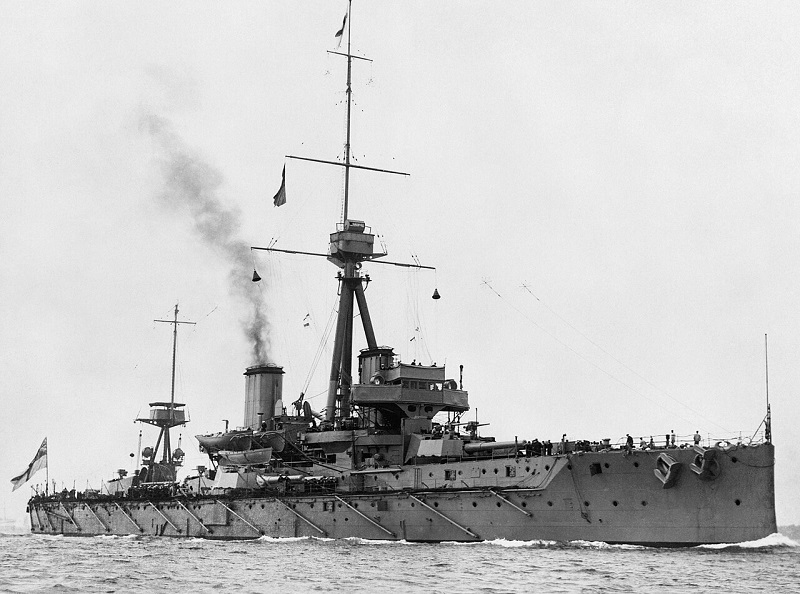
When HMS Dreadnought slipped into the waters of Portsmouth on February 10th, 1906, she was not just a new battleship. She was a floating revolution and a thunderclap that changed naval warfare forever. Her name became synonymous with an entire warship class, and her impact rippled through every major early twentieth century navy. The Dreadnought rendered every other battleship afloat at the time of her launch obsolete, triggered a global arms race, and reshaped strategies, shipbuilding, and geopolitics in ways that defined World War I and beyond.
A New Naval Gunnery Philosophy

Dreadnought had such a massive impact that soon as she was commissioned, all battleships before became known simply as “pre-dreadnoughts”. Those ships, which dominated the world’s fleets in the late nineteenth and early twentieth centuries, followed a mixed-armament design. Typically, they carried four large guns, often around 12 inches, in two twin turrets, one forward and one aft. They were supplemented by numerous smaller, faster-firing secondary guns of various calibers. The idea was to engage enemy ships at both long and medium range. At long distances, the big guns would open up. Once the distance closed, the smaller guns would join them and provide rapid fire to overwhelm opponents.
However, the rapid development of gunnery technology, fire control, and propulsion soon made that mixed configuration outdated. The effective range of naval guns increased dramatically, thanks to better optics, hydraulic recoil systems, and more accurate range finding. Battles were no longer expected to take place at short distances where mixed armament could be useful. Instead, fleets envisioned duels fought at ever greater ranges, where only the heaviest guns could reach the enemy. In that emerging reality, secondary batteries became dead weight. The Japanese victory over Russia in the 1905 Battle of Tsushima highlighted that shift.
The All-Big-Gun Design

At the Battle of Tsushima, the Japanese fleet, led by Admiral Togo Heihachiro, used superior fire control and longer-ranged heavy guns to destroy much of the Russian Baltic Fleet. Observers around the world noted that concentrated salvos of large guns were decisive. That confirmed that the future lay in “all-big-gun” ships. Admiral Sir John “Jackie” Fisher, a reform-minded officer who became First Sea Lord in 1904, paid special attention to that. Fisher was convinced that Britain’s naval supremacy was being challenged by technological stagnation. He believed the Royal Navy needed ships that were faster, more heavily armed, and more efficient than anything else afloat. He became the driving force behind Dreadnought.
Fisher pushed for the construction of a revolutionary new type of battleship, based on clear guiding principles. First, he wanted uniform, large caliber guns, for maximum firepower and simplified gunnery. Second, he wanted higher speed, to allow the ship to control engagement distance and outmaneuver opponents. Third, he wanted advanced propulsion and the replacement of outdated coal-fired engines with modern turbine technology. He found the perfect moment to act. British shipyards were the most advanced in the world, and new developments in steel and engineering could make his vision possible. In 1905, under Fisher’s direct supervision, construction of HMS Dreadnought began at record speed.
The Revolutionary HMS Dreadnought

When HMS Dreadnought was launched in 1906, her combination of technological breakthroughs made her far superior to any existing battleship. Dreadnought, which means “fear nothing”, was armed with ten 12-inch Mark X guns. They were arranged in five twin turrets – two on the centerline fore and aft, and three on the wings. That allowed her to fire up to eight guns in a broadside. The uniform caliber simplified fire control and increased accuracy at long ranges, since spotters no longer had to distinguish between splashes from different-sized shells.
At 850 pounds per shell, an eight-gun Dreadnought broadside could hurl nearly 7,000 pounds of steel at an enemy. That far outclassed earlier pre-dreadnoughts that could manage only about half that weight. Her maximum firing range exceeded 20,000 yards – more than ten miles – an extraordinary reach for the time. Another groundbreaking feature was Dreadnought’s steam turbine engines, designed by Charles Parsons. Traditional reciprocating engines were powerful but heavy, complex, and prone to vibration. Parsons’ turbines were lighter, smoother, and far more efficient at high speeds. As a result, Dreadnought could achieve 21 knots, which made her the world’s fastest battleship.
Resetting the Naval Competition

Dreadnought’s speed gave her strategic flexibility. She could dictate the terms of battle, pursue weaker fleets, or disengage when needed. It also meant that older ships could not keep pace, which further magnified her advantage. Despite her speed and armament, Dreadnought did not sacrifice protection. Her belt armor was up to 11 inches thick, with reinforced turrets and an armored deck. The arrangement followed lessons learned from earlier battles, and protection was focused around magazines and vital machinery. The design balanced offensive power and defensive strength more efficiently than ever before. Dreadnought incorporated some of her era’s most sophisticated range finding and gunnery. Centralized fire control allowed coordinated salvos rather than independent gunfire, which dramatically increased accuracy. That reflected the growing understanding that naval battles would be determined by the ability to deliver accurate fire from extreme distances.
The unveiling of HMS Dreadnought stunned the world. No other nation had a ship that could match her capabilities, but ironically, her appearance leveled the playing field. Before Dreadnought, Britain’s Royal Navy was already the world’s most powerful – and a by a long shot. The introduction of Dreadnought instantly made every other battleship, whether British or foreign, obsolete. Even the Royal Navy’s own massive fleet of pre-dreadnoughts, built at great expense, was suddenly outdated. Competitors no longer had to try and catch up with the Royal Navy’s massive lead in pre-1906 battleships. Now, the slate was clean. Rivals could make a fresh start in a new competition, focused solely on competing with the British in Dreadnought-like battleships.
HMS Dreadnought Fueled the Tensions that Led to World War I

The introduction of HMS Dreadnought in 1906 meant that any naval power that wanted to be taken seriously from then on had to have battleships equal to – or better than – the British behemoth. The result was the “Dreadnought Race” – a global naval arms competition that pitted the world’s great powers against one another. Germany, the United States, Japan, Italy, and Russia all began to build dreadnought-type ships as quickly as possible. The competition was fiercest between Britain and Germany, whose growing industrial might and ambitions under Kaiser Wilhelm II challenged British naval supremacy.
Britain won the Dreadnought Race. By 1914, she had twenty-nine dreadnoughts compared to Germany’s seventeen, and the gap was growing, as the rate of British dreadnought production exceeded that of the Germans. However, the financial costs and political pressures of maintaining such dominance were immense. Naval expenditure soared, public opinion hardened, and the rivalry between the two nations deepened. Kaiser Wilhelm wanted a strong navy both for prestige, and to strengthen Germany’s hand in negotiations with the British. To the British, the stakes were far higher than prestige or bargaining chips. Germany’s survival did not depend on her navy, but Britain’s survival most certainly did. The Kaiser’s failure to understand that his push for a strong German navy able to challenge the Royal Navy was seen by the British as a knife pointed at their throat fueled the tensions that led to WWI.
Dreadnought in Peace and War

HMS Dreadnought saw little combat. She spent much of her career with the Home Fleet, in which she served as a flagship and symbol of British might. It was during that time that she became the subject of one of Britain’s most epic pranks, in which a group, including a young Virginia Woolf, disguised themselves as Abyssinian royalty and got a guided tour of the Royal Navy’s most prestigious ship. For all her massive impact on naval warfare and geopolitics, Dreadnought’s impact in the actual war her launch helped trigger was minor. Her only notable wartime action came in March, 1915, when she rammed and sank the German submarine U-29. That made her the only battleship ever to sink a submarine by ramming. By the time of the Battle of Jutland in 1916, Dreadnought herself was no longer the most powerful ship afloat.
Newer British and German designs, known as super dreadnoughts, had larger guns of 13.5 or 15 inches, and better armor. Nonetheless, HMS Dreadnought remained a potent symbol of naval innovation until she was decommissioned in 1920 and scrapped in 1923. By then, the revolution sparked by Dreadnought had extended far beyond her hull. She changed how nations thought about naval power, and redefined the meaning of supremacy at sea. Dreadnought brought a major transformation, as naval strategy shifted from blockades and commerce raiding to decisive fleet engagements between dreadnought squadrons. Possession of such ships became the ultimate measure of national power.
Legacy of HMS Dreadnought

Dreadnought had a massive impact on industrial mobilization as well. Building dreadnoughts required massive shipyards, foundries, and advanced engineering industries. Naval expansion became a test of a nation’s industrial capacity, and tied military power directly to economic might. She also became a major catalyst of technological acceleration. The dreadnought race drove rapid innovation in metallurgy, propulsion, and fire control. Each innovation paved the way for even more advanced warships. Within a decade, that technological momentum led to super-dreadnoughts, battle cruisers, and eventually, aircraft carriers.
Dreadnought’s launch in 1906 had significant political and diplomatic consequences. The increasingly heated competition for dreadnought superiority strained and worsened international relations. The Anglo-German naval race was one of the key factors that worsened pre–WW I tensions and contributed to the atmosphere of mistrust and militarization. Although HMS Dreadnought herself had a relatively short active life, her legacy was monumental. She inaugurated the “dreadnought era”, in which battleships dominated naval strategy until aircraft carriers supplanted them in World War II.
Dreadnought’s design principles – concentration of firepower, speed, and technological integration – became the standard for decades. Even today, the term “dreadnought” evokes the image of overwhelming power and modernity. In less than a year, one ship overturned decades of naval design philosophy, rewrote strategic doctrines, and reshaped the balance of world power. In the end, HMS Dreadnought was more than just a ship – she was the embodiment of a revolution. A steel leviathan, she ushered in the modern age of naval warfare.

_________________
Some Sources & Further Reading
Blyth, Robert J. et al. eds. – The Dreadnought and the Edwardian Age (2011)
Massie, Robert K. – Dreadnought: Britain, Germany, and the Coming of the Great War (1991)
If you liked this, you will like History Halls – The Dreadnought Hoax: When Virginia Woolf Put on Blackface to Prank the Royal Navy

