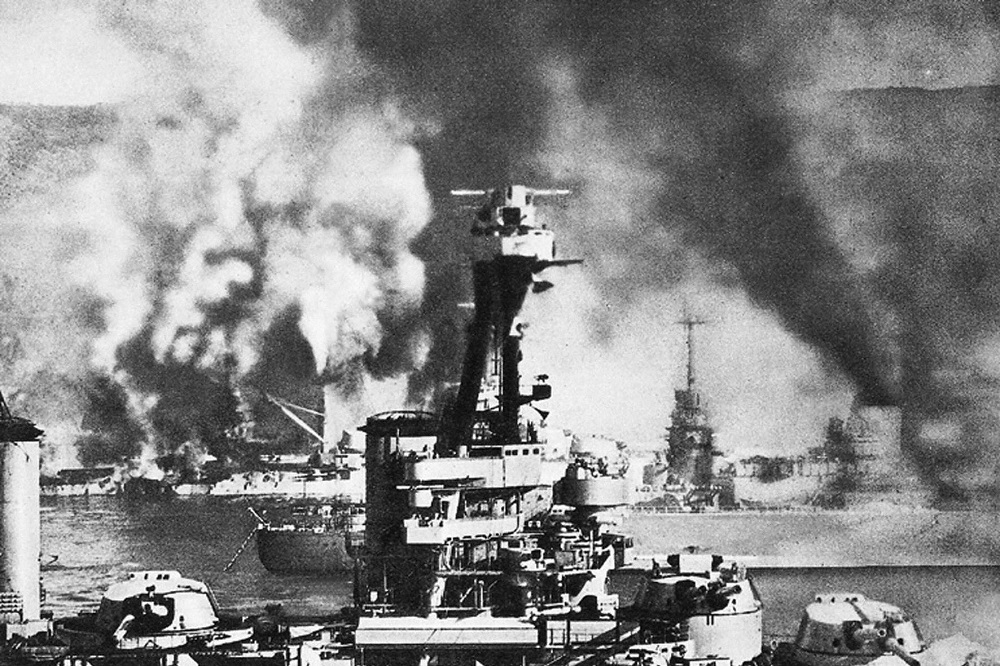
The British attack on Mers-el-Kebir on July 3rd, 1940, was one of World War II’s most controversial and tragic episodes. It involved the Royal Navy firing on its former ally, the French Navy, only weeks after France’s defeat by Germany. The action, officially known as Operation Catapult, resulted in the deaths of nearly 1,300 French sailors. It also cast a long shadow over Anglo-French relations for years. From the British perspective, however, the attack was driven by stark strategic fears and a sense of existential urgency at a moment when Britain stood alone against Nazi Germany.
The French Navy in 1940

In June, 1940, France collapsed with shocking speed under the German blitzkrieg. Paris fell on June 14th, and on the 22nd, the French government signed an armistice with Germany at Compiegne. A separate armistice with Italy followed shortly thereafter. Britain suddenly found itself without its principal continental ally and facing the full weight of German military power. The possibility of a German invasion of Britain loomed large. Central to British anxiety was the fate of the French Navy, the Marine Nationale.
At war’s outbreak, the French Navy was the world’s fourth-largest, with modern battleships, cruisers, and destroyers. Were those ships to fall into German hands, they could dramatically alter the naval balance in the Atlantic and Mediterranean. Britain’s sea lanes would be threatened, and invasion would become more feasible. The armistice terms stated that French ships would be disarmed and placed under German or Italian supervision. Hitler wanted to avoid provoking the French Navy into resistance, and preferred to neutralize rather than seize it outright. He promised to let the French retain control, but he had broken many international promises before. British leaders – especially Prime Minister Winston Churchill – were deeply skeptical. They feared that German promises could not be trusted and that, under pressure or later circumstances, the ships might be turned against Britain.
The British Nightmare of French Ships in German Hands

Churchill later wrote that the French fleet represented “the one factor which might tip the balance decisively against us”. It was in that atmosphere of desperation that Britain decided to act unilaterally. Operation Catapult was the British plan to neutralize the French fleet wherever it could be found. It involved several different actions across the globe. French ships in British ports were boarded and seized by surprise in the early hours of July 3rd, 1940. Bloodshed was kept to a minimum. In Alexandria, Egypt, where a French squadron lay alongside the Royal Navy, negotiations led to a peaceful resolution. The French agreed to let the ships get interned under British supervision.
It did not go smoothly everywhere, however. The most dangerous and dramatic situation was at Mers-el-Kebir, near Oran in French Algeria. There, a powerful French squadron lay at anchor under the command of Admiral Marcel-Bruno Gensoul. The force included the modern battleships Dunkerque and Strasbourg, the older battleships Bretagne and Provence, six destroyers, and seaplane tenders. Pitted against them was Force H, the British Mediterranean squadron based at Gibraltar, commanded by Admiral Sir James Somerville. His flagship was the battle cruiser HMS Hood, accompanied by the battleships Valiant and Resolution, the aircraft carrier Ark Royal, and several cruisers and destroyers.
The Ultimatum at Mers-el-Kebir

Somerville sent an ultimatum to Gensoul on the morning of July 3rd. The British terms were stark and left little room for compromise. The French ships were offered four options. One, sail with the British fleet and continue the fight against Germany. Two, sail to a British port and be interned for the duration of the war. Three, sail to a French port in the West Indies or the United States, where they would be disarmed and remain out of the war. Four, scuttle their ships within six hours.
If none of these options were accepted, Somerville was ordered to destroy the French fleet. Somerville sent the ultimatum through a French-speaking officer, Captain Cedric Holland. He arrived in Mers-el-Kebir on a destroyer, and things immediately got off to a bad start. Gensoul was insulted that a lower ranking officer, a captain, had been sent to negotiate with him, an admiral. He refused to meet Holland in person, and sent a lower ranking officer to negotiate with him instead. That led to significant delay and confusion. From the British point of view, the inclusion of the West Indies or the United States option was intended as a reasonable compromise. It removed the ships from the war, and still preserved French honor. From the French perspective, the ultimatum was humiliating and unacceptable.
Negotiations Got Off to a Bad Start

Gensoul believed that the armistice with Germany protected the French fleet from seizure. French ships were under orders not to surrender to any foreign power, but the British knew that orders could change. Gensoul hoped that continued negotiation might avert violence. Meanwhile, Somerville was deeply uneasy. He had served alongside the French Navy, and found the idea of opening fire on it morally troubling. Nonetheless, his orders from Churchill and the Admiralty were explicit. As the hours passed, tension mounted.
To drive home that that things were serious, British aircraft from Ark Royal dropped magnetic mines outside the harbor entrance. It further alarmed the French, but did not change Gensoul’s mind. Negotiations dragged on without resolution. In London, Churchill grew increasingly impatient. He feared that delay might let the French ships escape, or that political pressure might force Britain to back down. At 5:54 PM on July 3rd, 1940, after receiving final instructions from London, Somerville ordered Force H to open fire.
The British unleashed a devastating bombardment at close range against the anchored French vessels. Their targets were constrained by the narrow harbor, and had limited room to maneuver. Provence responded within 90 seconds. Strasbourg and Dunkerque could not bring their guns to bear, however. They were docked with their sterns facing the sea, and their main guns were forward of the superstructure. The results were catastrophic. Hit by several heavy shells, Bretagne’s magazines exploded, and she capsized rapidly, taking abouty 980 men with her. Dunkerque was badly damaged and run aground to prevent her from sinking. Provence was hit multiple times and put out of action. Destroyers were wrecked or damaged as they attempted to escape.
A Bloody Tragedy

Only Strasbourg, with several destroyers, managed a daring breakout. Taking advantage of smoke, confusion, and the onset of dusk, she slipped past the British blockade and made for Toulon. She became a symbol in Vichy France of resistance to British aggression. The French human cost was severe. Approximately 1,297 French sailors were killed and around 350 wounded. British losses were minimal, with no ships sunk, and only two airmen killed and two sailors wounded. The imbalance in losses reinforced the sense among the French that the attack had been brutal and unnecessary. The shock reverberated across France and its empire. Even French officers who were deeply hostile to Germany were outraged. They saw what happened at Mers-el-Kebir as a treacherous attack on ships that posed no immediate threat.
The Vichy government, led by Marshal Philippe Petain, seized on the attack as proof of British perfidy. Diplomatic relations between Britain and Vichy France were severed. French aircraft later conducted limited retaliatory raids on Gibraltar. The damage caused was minor, but it symbolically underscored the breach. Within Britain, the attack was controversial, but broadly supported once the scale of the threat was understood. Churchill addressed the House of Commons. He acknowledged the tragedy, but defended the necessity of the action. He argued that Britain could not risk the possibility, however remote, that the French fleet might be used against it. For a country facing invasion, he claimed, there was no alternative.
A Strategically Successfully but Morally Dubious Act

Strategically, the attack achieved its immediate objective. The bulk of the French fleet was either destroyed, damaged, or bottled up in port and could not be used by Germany or Italy. The Royal Navy retained its dominance in the Mediterranean and Atlantic at a critical moment. Politically, Mers-el-Kebir sent a powerful signal to the world, and especially to the United States, that Britain was determined to continue the fight alone if necessary. Churchill believed this demonstration of resolve helped persuade American leaders that Britain would not seek compromise with Hitler.
In that sense, the attack contributed to the growing US support that later manifested in Lend-Lease. For Charles de Gaulle and the Free French movement, the incident was deeply awkward. De Gaulle needed British support, but he also needed to appeal to French pride and honor. Mers-el-Kebir made that task far harder, and reinforced perceptions that Britain was willing to act ruthlessly at France’s expense. In the longer term, the tragedy of Mers-el-Kebir came to symbolize the brutal moral dilemmas of total war.
The Significance and Legacy of the Attack on Mers-el-Kebir

Critics have argued that Britain acted precipitously. That Churchill failed to exhaust diplomatic options, and underestimated the French commitment to keeping their fleet out of German hands. In November, 1942, the remaining French fleet at Toulon was scuttled by its own crews rather than surrender to German forces. That is often cited as evidence that French naval officers would never have handed over their ships. However, that outcome was not certain in July, 1940, and British leaders could not base policy on faith alone. Supporters of the attack argue that the risks of inaction were too great. Britain faced possible annihilation. It could not afford the luxury of trusting its survival to the Germans honoring their promises not to seize the French ships, or the French honoring their promises to prevent such a seizure from happening.
The attack on Mers-el-Kebir left scars that lasted well beyond the war. For many in France, it remained a bitter memory of betrayal by an ally. For Britain, it stood as a grim but defining moment of resolve, when strategic necessity overrode sentiment and tradition. Ultimately, Mers-el-Kebir illustrates the harsh reality of wartime decision-making at moments of extreme peril. It was an act born not of hostility toward France, but of fear. Britain feared that its survival hung by a thread. In such circumstances, a former ally’s fleet could not be allowed to become a weapon in an implacable enemy’s hands.

_________________
Some Sources & Further Reading
Paxton, Robert O. – Vichy France: Old Guard and New Order, 1940-1944 (1982)
Rankin, Nicholas – Defending the Rock: How Gibraltar Defeated Hitler (2017)
Newest Articles
- The Johnstown Flood – Thousands Perished When A Dam Collapsed After Gilded Age Tycoons Modified it for their Private Resort
- The Jacquerie: The Medieval Peasant Uprising That Terrified France’s Aristocrats
- Things That Weren’t Thought Through: WWII’s Sticky Bomb Stuck to Users’ Hands Once Activated
- German Tanks of World War II – The Panzer 38(t), a Czech Tank in German Service
- Nicholas Alkemade: The WWII Airman Who Survived an 18,000 Foot Fall From a Bomber Without a Parachute

