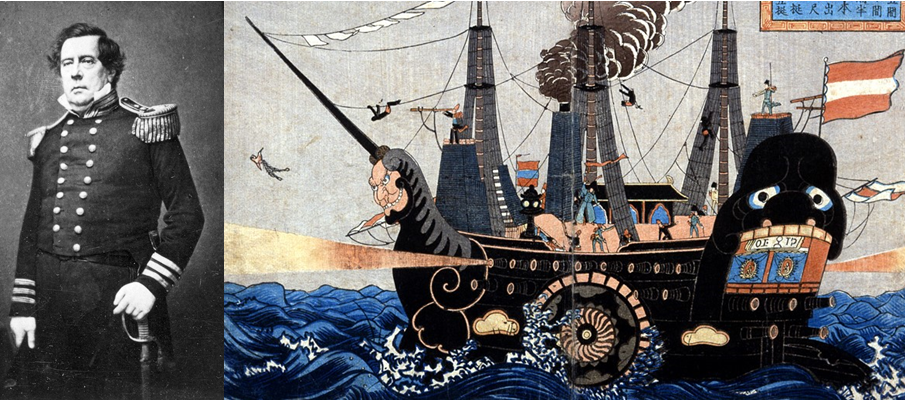
In 1853, Commodore Matthew Calbraith Perry sailed into Edo Bay in 1853 with a squadron of advanced American warships. His arrival set in motion one of the nineteenth century’s most consequential international encounters. The “Perry Expedition”, as it came to be known, was the catalyst for the end of more than two centuries of Japanese self-imposed isolation under the Tokugawa shogunate. It transformed Japan’s position in the world, and altered the balance of power in the Pacific. It ushered in a modern era whose political, economic, and military implications reverberated far beyond East Asia.
Japan’s Centuries of Isolation

To understand the significance of the Perry Expedition, we must first appreciate Japan’s unique status in the early modern world. Since the 1630s, under the policy known as sakoku, the Tokugawa regime severely restricted foreign contact. Only a few heavily regulated Dutch and Chinese traders could operate on the artificial island of Dejima in Nagasaki Bay. Christianity was banned, Western literature was censored, and Japanese citizens were forbidden from traveling abroad. The shogunate’s primary concern was internal stability. They especially wanted to prevent the return of missionary activity that had contributed to social unrest in earlier centuries. For more than two hundred years, this system preserved domestic peace. However, it also isolated Japan from the technological and political transformations reshaping Europe and North America.
By the mid-nineteenth century, Western nations were aggressively expanding into Asia. The Opium Wars had forced China to open its ports, which demonstrated the vulnerability of traditional East Asian regimes. They also demonstrated the determination of Western powers to secure commercial privileges in East Asia – by force, if necessary. At the time, the United States was emerging as a Pacific power after its acquisition of California in 1848. It began to see new opportunities for trade and whaling as American whalers roamed the North Pacific. Washington wanted a safe harbor for shipwrecked sailors, coaling stations for steamships, and commercial access to Japanese markets. Earlier attempts at peaceful negotiation had all failed: Japanese officials simply refused to accept foreign envoys or commercial overtures.
Preparing the Perry Expedition

Into that complex environment stepped the US Navy’s Commodore Matthew C. Perry. A stern, disciplined officer with decades of maritime experience, Perry believed strongly in naval power and modern technology. He was a proponent of steam propulsion, naval education, and professionalization. President Millard Fillmore’s administration tasked him with a clear mission: force Japan to open diplomatic relations, and ideally trade. He was to use a combination of diplomacy, backed by unmistakable military threat to ensure he got Japanese authorities’ attention. The United States did not seek outright colonization through the Perry Expedition. It wanted access and influence in the Pacific, and Japan’s isolation was increasingly seen as an impediment to American interests.
Perry’s preparations were meticulous. He demanded modern steam warships for the mission, knowing that their appearance would astonish observers used to wooden sailing vessels. He studied previous European encounters with Japan to avoid past mistakes, and crafted a strategy rooted in psychological intimidation. Rather than approach Japan timidly, he would demonstrate overwhelming power, which he defined as “dignified firmness”, to force negotiations. It was not all stick and no carrot, though. He also brought along lavish gift items such as a miniature steam locomotive, telegraph equipment, agricultural tools, and firearms, both to butter up Japanese officials, and impress them with American technological prowess.
The Arrival of the “Black Ships”

On July 8th, 1853, Perry with four vessels, including the steam frigates Susquehanna and Mississippi, appeared at Edo Bay’s entrance. Japanese coastal defenses were stunned by the appearance of what they called the “black ships” (kurofune), a reference to the dark hulls and the smoke from steam engines. No foreign warships had ever arrived in such force or ventured so deeply into the political heart of the shogunate. The Japanese guards and local officials were unsure how to react. Many assumed that any confrontation would be hopeless. To heighten the psychological impact, Perry refused to follow traditional protocols that required foreign vessels to proceed to Nagasaki. Instead, he defiantly anchored in nearby Uraga, and demanded to speak only with high-ranking representatives of the shogun.
Perry presented President Fillmore’s letter, requesting friendship, fair treatment of shipwrecked sailors, and opening Japan’s ports for supplies and coal. Alarmed and unprepared, Japanese officials stalled for time. They were particularly unsettled by Perry’s promise to return the following year with a larger fleet to receive Japan’s answer. The shogunate was deeply divided. Some senior advisers argued that resisting Perry would invite catastrophe. Others believed that opening the nation would lead to social and political collapse. Ultimately, fear of Western military might, demonstrated in the First Opium War, convinced the leadership to negotiate rather than fight.
The Forced Ending of Japan’s Isolation

Before his departure in 1853, Perry continued to increase pressure through limited displays of American military capability. He conducted shore drills, maneuvered his steam ships against the wind, and fired off artillery salutes. Although he avoided overtly hostile actions, he made it clear that the United States possessed overwhelming firepower. After several tense weeks, he sailed away, promising to return with a more formidable squadron. True to his word, the Perry Expedition reappeared in early February 1854. This time, it was an even larger fleet of eight vessels. The Japanese government, now fully aware of its strategic dilemma, recognized that it held a weak hand. The shogunate appointed senior negotiator Hayashi Akira and other high officials to meet with Perry.
After long discussions, compromises, and demonstrations of American technology, both sides worked toward an agreement. It was structured to preserve Japanese dignity, while achieving American goals. The resultant Convention of Kanagawa, signed on March 31st, 1854, opened the ports of Shimoda and Hakodate to American vessels. It also guaranteed humane treatment for shipwrecked sailors, and established an American consul in Japan. Although modest by later standards, the treaty represented a dramatic departure from more than two centuries of seclusion. Japan’s leaders hoped that signing a limited treaty with the US would forestall more extensive demands from other Western powers. In that, they were disappointed. Within a short time, Britain, Russia, and other European nations signed their own unequal treaties with Japan.
The Perry Expedition Revolutionized Japan

The Kanagawa Treaty itself contained little about trade, but it opened the door to further negotiation. In 1856, the first American consul, Townsend Harris, arrived in Shimoda and pressed the shogunate for commercial privileges. Harris, who built on the breakthrough of the Perry Expedition, ultimately secured the 1858 Harris Treaty. It opened several major ports, granted extraterritorial rights to American citizens, and established low import tariffs. The Harris Treaty, quickly duplicated by other Western powers, further eroded Japan’s sovereignty and inflamed domestic controversy.
The impact of the Perry Expedition inside Japan was profound and immediate. The black ships’ arrival revealed the Tokugawa regime’s vulnerability, and shattered the ideological foundation of sakoku – Japan’s system of isolation. Many samurai, scholars, and political factions viewed the shogunate’s willingness to negotiate as weakness. That fueled the rise of the sonnō jōi (“revere the emperor, expel the barbarians”) movement. It demanded both the restoration of political authority to the emperor, and resistance to foreign encroachment. The internal turmoil that followed contributed to the eventual collapse of the Tokugawa shogunate, and the Meiji Restoration of 1868.
The Black Ships’ Short and Long Term Impact on Japan

Other Japanese leaders drew a very different lesson from the Perry Expedition. Reform-minded samurai and regional lords concluded that the only way to preserve Japan’s independence was through fundamental change. The country had to modernize rapidly – militarily, technologically, and politically. The Meiji state that emerged after 1868 embarked on one of the most remarkable modernization drives in world history. It adopted Western science and industry, even as it managed to preserve a distinct national and cultural identity. Japan’s transformation into a modern nation-state and eventually an imperial power owes much to the shock of Perry’s black ships.
From the American perspective, the Perry Expedition was celebrated as a diplomatic and national triumph. It opened the Pacific to greater American activity, provided safe harbors for whalers and merchants, and signaled the United States’ growing role in world affairs. The mission also exemplified what contemporary Americans saw as their civilizing influence – though in practice, it was pure gunboat diplomacy. Perry became a national hero, and his official narrative of the expedition helped shape American understanding of Japan for decades.
The mission’s long-term consequences were complex, however. By opening Japan to the world, Perry inadvertently set the stage for Japan’s rapid ascent as a global power. Within a generation, Japan would defeat China in 1895 and Russia in 1905, shocking Western observers. Its modernization, industrial expansion, and militarization transformed East Asia’s geopolitics. Although Perry had sought peaceful cooperation, the broader pattern of forced engagement and unequal treaties generated resentment within Japan. That resentment would fester over time and metastasize, and contribute to the nationalist fervor that shaped Japan’s twentieth-century trajectory.
Significance and Legacy of the Perry Expedition

The Perry Expedition also produced lasting cultural and economic exchanges. Japanese art, design, and literature captivated Western audiences, and shaped Impressionism and other movements. American and European technology flooded into Japan, and reshaped everything from transportation to education. Diplomatically, the two nations would move from wary partners to adversaries and eventually allies. However, the initial contact in the 1850s remained a defining moment in their relationship. In retrospect, the Perry Expedition was a turning point not only in Japanese history, but in global history. It ended the early modern era in East Asia, and initiated a rapid, often turbulent process of international integration. The mission demonstrated the power of industrialized nations to impose their will on states with pre-industrial defenses. Its aftermath showed how a determined society could respond creatively, and adapt new foreign knowledge to its national needs.
Commodore Perry did not foresee the full implications of his mission, but his arrival irrevocably altered Japan’s path. Ultimately, the black ships’ arrival encapsulated a collision between two worlds. One shaped by centuries of controlled isolation and internal hierarchy, the other driven by global trade, industrialization, and naval might. The resultant negotiations, culminating in the Convention of Kanagawa, led to more than a simple treaty. They birthed modern Japan and its engagement with the wider world. From that moment onward, Japan could no longer remain apart from international currents. Its leaders confronted a stark choice: adapt or be dominated. Their response reshaped the Pacific and helped define the modern era.

_________________
Some Sources & Further Reading
History Halls – History’s Shortest War
Morison, Samuel Eliot – Old Bruin: Commodore Matthew Calbraith Perry (1967)
Schroeder, John H. – Matthew Calbraith Perry: Antebellum Sailor and Diplomat (2001)
Wittner, David G. – Commodore Matthew Perry and the Perry Expedition to Japan (2005)
Newest Articles
- The Johnstown Flood – Thousands Perished When A Dam Collapsed After Gilded Age Tycoons Modified it for their Private Resort
- The Jacquerie: The Medieval Peasant Uprising That Terrified France’s Aristocrats
- Things That Weren’t Thought Through: WWII’s Sticky Bomb Stuck to Users’ Hands Once Activated
- German Tanks of World War II – The Panzer 38(t), a Czech Tank in German Service
- Nicholas Alkemade: The WWII Airman Who Survived an 18,000 Foot Fall From a Bomber Without a Parachute

