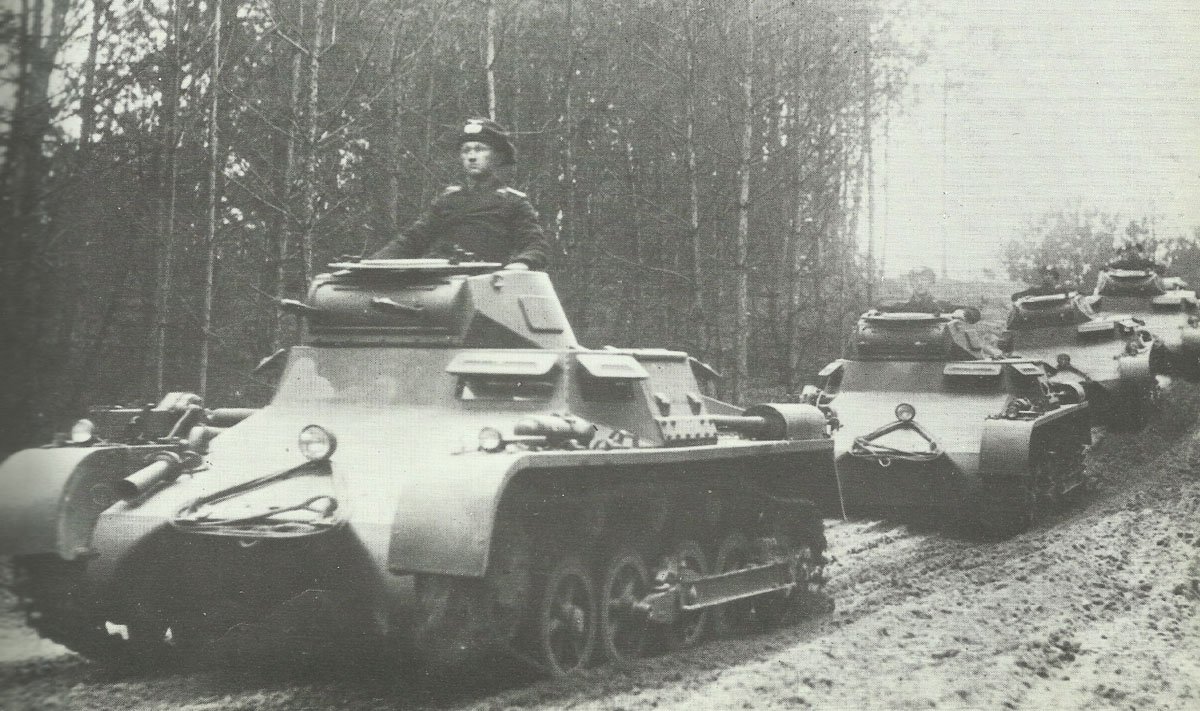
The Panzerkampfwagen I, commonly known as the Panzer I, was the first mass-produced tank of Nazi Germany. It was a foundational step in building the armored forces that later spearheaded the blitzkrieg early in World War II. Though lightly armed and armored, it played a crucial developmental, industrial, and doctrinal role in the 1930s, shaping the early Wehrmacht and its approach to mechanized warfare.
A Tank Designed in Secret

After World War I, the Treaty of Versailles banned Germany from the manufacture or possession of tanks. Nevertheless, the Reichswehr maintained an interest in armored warfare. It studied foreign developments, and experimented covertly. The rise of Adolf Hitler and the turn to open rearmament in 1933 accelerated efforts to create a modern panzer force. The Panzer I emerged as a stopgap design. It was intended primarily as a training vehicle to establish armored units, teach maintenance and tactics, and build industrial capacity.
Development had started in 1931, before Hitler came to power. To disguise its military purpose, it was done under the cover name “Landwirtsschaftlicher Schlepper” (LaS) – “agricultural tractor”. The design was simple, cheap, and quick to produce. It was to rapidly equip new panzer divisions, while more sophisticated tanks were still on the drawing board. Krupp and other firms contributed to its development, and production ramped up between 1934 and 1937. The resultant Panzer I was a very light tank, closer to a tankette by later standards.

The first model, the Ausf. A, weighed about 5.4 tons. It was powered by a modest Krupp M 305 four-cylinder engine that had frequent overheating issues. An improved Ausf. B followed shortly after, with a longer chassis and a more reliable six-cylinder Maybach NL 38 engine. Panzer I armor ranged from 7 to 13 mm, enough to stop small-arms fire but wholly inadequate against anti-tank weapons. Sole armament was two 7.92 mm MG-13 turret machine guns, which made it incapable of dealing with armored targets. That light armament reflected its intended role in training, not frontline combat.
The Backbone of the Early Blitzkrieg

Despite its limitations, the Panzer I was relatively modern compared to many interwar designs. It had a two-man crew: a driver, and a commander who also served as gunner and loader. The suspension used leaf springs that provided decent mobility for the time. Its small size was also an asset, and allowed for easy transport and maneuver. Though not designed for battle, Panzer Is were often pressed into service in the turbulent 1930s. Their first combat deployment occurred in the Spanish Civil War, 1936-1939, where the Germans supplied them to Franco’s Nationalists. They performed adequately against lightly armed militias. Once they faced Soviet-supplied T-26 tanks with 45 mm guns, however, their deficiencies became glaring.
Crews attempted makeshift modifications, such as extra armor plates, but those measures were only marginally helpful. Nonetheless, the Spanish experience was invaluable for German commanders. It exposed the weaknesses of light tanks, and influenced the development of the Panzer III and IV that would later form the backbone of Germany’s armored forces. When WWII began in 1939, the Panzer I still made up a significant portion of the Wehrmacht’s armored strength. Of the roughly 2,900 tanks available for the invasion of Poland, nearly forty percent were Panzer Is. Though vulnerable to even modest anti-tank guns, they contributed to victory through superior coordination, radios, and doctrine rather than firepower.
The Significance and Legacy of the Panzer I

Panzer Is next saw action in the 1940 Western Campaign and the invasions of France, Belgium, and the Netherlands. Losses were heavy, and its obsolescence became impossible to ignore. Panzer I formations relied on speed, surprise, and combined-arms tactics to compensate for their vulnerability. Once Panzer IIIs and IVs appeared in larger numbers, Panzer Is were relegated to secondary roles such as command tanks, artillery tractors, and training vehicles. The Panzer I’s chassis, however, proved more useful than the tank itself. For example, Germany’s first tank destroyer, the Panzerjager I, mounted a 47 mm anti-tank gun on a Panzer I hull.
Other variants included command vehicles with extra radios, recovery vehicles, and training tanks. A handful were used as flame-thrower tanks or fitted with experimental turrets. Though militarily obsolete by 1941, the Panzer I’s significance lay not in its combat power, but in its broader impact. It enabled Germany to build mass-production capabilities, train crews, and refine doctrines of fast, coordinated armored operations. It also provided experienced personnel who would command more advanced tanks later one when they became available. In essence, the Panzer I was a humble machine that helped unleash a revolution in warfare. Its story illustrates how even underpowered and lightly armed vehicles can play crucial roles in shaping military institutions and tactics.

_________________
Some Sources & Further Reading
History Halls – German Tanks of WWII: The Panzer 38(t)
McCarthy, Peter – Panzerkrieg: The Rise and Fall of Hitler’s Tank Divisions (2002)
Newest Articles
- The Johnstown Flood – Thousands Perished When A Dam Collapsed After Gilded Age Tycoons Modified it for their Private Resort
- The Jacquerie: The Medieval Peasant Uprising That Terrified France’s Aristocrats
- Things That Weren’t Thought Through: WWII’s Sticky Bomb Stuck to Users’ Hands Once Activated
- German Tanks of World War II – The Panzer 38(t), a Czech Tank in German Service
- Nicholas Alkemade: The WWII Airman Who Survived an 18,000 Foot Fall From a Bomber Without a Parachute

