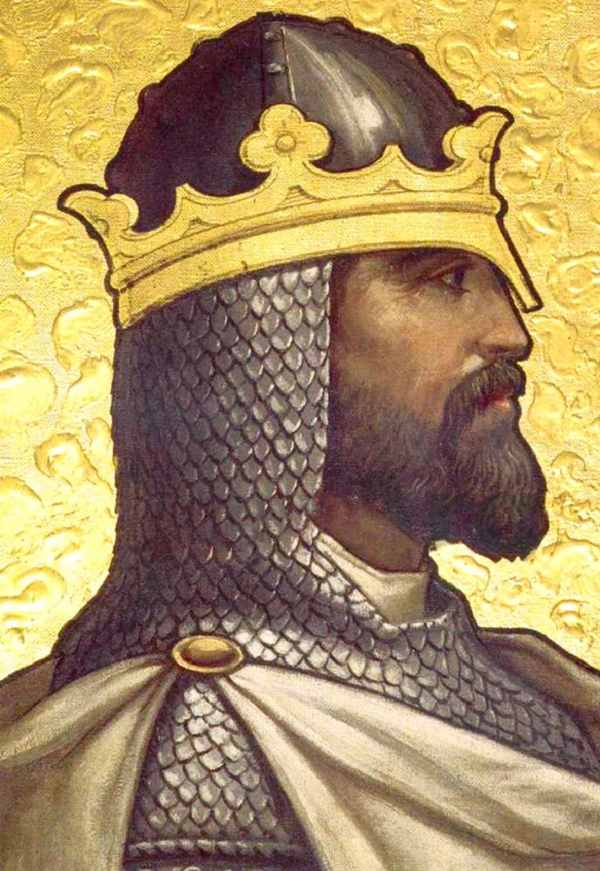
Afonso Henriques, who became Afonso I of Portugal, also known as “Afonso the Conqueror” and “Afonso the Founder”, was Portugal’s first king and one of the most pivotal figures in Iberian history. He transformed what had been a small, semi-independent county, into a sovereign kingdom recognized by both neighbors and the papacy. Through a blend of military prowess, political shrewdness, and unyielding ambition, he established the foundations of the Portuguese nation that has endured to the present.
The County of Portugal

Afonso the Conqueror was born circa 1109 in the County of Portugal, then a vassal of the Kingdom of Leon. He was the son of Count Henry of Burgundy, a French noble who had come to the Iberian Peninsula to aid in the Christian Reconquista, and Teresa of Leon, the illegitimate daughter of King Alfonso VI of Leon and Castile. Afonso’s lineage thus straddled both the French nobility and the royal bloodlines of Leon. That gave him a unique position in the complex feudal world of medieval Iberia.
When Count Henry died in 1112, his widow Teresa assumed control of the county on behalf of her young son. Initially, Teresa ruled effectively, and maintained the region’s semi-autonomous status under Leon. However, her growing alliance and romantic involvement with Galician noble Fernao Peres de Trava caused resentment among the Portuguese nobility. The Travas were seen as foreign interlopers who sought to bring Portugal under direct Galician control. As Afonso grew, he aligned himself with nobles who opposed his mother’s policies and the Galician influence over Portuguese affairs.
Afonso Henriques Had to Defeat His Own Mother in Battle

To hold on to power, Afonso’s mother, Teresa, exiled him when he was twelve. Portuguese nobles opposed to his mother and her Galician lover rallied to him, however, and he began to gather followers. The decisive moment in Afonso’s early career came in 1128 at the Battle of Sao Mamede, near Guimarães. Afonso, then about nineteen, led the rebellious Portuguese barons against the army of his mother and her Galician allies. Afonso won, exiled his mother to Galicia, and became Portugal’s ruler. That battle was the start of Portuguese independence, although it took decades more before that independence was formally recognized.
After his victory at Sao Mamede, Afonso consolidated his control over the territory. He began to style himself as Infante de Portugal, or “Prince of Portugal” – an assertion of autonomy. Simultaneously, he carefully managed relations with his cousin, King Alfonso VII of Leon, who considered himself “Emperor of all Spain”. Afonso’s goal was not just to rule Portugal, but to establish it as a fully independent kingdom. In the 1130s and 1140s, he turned his attentions to both consolidation and conquest. Internally, he worked to strengthen the new state’s institutions. To that end, he granted charters to towns and monasteries to encourage settlement, trade, and loyalty. Externally, his focus was on the Reconquista – the Christian campaign to reclaim Iberian lands from Muslim rule.
Becoming “Afonso the Conqueror”

Afonso gained the nickname “The Conqueror” through successful military campaigns that were both strategic and symbolic. In 1139, he achieved a major victory over the Moors at the Battle of Ourique, in southern Portugal. According to legend, Afonso experienced a divine vision on the eve of battle, in which Christ appeared to him and promised victory. The following day, his vastly outnumbered army triumphed. The event was later mythologized as a divine endorsement of Afonso’s kingship. In the aftermath, his troops acclaimed him as Rex Portugallensis – King of Portugal.
The historicity of Afonso’s divine vision and acclamation remain uncertain, but they became foundational myths in Portuguese national identity. His claim to kingship was initially contested by Leon, which continued to view Portugal as a vassal state. However, Afonso navigated the diplomatic landscape with great skill. In the Treaty of Zamora in 1143, Alfonso VII of Leon recognized Afonso Henriques as king. It was with the vague title rex rather than an explicit acknowledgment of independence, but still – a significant step forward. Afonso also sought papal support, which was crucial for legitimizing his rule.
Combining Diplomacy With Military Prowess

To bring the pope on side, Afonso the Conqueror pledged fealty not to Leon, but to the Holy Father himself. It not only stoked the pope’s ego, but also effectively placed Portugal under papal protection. In 1179, Pope Alexander III issued the bull Manifestis Probatum, which formally recognized Afonso as King of Portugal, and his kingdom as a vassal of the Holy See. Afonso’s deft diplomacy went hand in hand with relentless military campaigns that expanded Portugal’s territory southward. After consolidating control over the northern regions, he turned toward the Muslim-held territories of the Tagus Valley and the Alentejo.
Afonso was often supported by crusaders from northern Europe who passed through or along the coasts of the Iberian Peninsula on their way to the Holy Land. With their assistance, he captured key strongholds such as Santarém in 1147 and Lisbon later that same year. The successful Siege of Lisbon in 1147, in particular, was one of his most significant achievements. With the aid of English, Flemish, and German crusaders who had stopped in Portugal en route to the Second Crusade, Afonso’s army besieged and captured the city after several months.
Creating Portugal’s National Identity

The fall of Lisbon was a turning point for Afonso the Conqueror and the nascent Kingdom of Portugal. It secured a vital port and strategic capital. It also symbolized the consolidation of Christian rule over much of the central part of modern Portugal. From there, Afonso continued to expand southward, and captured Alcacer do Sal and Beja. Further expansion was limited by strong Muslim resistance, and Afonso’s advancing age. Beyond his military conquests, Afonso proved to be a capable and pragmatic ruler.
Afonso distributed lands to nobles and military orders, particularly the Knights Templar and the Order of Santiago. In exchange, he received their military service and commitment to defend Portugal’s frontier. That feudal network formed the backbone of early Portuguese society. Afonso also promoted the foundation of monasteries. They not only served religious purposes, but also acted as centers of settlement, agriculture, and education. Afonso’s governance laid the foundations of a distinctly Portuguese identity. Adopting Lisbon as the capital, minting coins, and establishing an independent church hierarchy – all signified the kingdom’s maturation.
Triumph and Tragedy

The relationship between Afonso the Conqueror and the Church was particularly close. He made sure that it remained close because he deemed ecclesiastical endorsement as essential to his legitimacy. He granted privileges to monastic orders, and sought to ensure the Portuguese Church autonomy and independence from Leon’s influence. After a lifetime of achievements, Afonso’s later years were marked by a mixture of triumph and tragedy. In 1169, he suffered a serious injury while besieging the Galician city of Badajoz, when he was thrown from his horse and crushed beneath it. That left him partially paralyzed.
Afonso’s injuries at Badajoz effectively ended his military career, although he continued to rule until his death. His son Sancho played an increasingly active role in governance during his father’s final years. Afonso died on December 6th, 1185, in Coimbra, a city that had served as one of his principal residences and administrative centers. He was buried at the Monastery of Santa Cruz, a site that became a royal pantheon. His death marked the end of an era, but he left behind a stable and sovereign Portugal. It was remarkable feat, given Iberia’s political fragmentation at the time.
The Legacy of Afonso the Conqueror

The reign of Afonso the Conqueror witnessed the transformation of Portugal from a peripheral county into a kingdom. His military campaigns established borders that, with minor adjustments, remain largely unchanged to this day – extraordinary continuity. He combined feudal pragmatism with visionary ambition, and balanced the demands of war, diplomacy, and governance to forge a coherent national identity. In Portuguese memory, he is revered not only as O Conquistador, “The Conqueror”, but also as O Fundador, “The Founder”. His victories at Sao Mamede, Ourique, and Lisbon became symbols of independence and divine favor, while his recognition by the papacy secured Portugal’s legitimacy within Christendom.
Over time, Afonso the Conqueror was romanticized by chroniclers and poets as a warrior-saint, chosen by God to establish a Christian kingdom on Europe’s western edge. His legacy endures not only in monuments and chronicles, but in the very existence of Portugal itself. He laid the groundwork for the nation’s medieval consolidation, its later maritime expansion, and its unique identity – a small kingdom with a global destiny. In many ways, every subsequent chapter of Portuguese history, from the Age of Discoveries to modern independence, traces its lineage back to the bold ambitions and iron will of Afonso Henriques, Portugal’s first king.

_________________
Some Sources & Further Reading
Encyclopedia Britannica – Afonso I, King of Portugal
If you liked this article, you will also like History Halls – Saint Olga of Kiev’s Vicious Vengeance Campaign

