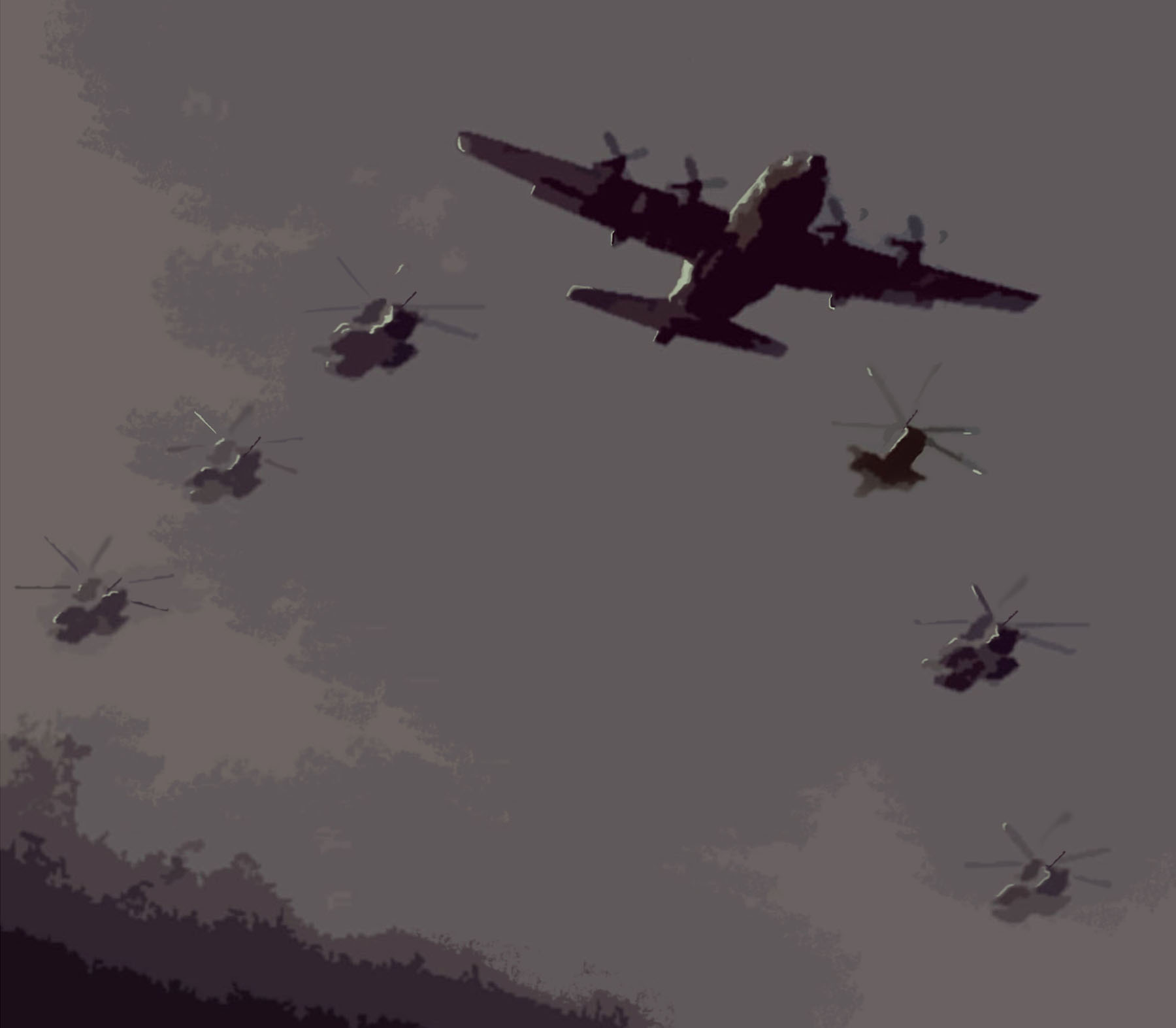
Operation Ivory Coast, better known as the Son Tay Raid, was one of the Vietnam War’s most daring special operations. Launched in November, 1970, it sought to rescue American prisoners of war from a prison camp in North Vietnam. As seen below, the raid was a brilliant tactical success, but nonetheless a failure through no fault of the raiders. It has since been celebrated for its flawless execution and innovative tactics, and its impact on US special operations forces.
The Need to Rescue Mistreated American POWs

US intelligence indicated that several dozen American POWs were held at the Son Tay facility, twenty miles west of Hanoi. Prisoner conditions in North Vietnam were notoriously harsh, and there were numerous reports of malnutrition, disease, and abuse. That was reinforced by aerial reconnaissance, which detected signs of distress – the prisoners had traced “SAR” on the ground. So American leaders began to consider a raid to rescue the captives. The United States Joint Chiefs of Staff selected Air Force Brigadier General LeRoy J. Manor to command the operation.
The ground forces who would conduct the raid were organized and trained by US Army Colonel Arthur “Bull” Simons. A revered Special Forces officer, Simons was known for his calm leadership and expertise. Planners gave the mission the codename Ivory Coast. A task force of around one hundred men was assembled, including Army Special Forces (“Green Berets”) and Air Force pilots. They began intensive rehearsals at Eglin Air Force Base, where a full-scale mockup of the Son Tay compound was constructed.
Preparations for the Son Tay Raid

The men practiced for the Son Tay Raid repeatedly, day and night, until every movement was committed to muscle memory. Their training emphasized speed, surprise, and overwhelming force: the entire ground mission was to last no more than thirty minutes. The camp’s location, defenses, layout, and other relevant information were studied exhaustively. Reconnaissance aircraft mapped guard towers, walls, buildings, and the prisoner area. Intercepted radio communications added further clues. Finally, all was ready. On the night of November 20th, 1970, the assault force departed from Udorn Royal Thai Air Force Base. The armada included HH-3E “Jolly Green Giant” helicopters, HH-53 “Super Jolly” helicopters, while C-130 airplanes served as navigators and support.
To reach Son Tay, the assault force had to penetrate one of the world’s most heavily defended airspaces. North Vietnam’s dense network of anti-aircraft guns, surface-to-air missiles, and radar systems usually restricted American aircraft to high altitudes. The raiders, however, flew at treetop level, and used darkness and terrain to mask their approach. Near the target, one of the leading helicopters, a HH-3E named Banana, veered slightly off course. It mistakenly landed at a nearby compound that housed hundreds of Chinese military advisors stationed in North Vietnam. The raiders shocked the unsuspecting personnel, and a fierce firefight erupted.
A Prison With No Prisoners

The Son Tay Raid had started off on the wrong foot when Banana landed at the wrong place. It proved to be a fortuitous mistake, though. The resultant engagement ended up neutralizing a potential threat to the main assault force. Meanwhile, the primary raider group descended on the actual Son Tay camp. The plan was simple and precise. One helicopter would crash-land inside the compound to deliver the initial assault team directly into the prison courtyard. Simultaneously, other teams would land outside the walls to eliminate guards, secure the perimeter, and fight off reinforcements. When Colonel Simons and his men charged into the camp, they found what they had trained for: guard towers, barracks, and sentry posts. What they did not find were the American prisoners.
The raiders went in believing that dozens of fellow Americans were waiting for rescue. Intelligence analysts had concluded that the Son Tay prison housed as many as fifty five POWs. However, despite extensive intelligence efforts, one crucial fact went undetected. Several months earlier, the North Vietnamese had quietly moved the prisoners to other facilities due to flooding near Son Tay. The relocation was unknown to US analysts because the Americans’ overhead imagery still showed signs of human presence. The prisoners were gone, but the prison still had some guards and maintenance personnel who were mistaken for POWs.
“No Packages”

The shock was immediate and profound. Within moments, Simons’ men realized the buildings were empty. Bunk beds were neatly arranged, and there were signs that people had lived there recently. The POW cells, however, held no captives. One soldier radioed the message that echoed through the mission: “No packages”. Despite the disappointment, the teams continued their tasks with discipline. They destroyed the camp, killed hostile guards, collected intelligence materials, and prepared for extraction. Once all soldiers regrouped, the raiders were lifted out by their helicopters. The entire ground operation had lasted less than half an hour – exactly as planned.
The raider flew back the same perilous route they had used to enter. Despite intense North Vietnamese anti-aircraft fire during the return flight, no American lives were lost in the Son Tay Raid. By dawn on November 21st, the raiders were safely back in Thailand, emotionally exhausted and frustrated. They had executed their mission nearly flawlessly, yet had been deprived of its purpose by a cruel twist of fate. News of the raid’s result reached Washington quickly. President Nixon and National Security Advisor Henry Kissinger admired the operation’s professionalism, but shared deep disappointment in its outcome.
A Cruel Twist of Fate With Far Reaching Consequences

For North Vietnam, the Son Tay Raid was a humiliating security breach. The audacity of a deep penetration so close to Hanoi stunned their leadership. It prompted the North Vietnamese to consolidate POWs into fewer, more centralized locations. That had the unintended side effect of improving living conditions for many prisoners: it enabled easier international scrutiny. The American public’s response to the raid was mixed. Some criticized the intelligence failures. Many praised the raiders’ courage, and saw the mission as a sign of America’s commitment to rescuing its POWs.
Although no prisoners were rescued at Son Tay, the raid had a significant impact on the welfare of American POWs. In the aftermath, the North Vietnamese leadership feared further rescue attempts. So they moved many prisoners to centralized facilities like Hoa Loa Prison, infamously known as the “Hanoi Hilton”. That concentration of prisoners allowed them to organize themselves better, support one another, and resist mistreatment more effectively. Former POWs later credited the raid with improving morale dramatically. The realization that their country had risked elite soldiers’ lives to save them was proof that they were not forgotten.
A Brilliant Tactical Success, a Massive Intelligence Failure

Operation Ivory Coast was a tactical success. It was also a massive failure by the Defense Intelligence Agency (DIA) and other entities that had gathered and disseminated the information upon which the assault was planned. There was plenty of criticism of the faulty intelligence that led to a risky operation to rescue prisoners from a prison camp that held no prisoners. So in the aftermath, the intelligence apparatus saw an extensive overhaul and restructuring. The raid became a case study in the dos and don’ts of joint special operations planning.
The precision, joint-service integration, and exhaustive rehearsal process influenced future missions. The raid was a precursor to significant change. The modern United States Special Operations Command was established years later to unify and streamline special operations forces. Lessons were learned from the Son Tay Raid, especially about the importance of intelligence coordination and inter-service cooperation. They shaped missions such as the 1980 attempt to rescue hostages in Iran, which although a failure, was not a failure due to bad intelligence, and later operations conducted by units like Delta Force and Seal Team Six.
Legacy of the Son Tay Raid

Today, the Son Tay Raid is remembered as a paradoxical success. On the one hand, it failed to rescue any POWs. On the other hand, it succeeded in nearly every operational sense. US forces demonstrated the ability to infiltrate one of the world’s most dangerous air-defense zones, carry out a complex assault with perfect coordination, and withdraw without losing a man. For veterans of the raid, the knowledge that the mission improved POW conditions offers some solace. Many former prisoners later met with the Son Tay raiders and expressed profound gratitude.
Operation Ivory Coast also occupies an important place in the history of military special operations. Its planning rigor, joint-service collaboration, low-level night penetration tactics, and emphasis on speed and precision helped forge the modern era of American special warfare. In the decades since, the raid has been studied by military planners around the world. Not for its outcome, but for its extraordinary execution. It stands as a testament to the skill, bravery, and discipline of the men who carried it out.

_________________
Some Sources & Further Reading
Air Force Magazine, November 1995 – The Son Tay Raid
Gargus, John – The Son Tay Raid: American POWs in Vietnam Were Not Forgotten (2007)
History Halls – The Tragic Death of Albert Dewey, America’s First Fatality in Vietnam
Tilford, Earl H. – Search and Rescue in Southeast Asia (1980)

