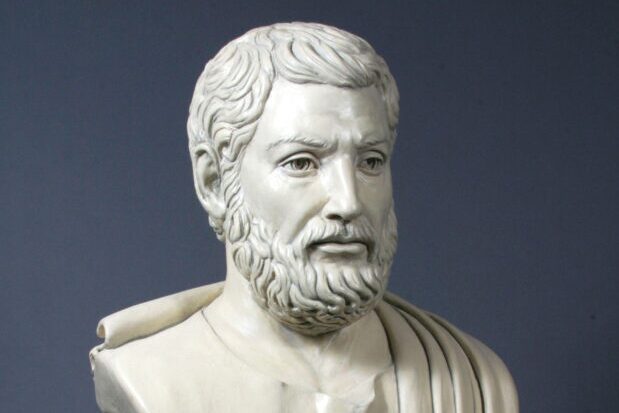
After a period of turbulence and civil strife, ancient Athenian statesman Solon got his countrymen to agree on a series of reforms that calmed things down. He then left the city and traveled, to let the Athenians carry out his reforms. When he returned from his travels years later, Solon discovered that Athens had divided into regional factions, one of them controlled by Peisistratos, a popular general whom Solon suspected of planning to overthrow the government and set himself up as tyrant. That tyranny would later be undone by Cleisthenes, who created Athenian democracy.
When a “Tyrant” Wasn’t So Bad

In Ancient Greece, the word “tyrant” did not carry the modern connotations of brutal oppression. It had instead a narrower meaning of a populist strongman who, with a support base of commoners excluded from power by an aristocracy, overthrew an oligarchy and replaced it with his own one man rule. Many tyrants were wildly popular – except with the aristocracy. Commoners had little power in the aristocratic system, so they were no worse off ruled by one tyrant than when they had been ruled by a clique of nobles. Moreover, with the power of an overbearing aristocracy reduced, government under tyrants tended to be more equitable, rather than wildly skewed to benefit the nobles.
Economically, commoners also tended to be better off under tyrants, who usually encouraged activities such as commerce and crafts and manufactures, that had previously been viewed by the aristocracy as socially gauche, and even threatening insofar as they destabilized the social order by making jumped up commoners as rich as or richer than their social betters. A tyranny was thus often a predicate for democracy, because it removed from its path the barrier of a strongly entrenched aristocracy. Tyrants had an interest in weakening the nobles who had monopolized power for centuries, so they adopted populist policies that appealed to commoners, whose support was necessary for the tyrant’s continued hold on power. Only after the aristocracy had been weakened, and its stranglehold on power broken, would there be an opening for democracy. That is what happened in Athens.
Inviting a Tyrant

The poorest and most populous region of Athens, the hill district whose impoverished residents got little from Solon’s reforms other than a meaningless vote, invited Peisistratos to make himself tyrant. With their support, he marched on the city in a procession headed by a tall girl dressed up as the goddess Athena, who blessed Peisistratos and declared it her divine will that he be made tyrant. The other Athenians saw through the mummery, and chased Peisistratos and his followers out of town.
The would-be tyrant was forced to flee Athens. He then headed to northern Greece, where he bought silver and gold mines, and got rich off their proceeds. Peisistratos invested his newfound wealth in mercenaries, and returned to Athens to try and seize power once again, this time without a girl dressed up as a fake goddess, but with a well-equipped private army. It worked, and in 546 BC, he managed to overthrow the government and get himself proclaimed tyrant.
Giving Tyranny a Good Name

Aware that the Athenian aristocrats who had previously held power were never going to embrace his rule, Peisistratos focused on securing a different power base of supporters. He championed the lower classes, who in return supported his rule, and with their support his tyranny became a wild success. The new tyrant suppressed the feuding factions, exiled his aristocratic enemies and confiscated their land holdings, which he broke up into small farms and redistributed to his followers, thus cementing their support.
Peisistratos also loaned small farmers money for tools; lowered taxes; standardized currency; enforced the laws even -handedly; promoted the growing of olives and grapes; encouraged commerce and craftsmen; funded popular religious rites such as the Dionysia; promoted theater, culture, and the arts; built an aqueduct; implemented a public buildings program, and beautified the city. By the time Peisistratos died, circa 527 BC, Athens was peaceful and more prosperous than it had ever been, with a growing and increasingly affluent middle class.

By all accounts, Peisistratos was a capable ruler, and Athens prospered with him at the helm. He died in 527 BC, and was succeeded as co-tyrants by his sons Hippias and Hipparchus. At first, the duo governed Athens competently and with a light hand. Then Hipparchus was assassinated in 514 BC at the hand of two gay lovers, Harmodius and Aristogeiton, in a private feud that stemmed from an attempt at romance that went bad.
Giving Tyranny a Bad Name

Hipparchus hit on Harmodius, the eromenus, or younger gay lover, of Aristogeiton. Harmodius shot Hipparchus down, and told Aristogen what had happened. The spurned Hipparchus then set out to get some payback. He invited Harmodius’ kid sister to play a role at a religious festival, then publicly berated and chased her away as ineligible because she was not a virgin. That shamed Harmodius’ family. In retaliation, Harmodius and Aristogeiton decided to assassinate both Hipparchus and his brother Hippias, and free Athens of tyranny. They were only partially successful. At the Panathenaian festival, they stabbed Hipparchus to death, but only wounded Hippias. Hipparchus’ bodyguards killed Harmodius on the spot, and Aristogeiton was arrested, tortured, and eventually killed by Hippias.
The lovers were celebrated and honored for centuries afterwards in Athens as the Tyrannicides, and public statues were commissioned in their honor. In the meantime, Hippias grew paranoid, and his rule became oppressive as he lashed out indiscriminately at enemies real and imagined. Hippias’ descent into violence eroded the popularity that tyranny had enjoyed since the days of Peisistratos, and the number of victims and exiles forced to flee Athens grew. One exile was Cleisthenes, who began to plot with other exiles to overthrow the tyranny.
The Fall of Tyranny, and Rise of Democracy

Cleisthenes and fellow Athenian exiles considered invasion to overthrow the tyranny. However, Hippias had a well-equipped army, while the exiles did not, and lacked the funds for an army of their own. So they sought to enlist the help of Sparta, which had the Greek world’s best army, to liberate Athens. As Hippias continued to spiral after the deadly gay sex scandal that killed his brother and almost did him in, opposition to his tyranny grew. Cleisthenes and his followers wanted help from the Spartans, who were known for their piety. So the exiles bribed the priests of Delphi, the Greek world’s most important religious site and home of the Oracle of Delphi, to put in a good word.
The Oracle, which for centuries had given petitioners cryptic answers that could be interpreted in a variety of ways, suddenly began to give every Spartan petitioner who showed up the same uncryptic answer: “Liberate Athens!” So the Spartans marched into Attica in 508 BC, liberated Athens, then marched back home. The Athenians, left to govern themselves, immediately split into rival camps. An oligarchic camp, led by an Isagoras, wanted government returned to the hands of the wealthy. They were opposed by a populist camp, which comprised a majority of Athenians and was led by Cleisthenes. The populists declared Athens a democracy ruled by a popular Assembly. Cleisthenes’ camp prevailed, but the oligarchic faction solicited Spartan aid to overthrow the democracy. The Spartans, no fans of democracy, sent another army to Attica, overthrew the democracy, and replaced it with an oligarchy.
The Oligarch Coup, and the Democratic Reaction

Supported by the Spartans, the oligarchs exiled Cleisthenes and 700 democracy-supporting Athenian families. However, Cleisthenes and the exiles soon returned. The population rose up in revolt. The aristocratic faction and the Spartans were besieged in the Acropolis, Athens’ fortified hilltop. The rebels allowed the Spartans to leave, but the Athenian anti-democrats were massacred. With the oligarchs decisively taken care of, Cleisthenes set out to establish democracy.
Key to that was the reorganization of the citizen body (demos) of Athens. Before, Athenians had been grouped into four tribes, based on kin groups. Cleisthenes argued that lent itself too readily to factionalism. Instead, Cleisthenes instituted an artificial classification system that divided the citizen body into ten at-large tribes, with membership drawn at random from all classes and all parts of Attica. Each new electoral tribe thus contained a representative sample of the entire population, including all classes and regions. Thereafter, no tribe was wedded to geographic or familial loyalties at the expense of Athens as a whole. A new council, the boule, was created, in which all citizens had the right to speak.
Cleisthenes Reformed Athens

At a stroke, Cleisthenes thus eliminated the parochialism that had plagued Athens for generations. He granted the entire male citizen population access to institutions and powers previously reserved for the aristocracy. Another of Cleisthenes’ reforms was ostracism, through an annual vote. Each citizen could name any person he thought was too dangerous or getting too powerful for the common good.
The citizen who received the most votes would be exiled for ten years. There was no prejudice to his property while he was gone, or to his citizenship rights upon his return. Cleisthenes’ reforms established basic democracy in Athens, and created the constitutional structure by which further incremental reforms would be made to transform Athens into a direct democracy. And to think that all of that had been set in motion by a deadly gay sex scandal.
_________________
Some Sources & Further Reading
Encyclopedia Britannica – Peisistratus
Gonick, Larry – Cartoon History of the Universe, Volumes 1-7 (1990)
Grant, Michael – The Rise of the Greeks (1987)
History Halls – The Men Who Made Ancient Athens: Solon
O’Neil, James L. – The Origins and Development of Ancient Greek Democracy (1995)

